
Service History
The Viggen dominated Swedish air defense throughout the final decades of the Cold War, equipping six squadrons of the Swedish Air Force from 1971 to the early 2000s. The Skaraborg Wing (F 7) became the first operational unit in July 1971, followed by rapid deployment across Sweden's dispersed base network. By 1980, the aircraft had established itself as the backbone of Swedish air power, with 338 aircraft serving in three distinct variants across the nation's territorial defense strategy.
Operational History
Developed specifically to counter Soviet air threats during the height of Cold War tensions, the Viggen served as Sweden's primary interceptor and ground-attack platform for over three decades. The AJ 37 attack variant, numbering 109 aircraft, provided precision ground-strike capability while maintaining secondary air-to-air functions. The JA 37 fighter-interceptor, with 149 examples built, represented the pinnacle of European fighter technology when it entered service in 1980, surpassing contemporaries until the Panavia Tornado's introduction in 1981.
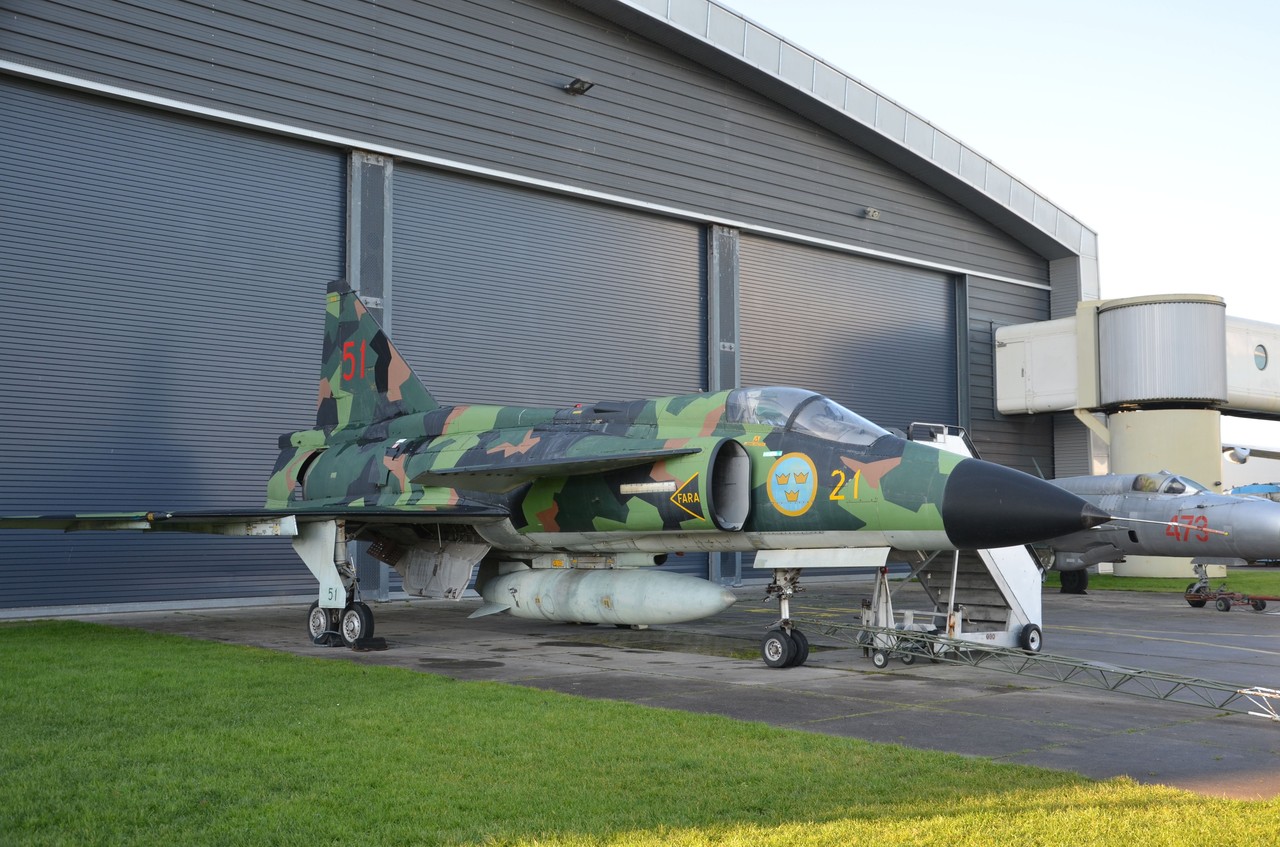
Swedish pilots operated the Viggen from highway strips and dispersed bases as part of the nation's total defense concept, with aircraft painted in distinctive four-color "fields and meadows" camouflage featuring tan, light green, dark green, and dark blue patterns designed for concealment at improvised airfields.
The Manufacturer
Saab (Svenska Aeroplan Aktiebolaget), founded in 1937, established itself as one of Europe's premier combat aircraft manufacturers through the Viggen program. The company had previously produced the successful Saab 32 Lansen and Saab 35 Draken fighters before undertaking the ambitious Aircraft System 37 project in December 1961. Today operating as Saab AB, the company continues as a major Swedish defense contractor, having transitioned from the Viggen to produce the JAS 39 Gripen fighter that began development in 1980.
Engine & Technical Innovation
The Viggen's Volvo RM8 afterburning turbofan engine, based on the Pratt & Whitney JT8D but extensively modified for military service, provided exceptional power and featured an innovative thrust reverser system to minimize landing distances. This powerplant enabled the aircraft's remarkable short-field performance, allowing operations from 500-meter runways compared to the 2,000-meter strips typically required by contemporary fighters.
The aircraft achieved multiple aviation firsts: it was the first canard-equipped fighter produced in quantity and the first combat aircraft to incorporate a digital central computer with integrated circuits. Chief test pilot Erik Dahlstrom conducted the maiden flight on February 8, 1967, though the program was later marked by tragedy when test pilot Lennart Fryoe died on May 31, 1968, after accidentally triggering his ejection seat during ground operations.
Pilot Perspective
Pilots praised the Viggen's exceptional handling characteristics at low altitudes and its ability to operate from austere airfields that would challenge conventional fighters. The JA 37 variant particularly impressed aviators with its advanced radar systems and air-to-air capabilities that exceeded most European contemporaries. The aircraft's canard configuration provided superior control authority during the critical short-field operations that defined Swedish air tactics.
The SK 37 trainer variant, first flown on July 2, 1970, with 17 examples built, provided pilots with realistic preparation for the demanding single-seat variants while maintaining full operational capability.
Production & Legacy
Production ran from 1971 to 1990, with manufacturing authorization granted by the Swedish government in April 1968 following successful prototype testing. The initial order for 175 aircraft eventually expanded to 338 total examples across all variants, representing one of Europe's largest indigenous fighter programs of the Cold War era.
The Viggen's influence extended beyond Swedish borders, demonstrating that smaller nations could develop world-class combat aircraft through innovative design and advanced technology integration. However, by 1990, rapid advances in microprocessor technology made the Viggen's fixed configuration less adaptable than newer designs, leading to production termination in favor of the more flexible Gripen program.
Today, several Viggens are preserved in Swedish museums, including the Flygvapenmuseum in Linköping, serving as testament to Sweden's remarkable achievement in independent fighter aircraft development during one of the most challenging periods of the Cold War.