
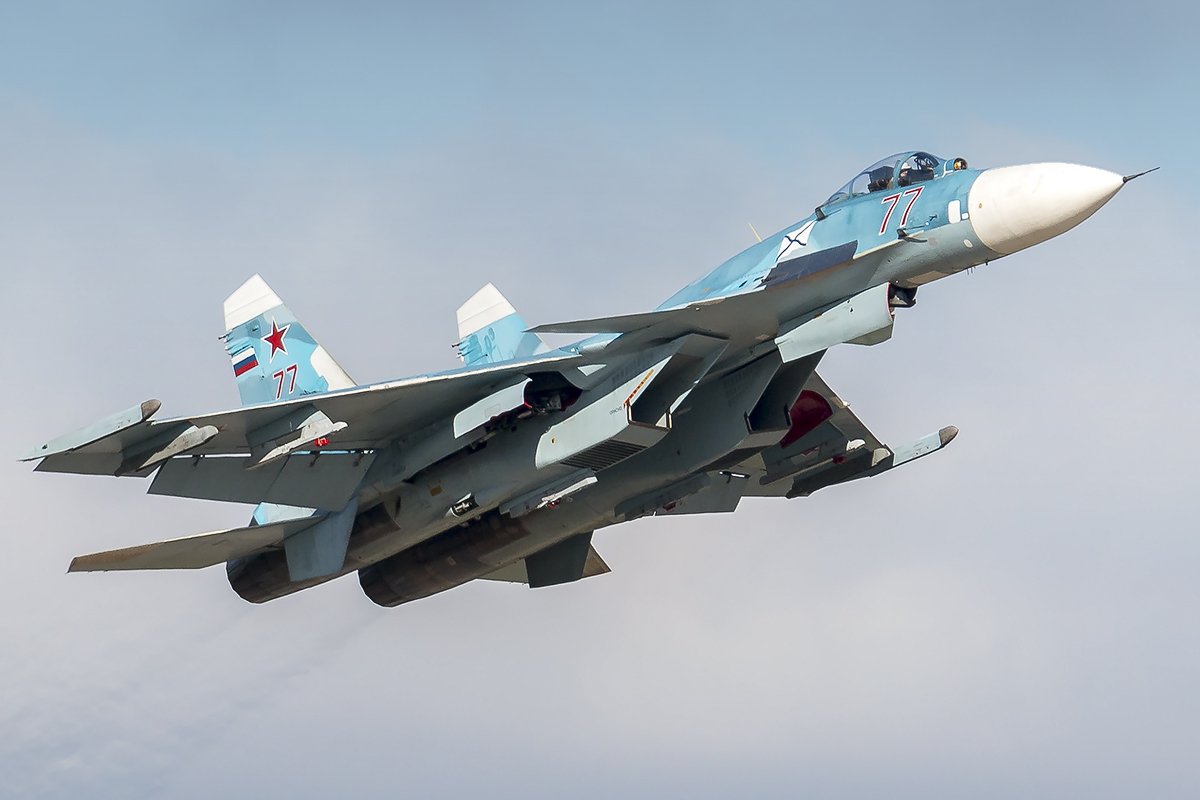
The Sukhoi Su-33, originally designated as the Su-27K, is a specialized naval derivative of the Su-27 air-superiority fighter. Developed by the Sukhoi Design Bureau under the leadership of Mikhail P. Simonov, the aircraft was designed to provide long-range air defense for Soviet and Russian carrier groups. The prototype first took flight on August 17, 1987, marking the beginning of a program to adapt a heavyweight fighter for the unique rigors of maritime operations.
To enable carrier operations, the Su-33 incorporates several critical design modifications. These include a reinforced airframe and landing gear to withstand arrested landings, a heavy-duty tail-hook for cable recovery, and the addition of canards (foreplanes) to enhance controllability and lift during low-speed carrier approaches. To optimize deck space, the aircraft features folding wings and horizontal tailplanes. Furthermore, the airframe utilizes corrosion-resistant coatings to protect against saltwater environments. The aircraft is specifically designed for STOBAR (short take-off but arrested recovery) operations, allowing it to launch from ski-jump decks without the need for catapults.
Production was carried out by the Komsomolsk-on-Amur Aircraft Plant (also known as KnAAPO or the Gagarin Aircraft Manufacturing Association), a facility established in either 1927 or the early 1930s. While official production figures are not public, estimates suggest that only a few dozen aircraft were built—likely fewer than 35—including prototypes and approximately 24 to 26 operational units. Series production is believed to have occurred between 1990 and 2004, with deliveries to the Russian Navy's 279th Independent Shipborne Fighter Aviation Regiment beginning around 1994–1995.
Power is provided by two NPO Saturn AL-31F-3 (or AL-31FM-series) afterburning turbofans. These engines produce approximately 7,600–7,800 kgf of dry thrust and 12,500–12,800 kgf with afterburner per engine. These specifications allow the Su-33 to reach maximum speeds of Mach 2.1–2.2 and a service ceiling of approximately 17,000–17,500 meters. For armament, the fighter is equipped with a 30 mm GSh-30-1 cannon and multiple hardpoints for R-27 and R-73 air-to-air missiles.
In operational service, the Su-33 has been utilized exclusively by the Russian Navy, primarily operating from the aircraft carrier Admiral Kuznetsov. Notably, the aircraft participated in combat operations over Syria between 2016 and 2017, performing both air-defense and air-to-surface missions. While a two-seat trainer variant, the Su-27KUB (Su-33UB), was developed and flown, it never entered series production. Today, the Su-33 remains Russia's only operational carrier-based fighter derived from a heavyweight 4th-generation platform, though the active fleet is small, with estimates suggesting around 20 operational aircraft remain.