
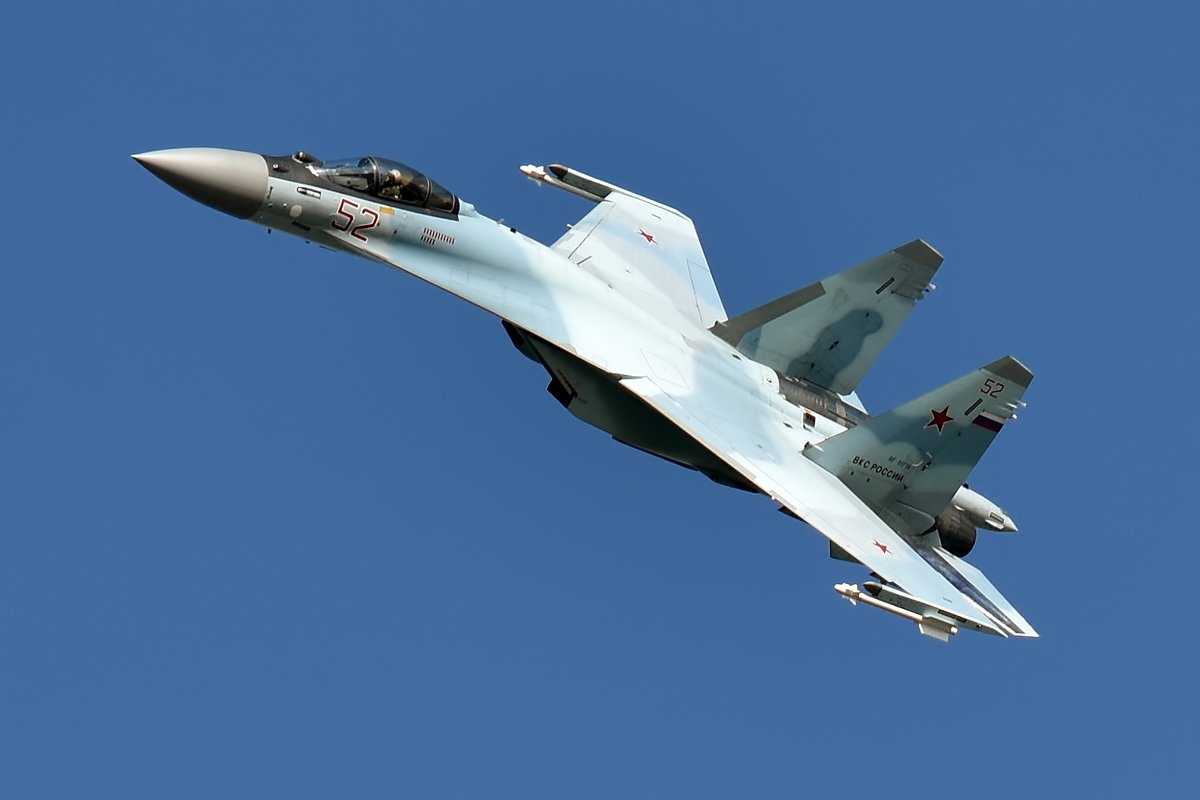
The Sukhoi Su-35 is a designation encompassing two distinct iterations of the Su-27 air superiority fighter: an early 1990s version (originally the Su-27M) and the modern Su-35S. Designed by the Sukhoi Design Bureau, the aircraft is primarily manufactured at the Komsomolsk-on-Amur Aircraft Production Association (KnAAPO/KnAAZ) in Russia's Far East. The early Su-27M, led by designer Nikolay Nikitin under Mikhail Simonov, first flew on June 28, 1988, piloted by Oleg Tsoi. This version introduced canards, taller vertical stabilizers, and the N011 Bars phased-array radar. Between 1987 and 1995, only 12 of these aircraft were built, serving primarily as testbeds due to post-Soviet economic constraints.
The current production Su-35S (T-10BM) represents a deep modernization led by I. Demin. The first prototype flew on February 19, 2008, piloted by Sergey Bogdan. Unlike its predecessor, the Su-35S omitted canards in favor of 3D thrust-vectoring nozzles for supermaneuverability. It features the N035 Irbis-E PESA radar, capable of detecting targets at approximately 400 km, and the OLS-35 IRST system. The airframe utilizes advanced composites and aluminum-lithium alloys to reduce weight and radar cross-section, with a frontal RCS reported between 1 and 3 m².
Power is provided by two Saturn AL-41F1S afterburning turbofans, produced by NPO Saturn and UMPO. These engines deliver 86.3 kN of dry thrust and up to 142.2 kN in emergency power, enabling supercruise capabilities above Mach 1.1. The Su-35S can reach a maximum speed of Mach 2.25 and has a service ceiling of approximately 18,000 meters. It is armed with a 30 mm GSh-301 cannon and 12 hardpoints for long-range missiles and anti-ship weapons like the Oniks.
In service, the Russian Aerospace Forces (RuAF) entered the Su-35S into operation in February 2014, with approximately 110 aircraft in inventory by December 2022. China became the first export customer in 2015, receiving 24 aircraft by 2019. Algeria is the third confirmed operator, with deliveries reported starting around 2025. Production continues at the Komsomolsk-on-Amur plant, with over 155 Su-35S units built as of recent reports, and deliveries scheduled through 2026.