
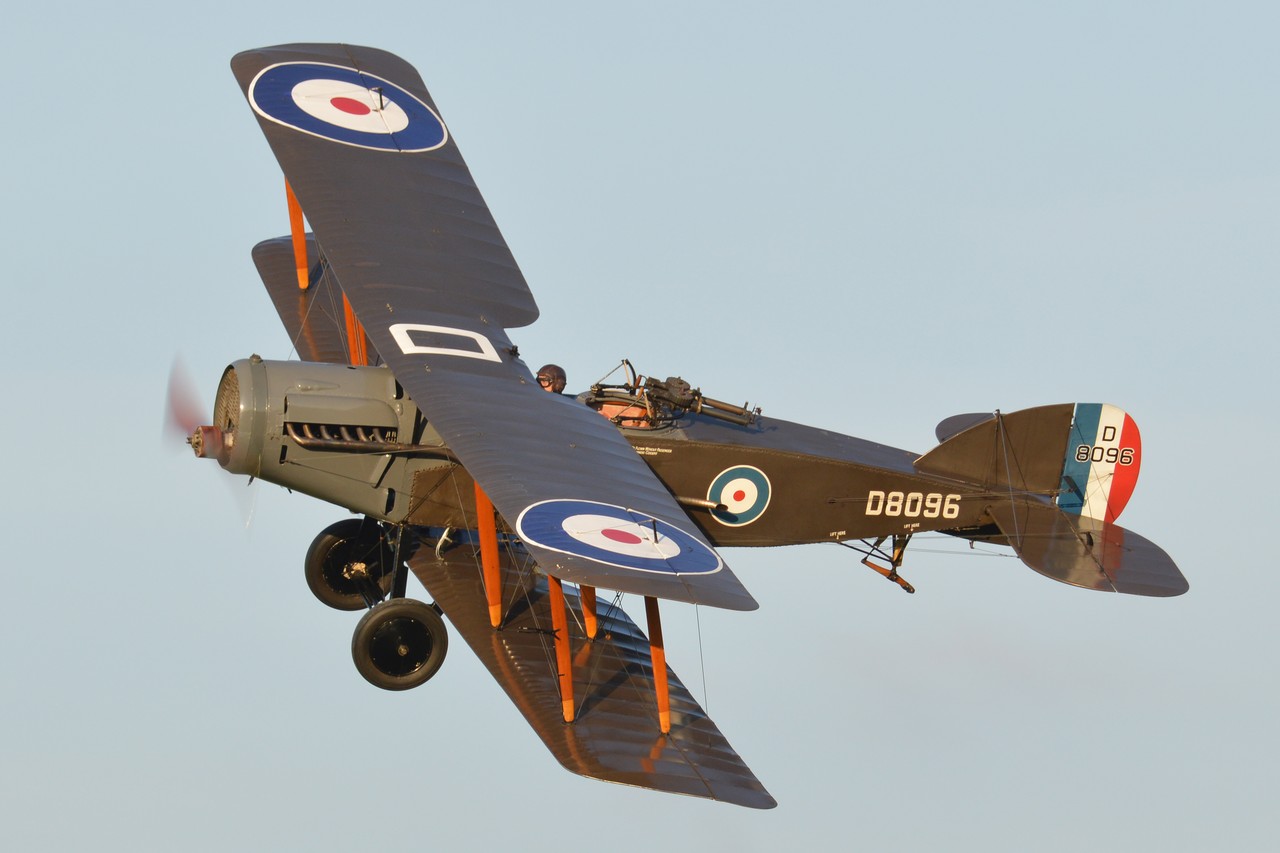
Combat Evolution and Tactical Revolution
The Bristol F.2B's operational debut on April 5, 1917, during the Battle of Arras nearly ended its career before it began. No. 48 Squadron of the Royal Flying Corps lost four of six aircraft on their first combat mission, with German fighters destroying them without sustaining losses. This disaster occurred during the period known as "Bloody April," when Allied aviation suffered devastating casualties on the Western Front.
The early failures stemmed from fundamental tactical misunderstanding rather than aircraft deficiency. Pilots initially flew the Bristol Fighter in tight defensive formations typical of reconnaissance aircraft, failing to exploit its superior speed and maneuverability. Once crews adopted aggressive single-seat fighter tactics while utilizing the rear gunner for defensive coverage, the aircraft transformed into a formidable combat platform. By war's end, the Bristol Fighter had achieved supremacy among two-seat fighters.
Widespread Military Deployment
By November 1918, Bristol Fighters equipped 13 squadrons on the Western Front, with additional units deployed to Italy, the Middle East, and home defense operations. Five squadrons successfully employed the type as night fighters, intercepting German Gotha bombers over Britain. The aircraft's versatility enabled missions ranging from offensive patrols and photographic reconnaissance to ground attack, artillery spotting, and light bombing operations.
Production continued until 1926, with the aircraft remaining in active military service until 1932. Some Commonwealth air forces operated the type even longer, with New Zealand maintaining Bristol Fighters until 1935, demonstrating the design's enduring utility.
Bristol Aeroplane Company Heritage
Designed by Frank Barnwell, the F.2B represented Bristol Aeroplane Company's most successful wartime fighter design. The company served as primary contractor while subcontracting production to Standard Motors, Armstrong Whitworth, and notably the Cunard Steamship Company. Bristol Aeroplane Company evolved through decades of mergers and acquisitions, eventually becoming part of BAE Systems, which continues operations today as one of Britain's major defense contractors.
The F.2B's design featured innovative engineering solutions, including a fuselage suspended between upper and lower wings that initially concerned crews despite the aircraft's robust construction. Key improvements over the earlier F.2A model included enhanced pilot visibility, enlarged tail surfaces, increased fuel capacity, and superior powerplant options.
Powerplant and Performance
The majority of F.2B aircraft employed the Rolls-Royce Falcon III inline engine, producing 275 horsepower and providing reliable performance throughout the aircraft's service life. Earlier variants used Falcon I and Falcon II engines, while the initial prototype flew with a Falcon I on September 9, 1916.
This powerplant combination enabled the Bristol Fighter to outperform contemporary two-seat aircraft in speed and climb rate while maintaining sufficient endurance for extended reconnaissance missions. The aircraft's ability to fight aggressively while providing rear-hemisphere defense through its Lewis gun-armed observer created a new tactical paradigm for multi-seat fighters.
American Production Struggles
The United States attempted domestic production under the designation O-1, but the program encountered severe difficulties. American insistence on using the 400-horsepower Liberty L-12 engine created chronic nose-heavy characteristics that compromised handling. Production drawing errors and three early crashes further damaged the program's reputation.
Out of initial contracts for 2,000 aircraft, only 27 O-1s reached completion. The Dayton-Wright Company later produced 40 B-1A variants with Wright engines and monocoque fuselage construction, intended for nocturnal observation missions. Despite these efforts, no American-built Bristol Fighters reached European combat zones. Major Rudolph Schroeder achieved an unofficial altitude record of 29,000 feet over Dayton, Ohio, on November 18, 1918, flying an American Bristol Fighter variant.
Modern Replica Programs
Six replica Bristol F.2B aircraft were constructed for the 1990 film "High Road to China," though completion occurred after filming concluded. These replicas survive in private collections and museums, maintaining the aircraft's legacy for modern audiences. Two additional replica Bristol Tourers built in Australia during the 1980s remain preserved, with one located at Oakey, Queensland.
Enduring Legacy
The Bristol F.2B's transformation from combat liability to air superiority asset illustrates the critical importance of tactical development alongside technological advancement. Its success established principles for multi-seat fighter employment that influenced aircraft design and doctrine development throughout the interwar period. The Smithsonian Institution acquired a Bristol F.2B on September 5, 1917, recognizing its significance as one of the war's most important aviation developments.
Total production of 5,329 aircraft made the Bristol Fighter one of Britain's most numerous wartime types, cementing its position as the definitive two-seat fighter of World War I and establishing Bristol Aeroplane Company's reputation for innovative military aircraft design.