
Origins and Development
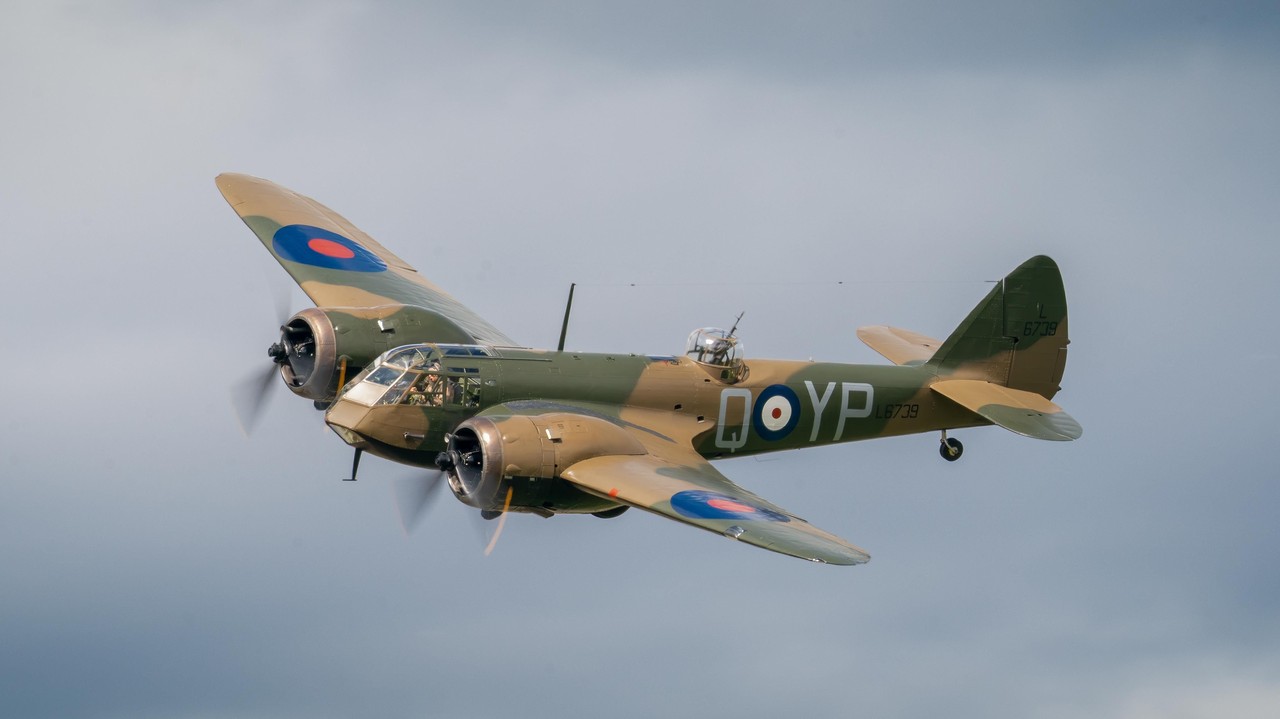
The Blenheim's remarkable story began with Lord Rothermere's 1934 challenge to create Europe's fastest commercial aircraft. Frank Barnwell, head of Bristol's design office, had been developing the concept since July 1933, resulting in the Type 142 prototype named Britain First. When Captain Cyril Uwins, Bristol's chief pilot, took the aircraft aloft from Filton Aerodrome on April 12, 1935, it achieved 307 mph—embarrassingly faster than the RAF's frontline fighters.
The Air Ministry, recognizing the military potential, ordered a bomber version designated Type 142M directly from the drawing board in September 1935 as part of rapid RAF expansion. The first production Blenheim Mk.I, serial K7033, flew on June 25, 1936, serving as the sole prototype. The Type 149 designation specifically referred to the long-nosed variant featuring a 91-centimeter fuselage extension to accommodate a radio-navigator ahead of the pilot, eventually becoming the Blenheim Mk.IV.
Rapid Production and Service Entry
Production accelerated dramatically as war clouds gathered. By 1937, Bristol's Filton factory delivered 25 Blenheims daily. Manufacturing expanded beyond Bristol to include Rootes Securities at Speke (422 aircraft) and A.V. Roe at Chadderton (250 aircraft). By late 1936, orders totaled 1,568 aircraft, rising to 2,088 by September 1939.
RAF squadrons received their first Blenheims on March 10, 1937. The Mk.I production reached 1,351 aircraft before ending in 1939, while the Mk.IV continued until June 1943. On September 3, 1939, when Britain declared war, 168 Blenheim IVs equipped ten RAF squadrons. The final variant, the Blenheim V (originally called Bisley), first flew February 24, 1941, with 940 examples built by Rootes at Blythe Bridge.
Combat Configuration and Armament
The Blenheim carried defensive armament of two .303-inch machine guns in a powered dorsal turret and two remotely controlled rearward-firing guns beneath the nose. Internal bomb capacity reached 1,000 pounds, with an additional 320 pounds externally. In January 1940, Bristol proposed a tactical support version with four 7.7mm Browning machine guns in a modified nose section, reflecting combat experience from the war's opening months.
The aircraft's three-man crew included pilot, navigator/bomb-aimer, and wireless operator/air gunner. The extended nose of the Type 149/Mk.IV provided better accommodation for the navigator and radio equipment, enabling longer-range reconnaissance missions over the North Sea and enemy territory.
Wartime Service and Limitations
Despite its pre-war promise, the Blenheim's combat career revealed sobering realities. The speed advantage that impressed in 1935 proved insufficient against improved German fighters by 1940. Nevertheless, Blenheim crews pressed home attacks during the Battle of France, Norwegian campaign, and early bombing raids over Germany, often suffering heavy casualties.
The aircraft served extensively in the Mediterranean, North Africa, and Far East, where its range and bomb load proved valuable despite vulnerability to enemy fighters. Many Blenheims continued serving as trainers throughout the war, preparing crews for more advanced bombers like the Beaufort-derived Beaufighter that ultimately replaced them.
The Bristol Aeroplane Company Legacy
Bristol Aeroplane Company established itself as a major British manufacturer during aviation's golden age. Beyond the Blenheim, Bristol produced the Mercury radial engines that powered the aircraft, demonstrating the company's integrated approach to aircraft development. The Mercury engines, available in various marks including the Mercury 25 and 30 that powered the Blenheim V, represented reliable powerplants for their era.
Canadian production under license by Fairchild Canada as the Bolingbroke extended the type's reach across the Commonwealth, with some variants featuring Bristol Aquila engines for extended range operations.
Technical Innovation and Performance
The Blenheim incorporated several advanced features for its time, including retractable landing gear, variable-pitch propellers, and all-metal stressed-skin construction. The clean aerodynamic design contributed significantly to its impressive speed, though this came at the cost of defensive firepower compared to more heavily armed contemporary bombers.
Cruising performance and range capabilities made the Blenheim suitable for reconnaissance missions over vast distances, particularly in theaters like the Middle East where airfield networks were sparse. The Mk.IV's increased fuel capacity in new wing tanks enhanced this capability further.
Production Statistics and Final Assessment
Total Blenheim production reached 3,307 aircraft across all variants by the time manufacturing ended in June 1943. This substantial number reflected both the aircraft's importance to RAF expansion and the lengthy production run spanning seven years. The type represented a crucial bridge between pre-war aviation technology and the more sophisticated bombers that followed, demonstrating how civilian innovations could rapidly transform military aviation when circumstances demanded.