
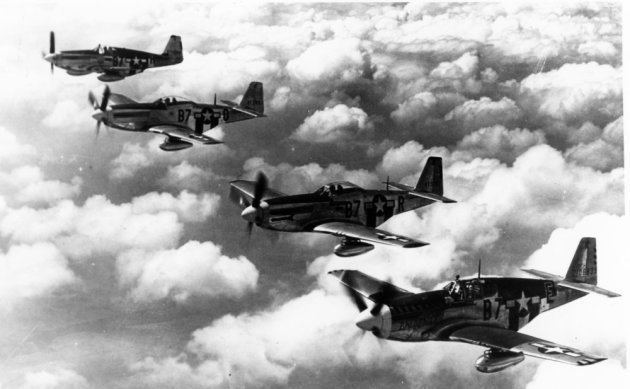
Production History and Development
The confusion surrounding the "A.f. Hamblin F.E.W. TP-51" designation highlights the importance of accurate aircraft identification. While this specific aircraft does not exist, the research reveals the remarkable story of the actual North American P-51 Mustang, which emerged from one of aviation's most ambitious development programs.
In 1940, North American Aviation President "Dutch" Kindelberger made a bold proposal to the British Purchasing Commission. Rather than license-produce the aging Curtiss P-40, he promised to deliver a superior fighter design within 102 days. Edgar Schmued led the NAA design team that created the NA-73X prototype, which first flew on October 26, 1940, with test pilot Vance Breese at the controls.
Manufacturing Excellence
North American Aviation operated from 1929 through various corporate mergers, eventually becoming part of Rockwell International in 1967 and later Boeing in 1996. During World War II, NAA's primary manufacturing facilities in Inglewood, California, and Dallas, Texas, produced over 15,000 Mustangs of all variants. The P-51D alone accounted for 8,000 aircraft, while 555 examples of the high-performance P-51H were completed before production ended in 1946.
The TP-51C variant mentioned in the research represents the dual-control trainer version, designed to transition pilots to the high-performance fighter. These training aircraft featured tandem seating while maintaining the Mustang's essential flight characteristics.
Engine Evolution and Performance
The Mustang's transformation from a capable low-altitude fighter to a war-winning long-range escort resulted from its engine evolution. Early variants used the Allison V-1710 inline engine, which provided adequate performance below 15,000 feet. However, RAF test pilot Ronald Harker's 1942 suggestion to install the Packard-built Merlin engine revolutionized the aircraft's capabilities.
The Packard V-1650-3, a license-built version of the Rolls-Royce Merlin 61, transformed the P-51B and subsequent variants into 440-mph fighters capable of operations above 30,000 feet. This powerplant enabled the Mustang to escort Allied bombers throughout occupied Europe, fundamentally changing the strategic bombing campaign.
Wartime Service and Impact
The P-51 entered Royal Air Force service in February 1942 as the Mustang Mk I, initially serving in tactical reconnaissance roles with 620 aircraft delivered. The United States Army Air Forces first deployed Merlin-powered P-51Bs with the 354th Fighter Group in December 1943, marking the beginning of the type's legendary escort career.
Notable units included the 332nd Fighter Group of the 15th Air Force, operating from Italian bases in 1944, and numerous fighter groups that protected Boeing B-17 and Consolidated B-24 formations over Germany. The Mustang's exceptional range allowed bombers to strike previously unreachable targets while maintaining fighter protection.
General "Hap" Arnold personally directed the USAAF's adoption of the Mustang, recognizing its potential to achieve air superiority over Europe. The aircraft continued serving through the Korean War from 1950 to 1953, demonstrating its adaptability to changing combat requirements.
Technical Innovation
Schmued's design team incorporated several advanced features that distinguished the Mustang from contemporary fighters. The laminar flow wing design reduced drag while providing excellent high-speed handling characteristics. The low-drag fuselage contributed to the aircraft's exceptional range and speed performance.
The P-51H represented the pinnacle of piston-engine fighter development, achieving 487 mph maximum speed at altitude. However, with only 555 built, this variant arrived too late for combat service in World War II.
Legacy and Preservation
Today, more than 100 airworthy P-51 Mustangs continue flying, making it one of the most popular warbird types at airshows and fly-ins. Major museum collections preserve significant examples, including the National Museum of the U.S. Air Force's P-51D, the Planes of Fame Air Museum's "Wee Willy II," and the American Airpower Museum's 1944 Inglewood-built P-51D.
The National World War II Museum displays a 332nd Fighter Group P-51, commemorating the Tuskegee Airmen's contributions to the war effort. These preserved aircraft serve as tangible reminders of the Mustang's role in achieving Allied victory and its status as one of history's most effective fighter aircraft.
The nonexistent "A.f. Hamblin F.E.W. TP-51" serves as a reminder of the importance of accurate historical documentation, while the real P-51 Mustang's legacy continues inspiring aviation enthusiasts worldwide.