
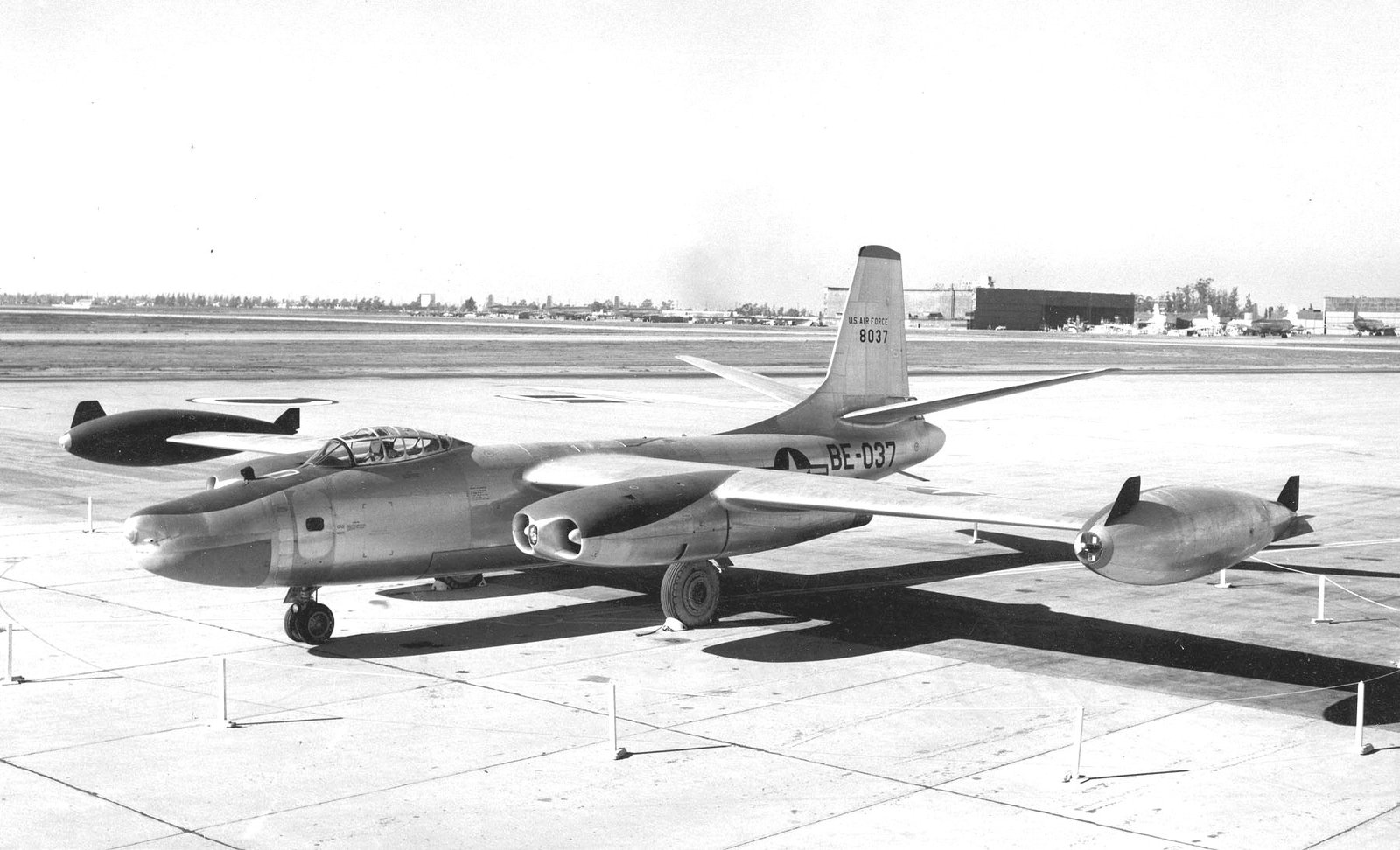
The North American B-45 Tornado represents a pivotal transition in American strategic aviation, serving as the first operational jet bomber for the United States Air Force (USAF). The aircraft's origins trace back to a late World War II U.S. War Department initiative to develop a jet-propelled bomber comparable to the German Arado Ar 234 Blitz. This effort culminated in the first flight of the XB-45 prototype on March 17, 1947, at Muroc Army Air Field, California, piloted by George William Krebs with flight engineer Paul W. Brewer. The B-45 officially entered operational service on April 22, 1948.
Designed by North American Aviation, the B-45 was a shoulder-wing, four-engine aircraft featuring a straight-wing design, tricycle landing gear, and pressurized crew compartments for a four-person crew consisting of a pilot, co-pilot, bombardier/navigator, and tail gunner. Production totals are slightly disputed; while the USAF Museum cites 142 aircraft, other records indicate 143 total airframes, including three XB-45 prototypes, 96 B-45As, 10 B-45Cs, and 33 RB-45Cs. The production B-45s were powered by four General Electric J47 axial-flow turbojet engines, each producing approximately 6,000 lbf of thrust in the B-45A variant.
Technically, the B-45A achieved a maximum speed of 492 knots (566 mph) at 4,000 feet and a service ceiling of 46,800 feet. Its internal bomb bay could accommodate up to 22,000 lbs of ordnance, including the M110 (T-14) 'Grand Slam' bomb. For defense, it utilized two 0.50-inch Browning AN-M3 machine guns in a tail turret. Later variants improved range; the B-45C featured wingtip fuel tanks, and the RB-45C reconnaissance version became the first multiengine jet bomber capable of mid-air refueling.
During the Cold War, the B-45 was a cornerstone of U.S. nuclear deterrence. The 47th Bomb Wing (Light), based at RAF Sculthorpe in England from 1952 to 1958, operated as a forward-based nuclear strike force. Additionally, RB-45C aircraft conducted highly classified reconnaissance overflights of Russia, China, and Korea. During the Korean War, the B-45 performed conventional bombing and reconnaissance, though it suffered a notable loss on December 4, 1950, when a B-45 was shot down by a MiG-15, marking the first successful jet-on-jet bomber interception. The B-45 remained in service until 1959, eventually superseded by the Boeing B-47 Stratojet. Today, a few examples survive as static museum exhibits, including a B-45A at the Castle Air Museum and a B-45C at the National Museum of the U.S. Air Force.