
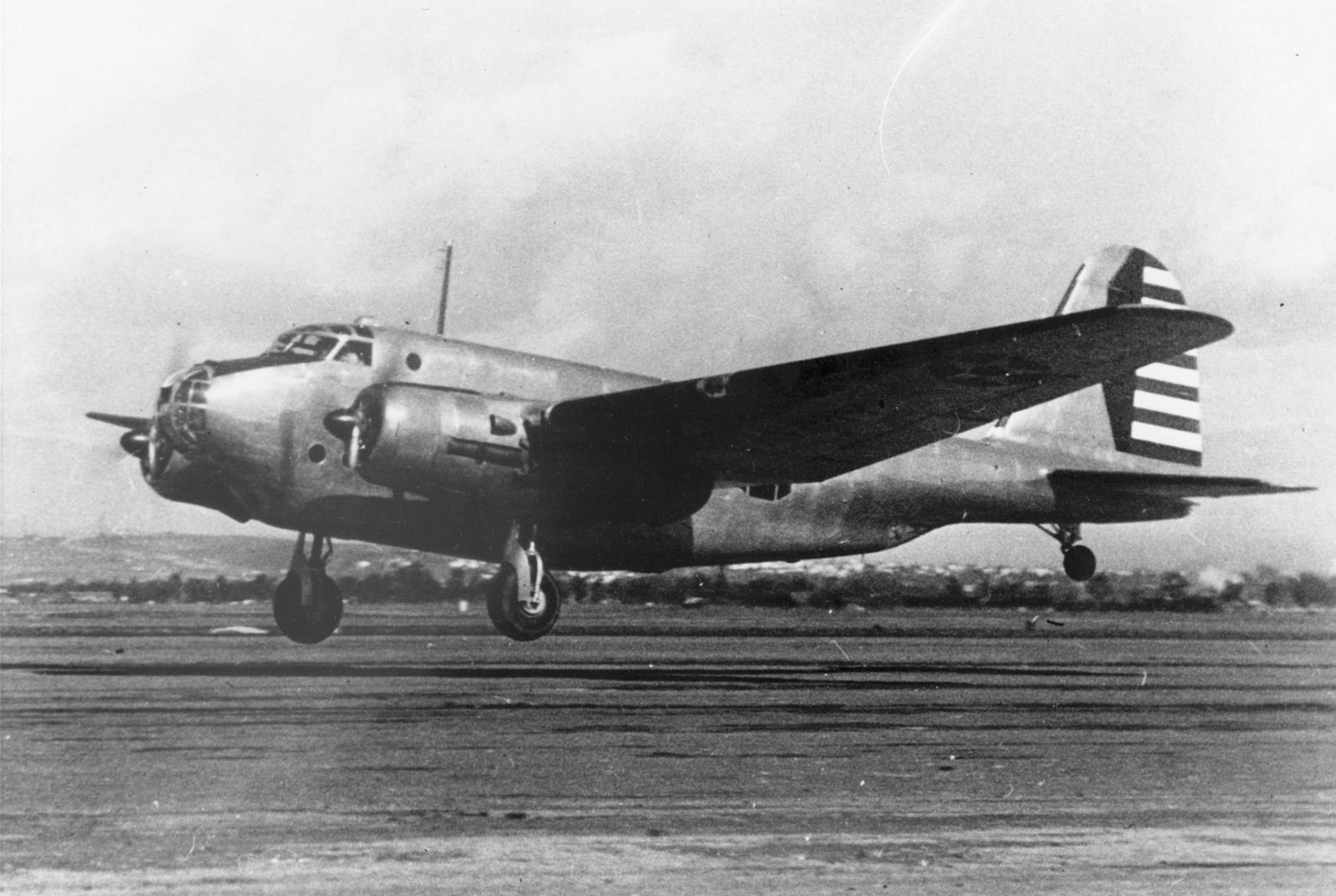
The North American XB-21, known as the "Dragon," was an experimental twin-engine medium bomber developed by North American Aviation (NAA) during the mid-1930s. Designed to meet a vague U.S. Army Air Corps (USAAC) requirement for a bomber capable of delivering a larger payload over a longer range than the Martin B-10, the aircraft was evaluated as a potential alternative to the Douglas B-18 "Bolo."
Constructed as an all-metal mid-wing aircraft, the XB-21 was built at North American Aviation's principal plant in Inglewood, California. The prototype first flew on December 21, 1936, and was formally procured by the U.S. Army in March 1937 under serial number 38-485. The aircraft was designed to house a crew of either six or eight members. To defend itself, the bomber was equipped with five rifle-caliber machine guns, including mounts in the nose and dorsal positions, representing one of the heaviest defensive armament configurations for a medium bomber of its era.
Power was provided by two turbo-supercharged Pratt & Whitney radial piston engines (identified as either Twin Wasp or Twin Hornet models), each producing approximately 1,200 hp. While the XB-21 achieved its primary goal of significantly improving range over the B-18—reaching a maximum range of nearly 1,660 miles with a light payload—its speed was a point of contention. Although some technical descriptions cite a top speed of roughly 220 mph, contemporary text sources indicate the aircraft was ultimately slower than the bombers it was intended to replace, which contributed to the decision to cancel the project.
Because it remained a single prototype, the XB-21 never entered series production or operational combat service. However, the project was historically vital for North American Aviation. The experience gained in aerodynamics, crew layout, and structural design during the XB-21 project fed directly into the NA-40 prototype and eventually the highly successful B-25 Mitchell. No airframes survived the program, and the XB-21 is not present in any modern museum collections.