
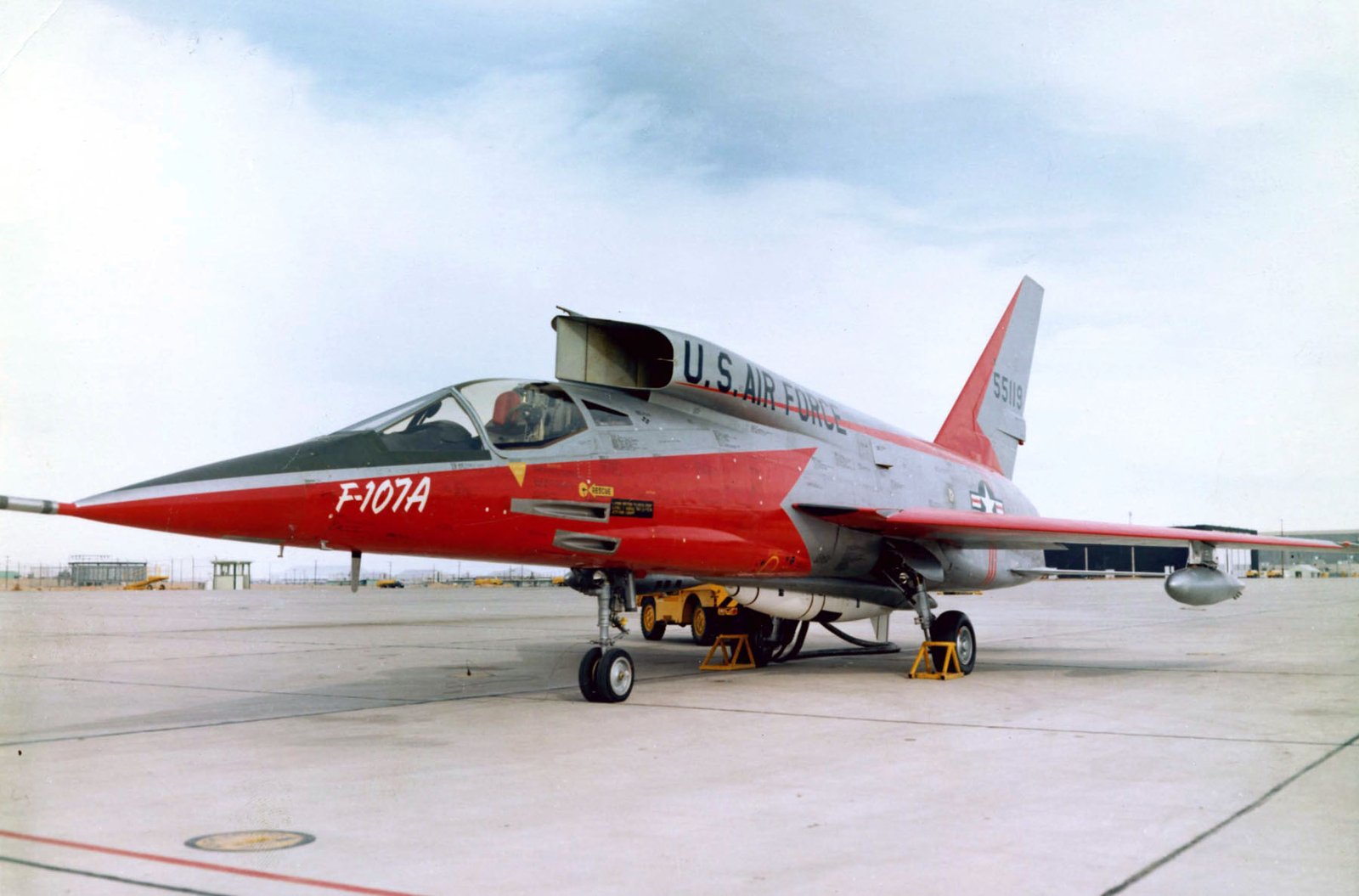
The North American Aviation F-107A was developed in the mid-1950s as a contender for a United States Air Force (USAF) tactical fighter-bomber competition. Built in Inglewood, California, the aircraft was designed to push the boundaries of supersonic performance and ordnance efficiency. Its most striking design feature was a dorsal, over-fuselage air intake, which was paired with a variable-area inlet duct. This configuration was specifically chosen to allow for a partially recessed weapons carriage in the aircraft's belly, reducing drag while maintaining a high payload capacity. Other advanced design elements included an all-moving vertical fin and sophisticated control systems.
The F-107A first took to the skies on September 10, 1956. Only three prototype aircraft were constructed between 1956 and 1957. Despite its technical innovations, the F-107A lost the USAF competition to the Republic F-105 Thunderchief, which resulted in the cancellation of the program before it could reach full production.
Powering the F-107A was a Pratt & Whitney turbojet engine with an afterburner, identified as the J75 family (specifically the YJ75-P-11 or YJ75-P-9). Depending on the specific engine variant, thrust was rated between 23,500 lbf and 24,500 lbf (108.98 kN). This propulsion system enabled the aircraft to reach impressive speeds; while it hit Mach 1.03 during its maiden flight, later performance figures indicated capabilities of Mach 2+ and a top speed of 1,295 mph (2,084 km/h) at an altitude of 36,000 feet. The aircraft's service ceiling was reported between 48,000 and 53,200 feet. Its range varied by mission profile, with sources citing figures between 1,570 miles and 2,109 nautical miles.
Although it never entered operational military service, the three prototypes served critical roles. The first prototype (serial 55-5118) was utilized for initial testing before being transferred to the National Advisory Committee for Aeronautics (NACA) for high-speed research. A second prototype was dedicated to weapons testing, equipped with four 20 mm M39 cannons and provisions for rockets and bombs. Payload capacities were source-dependent, with estimates ranging from 4,000 lb to as high as 10,582 lb across five hardpoints. Ultimately, two of the aircraft were used by NACA for research, while one remained focused on weapons evaluation. Today, the first prototype is preserved at the Pima Air & Space Museum, having been loaned by the National Museum of the United States Air Force.