
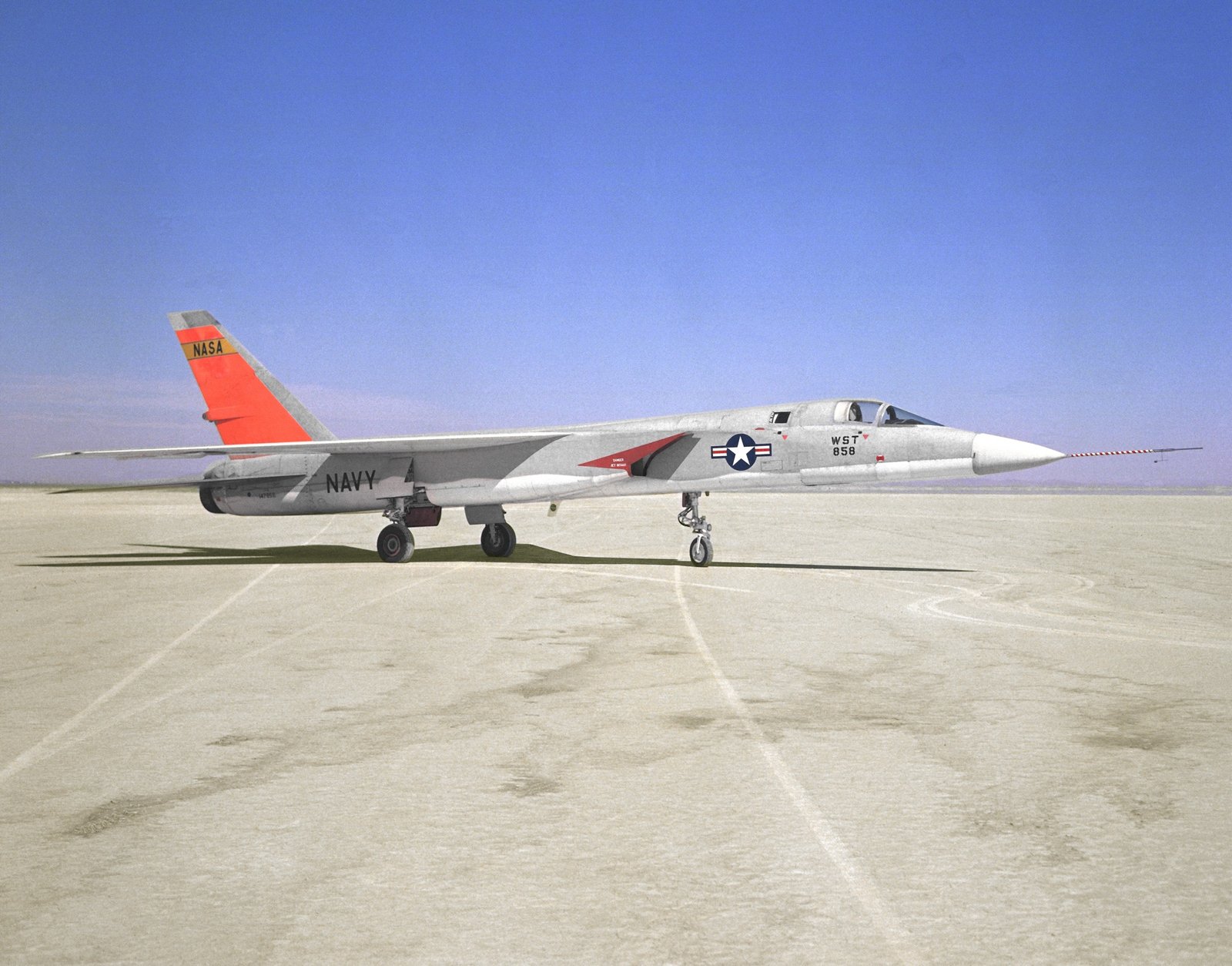
The North American A-5 Vigilante was developed as a supersonic, carrier-based nuclear strike bomber for the U.S. Navy. Produced by North American Aviation at their facility in Columbus, Ohio, the aircraft represented a peak of naval aviation technology for its era. The first prototype, designated the YA3J-1, completed its maiden flight on August 31, 1958. A total of 156 aircraft were manufactured, with operational deliveries beginning in 1960.
Technically, the Vigilante was distinguished by its Mach 2 capabilities and a unique internal weapons-bay system designed to eject munitions through a chute located between the engines. The aircraft was powered by two General Electric J79 turbojets (cited as either J79-GE-8 or J79-GE-10 variants), each producing 10,800 lb of thrust. These engines enabled a maximum speed of 1,385 mph and a service ceiling reaching between 48,400 and 52,100 feet. The aircraft operated with a crew of two, consisting of a pilot and a navigator/reconnaissance attack navigator.
While initially intended for strategic nuclear bombing, changes in the U.S. Navy's mission requirements led to the conversion of the fleet into the RA-5C, a high-speed reconnaissance aircraft. In this role, the Vigilante saw extensive action during the Vietnam War, where it was utilized for target search, mapping, and post-strike reconnaissance over both North and South Vietnam. This combat service came at a cost, with the Naval History and Heritage Command recording the loss of 18 RA-5C aircraft to enemy fire. The Vigilante's operational career concluded on November 20, 1979.
Today, the legacy of the A-5/RA-5C persists through museum preservation. Notable examples are held by the Pima Air & Space Museum and the Naval History and Heritage Command. Though the original North American Aviation company no longer exists as an independent entity—having transitioned through a corporate succession involving Rockwell—the Vigilante remains a symbol of the transition toward high-speed, technologically complex naval strike and reconnaissance platforms.