
Production and Manufacturer History
The North American XB-70 Valkyrie was developed by North American Aviation (NAA), a company incorporated in 1928 known for aircraft such as the P-51 and F-86. In the early 1960s, NAA constructed two XB-70A prototypes, AV-1 and AV-2, in California. While the broader B-70 bomber program was cancelled in 1961, these two prototypes were completed and flying by 1965. A third airframe, the XB-70B (AV-3), was authorized on October 4, 1961, but was cancelled before completion. Following a 1967 merger with Rockwell-Standard to form North American Rockwell, the company later became Rockwell International in 1973. The design lineage eventually passed to Boeing after the acquisition of Rockwell's aerospace units in 1996–1997.
Design and Technical Specifications
Conceived in the mid-1950s to meet a 1954 requirement for a high-altitude strategic bomber, the Valkyrie was designed for Mach 3+ cruise at approximately 70,000 feet. North American won the development competition against Boeing in December 1957. The aircraft utilized a stainless-steel honeycomb sandwich structure to manage extreme aerodynamic heating. Its most notable feature was the use of compression lift, supported by outer wing panels that could fold downward up to 65 degrees during flight to increase directional stability and lift. For crew safety, the aircraft incorporated individual escape capsules.
Propulsion and Performance
The XB-70A was powered by six General Electric YJ93-GE-3 axial-flow turbojets. Each engine produced 30,000 lbf of thrust with afterburner, providing a total installed thrust of approximately 180,000 lbf. These engines were specifically designed for sustained high-speed flight in severe temperature environments. In test flights, the XB-70A reached a maximum speed of 2,056 mph (approximately Mach 3.1) at 73,000 feet, with a service ceiling of 77,350 feet and a range of 4,288 miles.
Service History and Legacy
Though intended as a nuclear-armed bomber to replace the B-52, the XB-70 never entered operational service due to the rise of intercontinental ballistic missiles (ICBMs) and surface-to-air missiles. Instead, the two prototypes served as research platforms for the USAF and NASA, conducting 129 flights between 1964 and 1969. AV-1 first flew on September 21, 1964, and reached Mach 3 in October 1965. AV-2 first flew on July 17, 1965, but was destroyed on June 8, 1966, during a midair collision with an F-104 chase aircraft. This accident resulted in the deaths of NASA pilot Joe Walker and USAF Major Carl Cross, while pilot Alvin White survived.
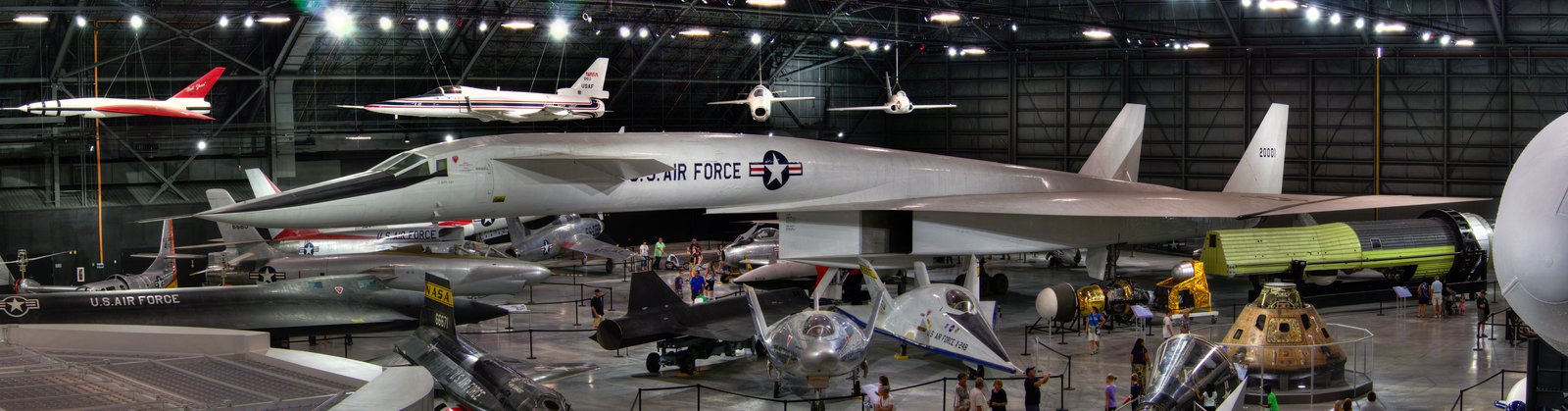
Following the loss of AV-2, AV-1 continued to provide critical data for the American Supersonic Transport (SST) program. Its final flight occurred in February 1969, when it was delivered to the National Museum of the U.S. Air Force at Wright-Patterson Air Force Base, where it remains the only surviving XB-70 in the world.