
Design and Production
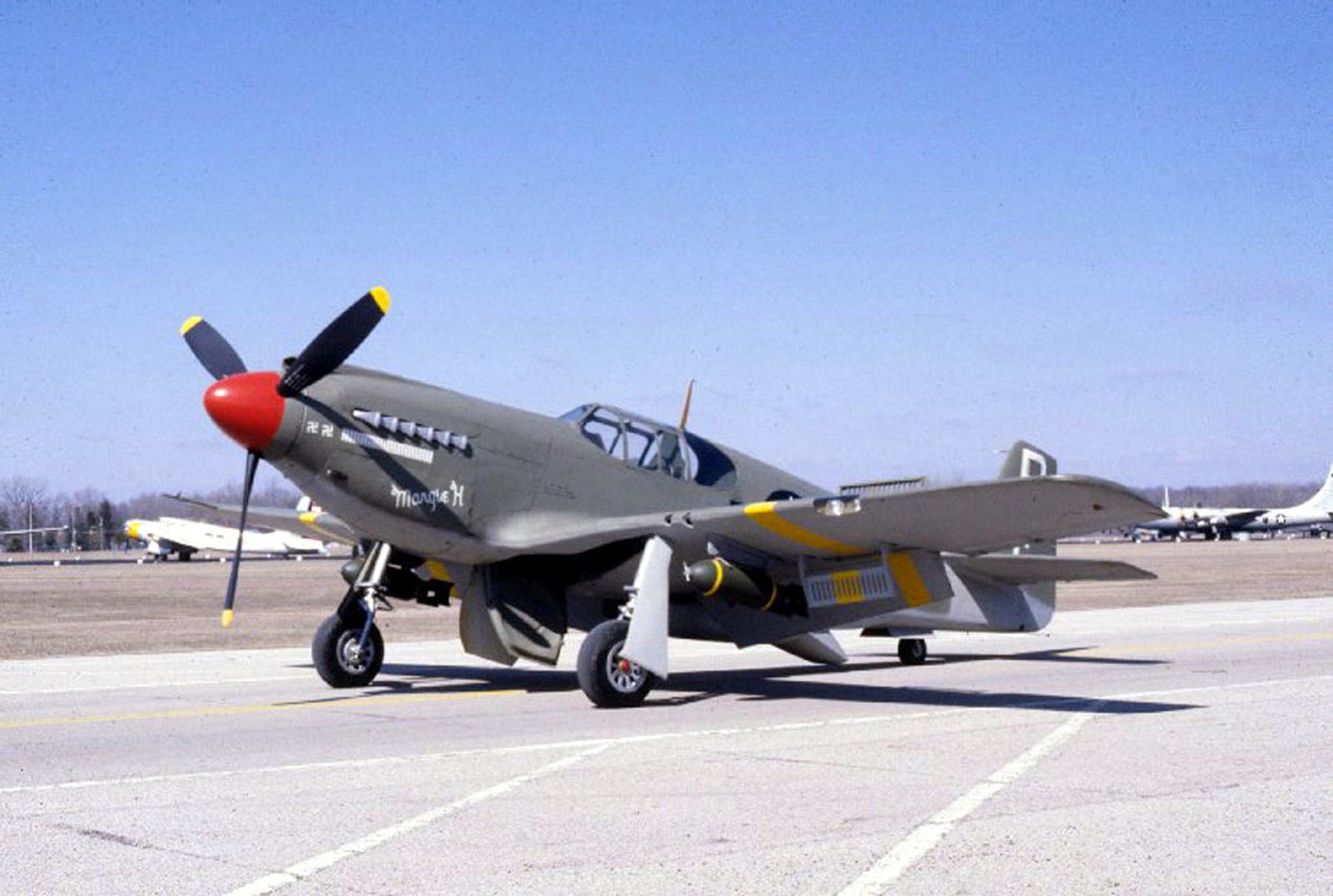
Designed by Edgar Schmued, the North American A-36 (company designation NA-97) was a specialized derivative of the early Mustang series adapted for the dive-bomber and ground-attack role. To facilitate near-vertical bombing attacks, the aircraft was equipped with rectangular, slatted dive brakes on both the upper and lower wing surfaces. Production of the A-36A began in September 1942, with a single USAAF order totaling 500 aircraft. This production run, which concluded in 1943, served as a strategic stopgap to maintain North American Aviation's production lines while the USAAF finalized other fighter procurement plans.
Technical Specifications
The A-36 was powered by a liquid-cooled, supercharged V-12 Allison V-1710-87 engine, produced by the Allison Division of General Motors. This powerplant delivered approximately 1,325 horsepower, providing strong performance at low to medium altitudes. The aircraft reached a maximum speed of 365 mph, a service ceiling of 25,000 feet, and a range of 550 miles. Its armament consisted of six 0.50 in M2 Browning machine guns—four located in the wings and two in the nose—and under-wing racks capable of carrying up to 1,000 lb of bombs.
Military Service
Operating exclusively during World War II, the A-36 saw extensive action in the Mediterranean and China-Burma-India (CBI) theaters. In the Mediterranean, the 12th Air Force utilized the aircraft through the 27th and 86th Fighter-Bomber Groups. The 522nd Fighter-Bomber Squadron became particularly noted for its air-to-air success. Lt. Michael T. Russo of the 522nd FBS became the only A-36 ace of the war, credited with five aerial victories, making him the first ace to achieve this feat in an Allison-engined Mustang. In the CBI theater, the 311th Fighter-Bomber Group operated the type from bases in India.
Combat operations began in French Morocco in April 1943, with the first recorded dive-bombing mission occurring on June 6, 1943, during a raid on Pantelleria. In the Mediterranean alone, A-36s flew 23,373 combat sorties and dropped over 8,000 tons of bombs. While the aircraft achieved roughly 80–84 air-to-air victories, it was gradually replaced by P-40 Warhawks and P-47 Thunderbolts by June 1944 in the Mediterranean, and by P-51s in the CBI theater by late 1944 or early 1945.
Legacy
Though often overshadowed by the later Merlin-powered P-51D, the A-36 proved the versatility and robustness of the Mustang airframe. While internally referred to by North American as the "Apache" and occasionally called the "Invader," neither name was officially adopted by the USAAF. Most airframes were scrapped after the war, but a small number survive in museums, such as the American Heritage Museum in Massachusetts, and a few remain airworthy within the warbird community.