
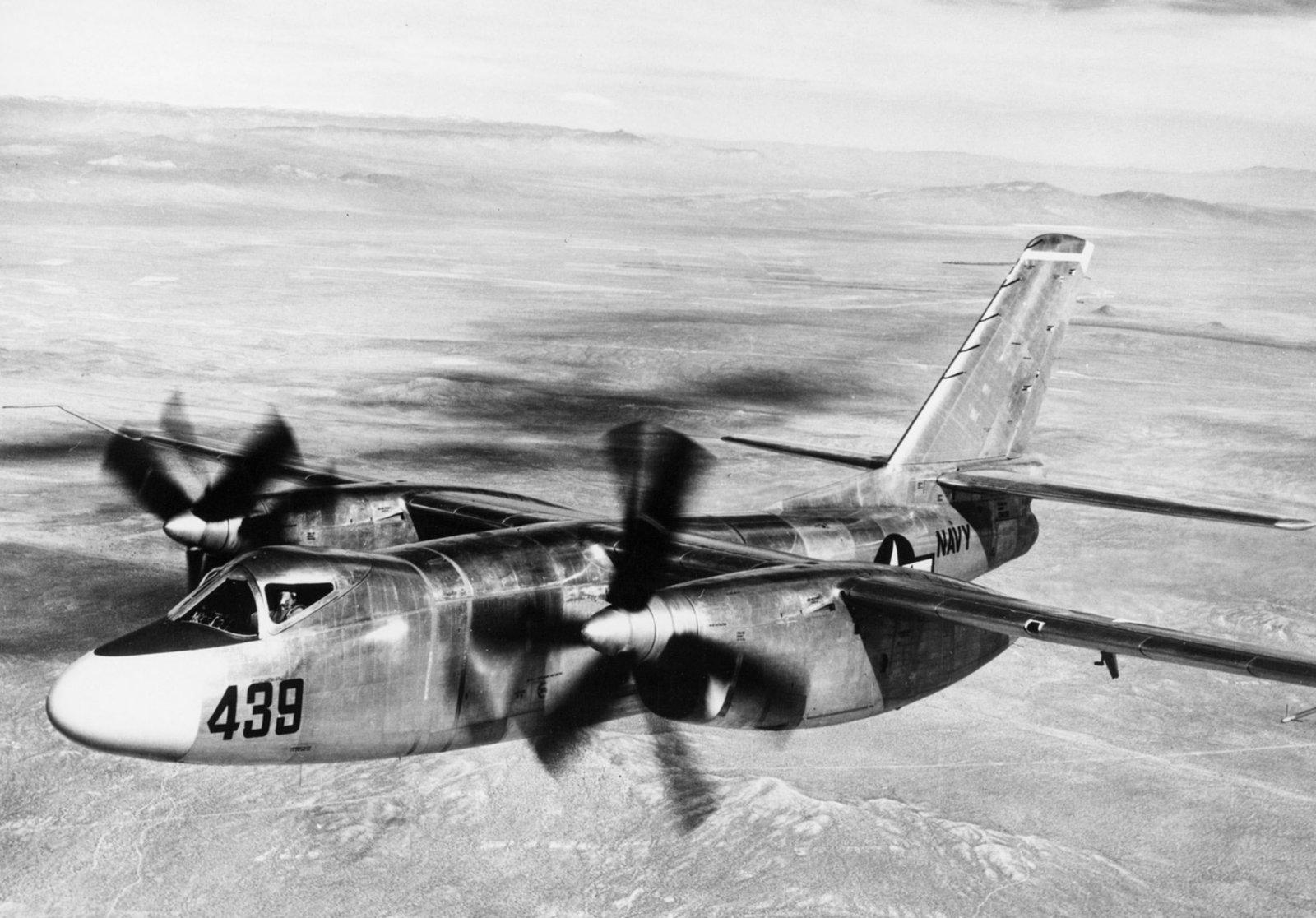
The North American XA2J "Super Savage" was developed in the late 1940s and early 1950s to meet a U.S. Navy requirement for an enhanced carrier-based nuclear strike aircraft. Conceived as a more capable evolution of the AJ Savage, the XA2J was intended to provide superior speed and payload capacity for strategic missions. The project was initiated in October 1948, with the design progressing through internal North American Aviation project numbers NA-158 and NA-163.
Technically, the XA2J was a significant departure from its predecessor. While the AJ Savage utilized a mixed piston and jet propulsion system, the XA2J relied on two powerful Allison T40 turboprop engines. Each T40 was a complex powerplant consisting of two T38 gas generators coupled through a common gearbox to drive a pair of contra-rotating propellers. These engines were designed to produce approximately 5,332 shp and 1,225 lbf of residual jet thrust each, totaling roughly 10,000 to 10,700 shp for the aircraft. The airframe was significantly enlarged to accommodate an internal bomb bay capable of carrying up to 10,500 lb of ordnance, including large nuclear weapons. For defense, the aircraft featured a radar-equipped tail turret armed with two 20 mm cannons.
Only one prototype, Bureau of Aeronautics serial number 124439, was completed and flown, making its first flight on January 4, 1952. Although estimated to reach a maximum speed of 451 mph at 24,000 feet, the aircraft only achieved speeds just over 400 mph during testing. This performance limitation was a direct result of the chronic unreliability of the Allison T40 engines and their complex gearboxes, which suffered frequent failures.
The U.S. Navy had originally ordered two flying prototypes and one static test airframe. However, the second prototype (serial 124440) was never completed, and the program was canceled in mid-1953. The cancellation was driven by the engine failures and the emergence of the jet-powered Douglas XA3D/A3D Skywarrior, which flew in October 1952 and offered a more promising future for carrier-based strike missions. Consequently, the XA2J never entered production or operational service, and no airframes are known to have survived.