
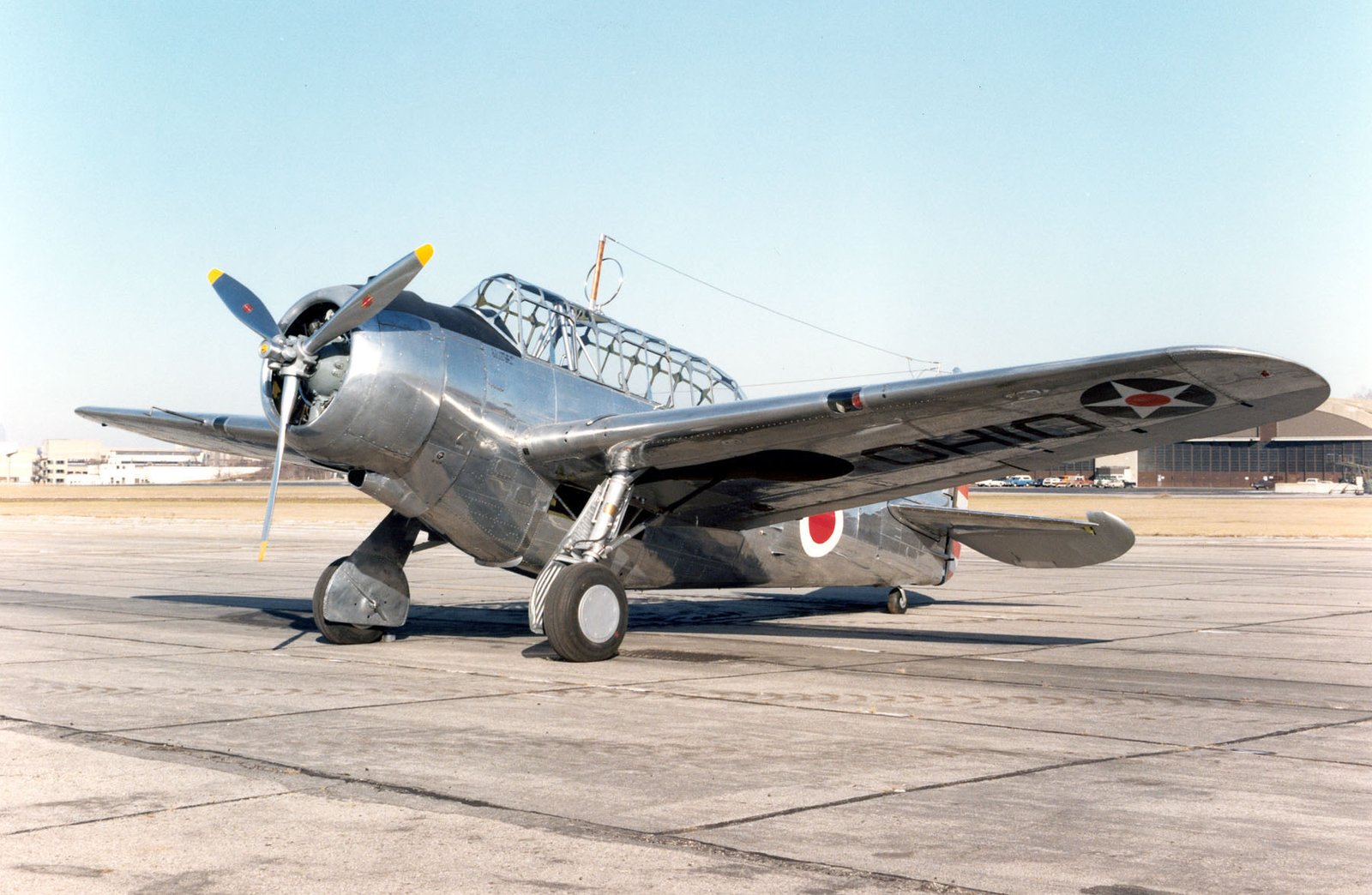
Developed in 1934 by North American Aviation and its subsidiary, the General Aviation Corporation, the O-47 (originally designated the GA-15) was designed to meet a U.S. Army Air Corps requirement to replace the Douglas O-38 and Thomas-Morse O-19 observation biplanes. The resulting aircraft was a modern monoplane that was notably larger and heavier than its predecessors. To enhance its reconnaissance capabilities, the design incorporated a deep fuselage belly equipped with windows for improved photography and downward observation. Other advanced features for the era included retractable landing gear and a crew capacity of three.
Production took place at North American Aviation's plant in Inglewood, California, between 1936 and 1939. Under the company designation NA-25, approximately 238 to 239 units were manufactured. The aircraft was powered by Wright R-1820 piston radial engines. The O-47A variant utilized an engine rated between 975 hp and 1,060 hp, depending on the specific source or subvariant, while the O-47B variant featured a more powerful Wright R-1820 rated at 1,060 hp.
In terms of performance, the O-47 reached a maximum speed of 227 mph and a cruising speed of 200 mph, with a service ceiling of 24,100 ft and a range of 840 miles. Its armament consisted of one fixed forward-firing .30-caliber machine gun and one flexible rear .30-caliber machine gun. The aircraft had a wingspan of 46 ft 4 in, a length of 33 ft 3 in, and a maximum takeoff weight of 7,636 lb.
During its military service with the U.S. Army Air Corps, 174 O-47s were ordered in 1937, with 93 of these assigned to National Guard units. An additional 74 O-47Bs were ordered in 1938. However, by 1941 training maneuvers, it became evident that the O-47 was unsuitable for frontline reconnaissance, as faster bombers, fighters, and lighter liaison aircraft were more effective. Consequently, the O-47 was relegated to secondary roles such as target towing, coastal patrol, anti-submarine patrol, and training, although some remained at overseas bases during the initial Japanese attacks of World War II.
Following the war, a small number of O-47Bs were modified into single-seat commercial cargo aircraft by removing the rear and center seats. While 71 airframes survived the war, only four are believed to exist today. Notable survivors include serial 39-112 at the National Museum of the U.S. Air Force, restored as an O-47A of the 112th Observation Squadron, and serial 25-554, which is being restored to flight by Planes of Fame.