
Design and Development
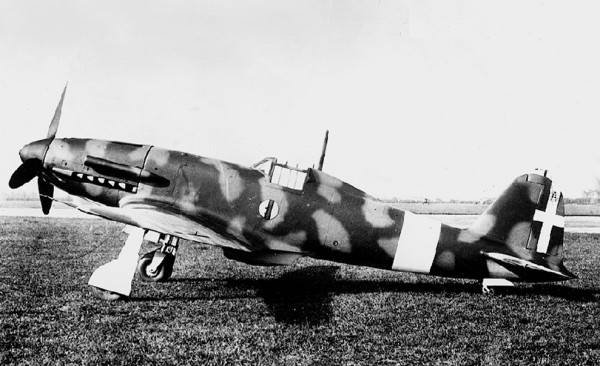
The Fiat G.59 was developed by chief aeronautical engineer Giuseppe Gabrielli as a post-war evolution of the wartime Fiat G.55 Centauro. Designed to serve as both a fighter and an advanced trainer, the G.59 was a single-engine, low-wing monoplane featuring a conventional tailwheel arrangement and retractable landing gear. The aircraft's most notable design characteristic was its hybrid nature, pairing a proven Italian airframe with British-made Rolls-Royce Merlin inline piston engines. This approach allowed Italy to restart its military aircraft production quickly after 1946. Later iterations, specifically the G.59-4 series, introduced a modernized bubble canopy to improve all-around visibility for the crew.
Production and Manufacturer
Production of new-build G.59 aircraft began in 1948 and continued into the early 1950s at Fiat Aviazione facilities in Italy. While production totals are disputed, estimates range from 87 units to more than 180 copies, with the latter figure provided by the Museo Motori. The original manufacturer, Fiat Aviazione, eventually saw its aviation activities merge into Aeritalia in 1969, which later became Alenia Aeronautica and is now part of Leonardo S.p.A.
Technical Specifications
The G.59 utilized various liquid-cooled V-12 engines from the Rolls-Royce Merlin family. The G.59-1 and G.59-2 series were powered by the Merlin 24, producing 1,201 kW (1,610 hp). The G.59-3 and G.59-4 series utilized the Merlin 500/20, with power ratings cited between 1,044 kW (1,400 hp) and 1,660 hp depending on the standard used. Performance figures indicate a maximum speed of approximately 592 km/h (368 mph), though the G.59-4B variant is credited with a top speed of 609 km/h at 6,400 meters. The aircraft had a service ceiling of approximately 39,000 to 39,700 feet and a range of 1,419 km (882 miles).
Military Service
The G.59 served primarily as an advanced trainer for the Italian Air Force (Aeronautica Militare), where it helped pilots transition to jet aircraft like the Macchi MB-326. Italy operated both single-seat fighters (G.59-1A and G.59-4A) and two-seat trainers (G.59-1B and G.59-4B). Export versions were supplied to Syria, which operated 30 G.59-2A single-seat fighters armed with four 20 mm Hispano-Suiza wing cannons and 10 G.59-2B two-seat trainers equipped with two 12.7 mm machine guns. The Egyptian and Argentine air forces also operated the type. In Italy, some units remained in service until 1964.
Legacy
As one of the last high-performance piston-engined military aircraft produced in Europe, the G.59 remains a key example of early Cold War aviation. Today, a G.59-4B is preserved as a static exhibit at the Museo dei Motori e dei Meccanismi in Palermo. Additionally, at least one airworthy example is known to exist in a private collection at Parma airport, operated by the Nucleo Aereo Acrobatico Parmense.