
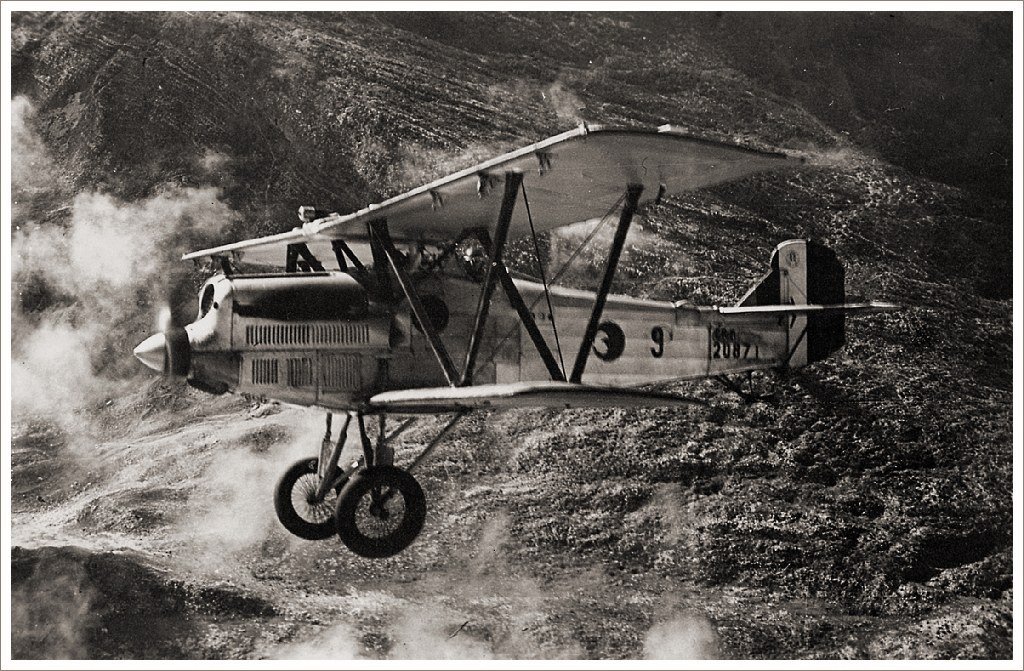
Designed by aeronautical engineer Celestino Rosatelli, the Fiat CR.20 was a single-seat biplane fighter developed by Fiat Aviazione in Italy. The aircraft's first prototype flew on 19 June 1926, with official testing conducted at Montecelio in September of that year. These trials highlighted the aircraft's responsive controls, flight balance, and overall maneuverability. The CR.20 represented a significant technological shift as one of the first Italian fighters to utilize an all-metal frame constructed from steel and duralumin, though the structure remained covered in fireproof fabric, with duralumin sheeting used specifically around the engine area.
Production began in the late 1920s, with an initial order of 88 aircraft delivered between 1927 and 1929. While a precise total production figure is not documented, some sources indicate approximately 250 standard CR.20 units were built. Manufacturing took place at Fiat's facilities in the Turin area, likely including the Lingotto complex. The aircraft was powered by a Fiat A.20 water-cooled V-12 piston engine producing 306 kW (410 hp), allowing for a maximum speed of 270 km/h and a service ceiling of 7,500 meters. For armament, the fighter was equipped with two 7.7 mm Vickers-modificate machine guns synchronized to fire through the propeller arc.
In military service, the CR.20 was a mainstay of the Regia Aeronautica, equipping between 27 and 32 squadrons by 1933. It saw operational use in Italian colonial campaigns against Libyan rebels and during the early stages of the Second Italo-Abyssinian War (1935–1936), where it performed ground-attack missions. Internationally, the aircraft was exported to several nations, including Poland, Hungary, and Lithuania (which operated 15 units from 1928 to 1940). Notably, Paraguay purchased five aircraft in 1933, which served as the nation's only fighters during the Chaco War, providing a qualitative advantage over Bolivian forces. Other operators included Austria and Spain, as well as the Soviet Union, which used two aircraft for trials.
As newer models like the CR.32 entered service, the CR.20 was relegated to advanced training and aerobatic roles. Variants included the CR.20bis, the CR.20bis AS for North African operations, and the two-seat CR.20B used for communications and training. The CR.20's legacy lies in its role as the foundation for Rosatelli's subsequent successful biplane fighters, establishing the structural and design philosophy that dominated Italian fighter aviation throughout the 1930s.