
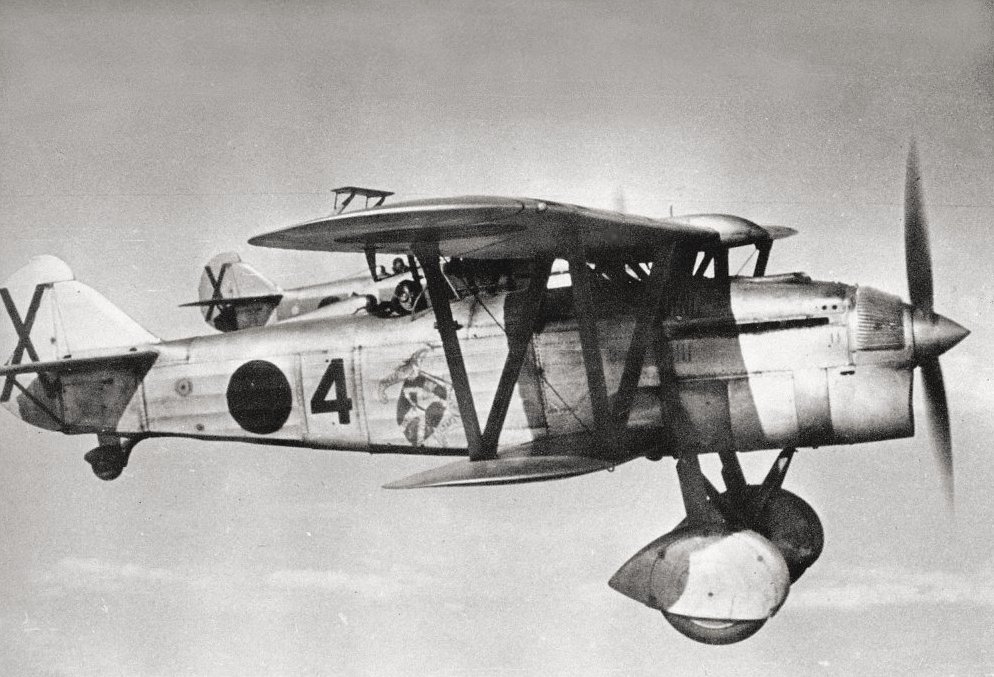
The Fiat CR.1 was a pivotal single-seat biplane fighter designed by the renowned aeronautical engineer Celestino Rosatelli for Fiat Aviazione. The aircraft's "CR" designation was derived from Rosatelli's own initials, marking the beginning of a design series that would eventually lead to the more famous CR.32 and CR.42 fighters. Developed in the mid-1920s, the CR.1 featured a conventional biplane configuration with an open cockpit, fixed tailskid landing gear, and a primary structure composed of wood and fabric.
Production and delivery of the CR.1 were centered around 1924 and 1925. The Regia Aeronautica (Italian Royal Air Force) began equipping its 1st Fighter Group with the type in 1924, and by 1925, more than two hundred units had been commissioned. Specifically, the 36th Squadron of Centocelle received some of the first CR and CR.1 aircraft in 1924. By 1926, the aircraft had been allocated to 12 Italian fighter squadrons. While an exact production span is not documented, the type was quickly superseded in 1926 by the all-metal Fiat CR.20. In total, approximately 240 CR.1s were placed in Italian military service.
Technical specifications for the standard Italian version included a single Isotta Fraschini Asso V-8 water-cooled piston engine producing approximately 240 kW (320 hp). This powerplant allowed the CR.1 to reach a maximum speed of 270 km/h, with a range of 650 km and a service ceiling of 7,450 m. For armament, the fighter was equipped with two synchronized 7.7 mm (.303 in) Vickers machine guns firing through the propeller arc. The aircraft's power-to-mass ratio was recorded at 0.2146 kW/kg.
Beyond Italy, the CR.1 saw limited export success, with Latvia acquiring nine aircraft. These export models were fitted with Hispano-Suiza HS 8N B V-8 water-cooled piston engines producing 224 kW (300 hp) and served with Latvian Naval Aviation until 1936. Within Italy, some CR.1s were retrofitted in the 1930s with Isotta Fraschini Asso Caccia engines, increasing power to 328 kW (440 hp). These modified aircraft served with the 163a Squadriglia at Rhodes in the Aegean Sea until their withdrawal in 1937.
Despite its widespread use in the Regia Aeronautica, the CR.1 saw no confirmed combat use, as it was relegated to training and secondary roles shortly after its introduction. The legacy of the CR.1 lies in its role as a transitional design that modernized the Italian fighter fleet. No surviving examples of the CR.1 are verifiably documented in current public museum inventories.