
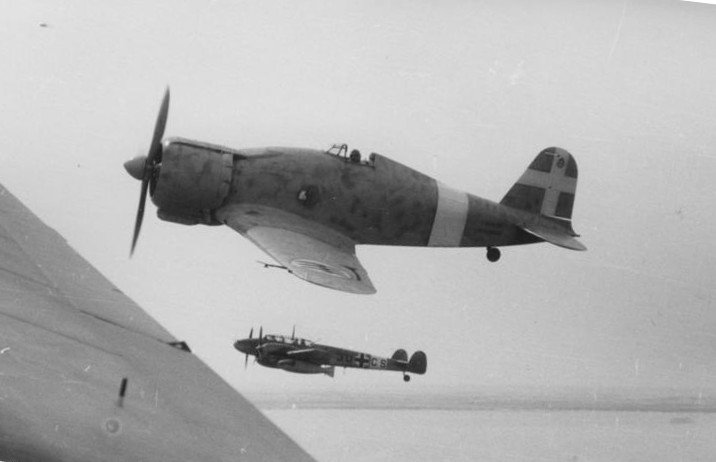
Designed by Giuseppe Gabrielli at the Fiat Aviazione technical office in Marina di Pisa, the Fiat G.50 Freccia represented a pivotal shift in Italian aeronautical engineering. The aircraft first flew on 26 February 1937, piloted by Comandante Giovanni De Briganti. It was distinguished as the first Italian production fighter to feature an all-metal stressed-skin construction, a low-wing cantilever monoplane layout, and retractable landing gear. While it initially featured an enclosed cockpit—a first for the Regia Aeronautica—operational units later reverted to open cockpits to improve ventilation and visibility.
Production began between 1937 and 1938, with the type entering service in early 1938. While exact production totals vary, estimates range between 774 and 791 airframes, with 784 and 778 being frequently cited figures. Manufacturing was primarily centered at Fiat's aviation plant in Turin. The G.50 was powered by a Fiat A.74 RC.38 14-cylinder double-row radial engine, which delivered approximately 840 hp and drove a constant-speed propeller. This powerplant enabled a maximum speed of roughly 470–480 km/h and a service ceiling of up to 11,000 meters.
During World War II, the G.50 saw diverse operational employment. The Regia Aeronautica used it as an interceptor and bomber escort, notably during raids against Corsica and in the North African campaign. The aircraft also participated in the Battle of Britain in late 1940 as part of the Corpo Aereo Italiano. Beyond Italy, the Finnish Air Force operated 35 G.50s during the Winter War and Continuation War; Finnish pilots achieved a remarkable kill-to-loss ratio of approximately 33:1. Other operators included Spain, where aircraft served in the Spanish Civil War and Morocco, and the Independent State of Croatia, which utilized the fighter against Yugoslav partisans from June 1942 until 1945.
As the war progressed, the G.50 became obsolete compared to newer designs. By 1943, surviving Italian airframes were transitioned into ground-attack roles, carrying bomb loads of approximately 100 kg. Notable aces associated with the type include Italy's Furio Lauri (18 victories) and Finland's Oiva Tuominen (23 victories). Today, only one Fiat G.50 Freccia survives, preserved at the Aeronautical Museum Belgrade in Serbia.