
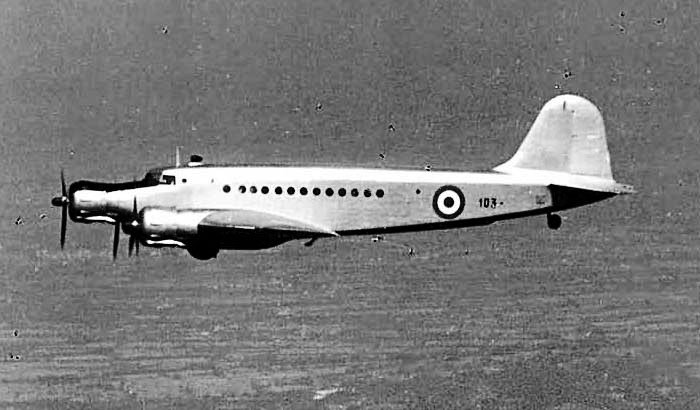
Designed by Giuseppe Gabrielli, who headed Fiat's Aviation Technical Office starting in 1931, the Fiat G.12 was developed in early 1939 to address the needs of Italian airlines for a reliable transport capable of crossing the Alps in winter. The design target was a service ceiling of 6,500 to 7,000 meters, offering superior speed and range compared to alternatives like the Savoia-Marchetti SM.73. The resulting aircraft was an all-metal monocoque low-wing trimotor featuring a fully enclosed flight deck and cabin, an autopilot, and advanced de-icing systems. The civil prototype, the G.12C, first flew on October 15, 1940, and the type entered production in 1941.
Production took place at Fiat facilities in Turin, Italy, with the majority of the 104 aircraft built between 1941 and 1944, though some modifications continued until 1949. The standard powerplant consisted of three Fiat A.74 R.C.42 14-cylinder air-cooled radial piston engines, each producing 574 kW (770 hp) and driving three-blade feathering metal propellers. Later civil variants utilized different engines, including the Alfa Romeo 128, the Bristol Pegasus 48, and the Pratt & Whitney R-1830-S1C3-G Twin Wasp.
While intended as a civil airliner, the G.12 was primarily utilized in military roles during World War II. The Regia Aeronautica operated the G.12T troop and cargo version, which was armed with two 7.7 mm Breda-SAFAT machine guns from the 22nd aircraft onward. The aircraft supported the Axis air bridge to North Africa, specifically Tunisia, between 1942 and early 1943, though it suffered losses from Allied fighter intercepts and B-17/B-24 bombing raids in April 1943. Other military operators included the Luftwaffe and the Royal Hungarian Air Force, the latter of which operated 12 aircraft. Specialized variants included the long-range G.12 Gondar and the G.12RT for extreme-range missions.
In the civil sector, the G.12 played a pivotal role in the birth of Alitalia. On May 5, 1947, a Fiat G.12CA piloted by Captain Virginio Reinero flew from Turin-Aeritalia to Rome-Ciampino and Catania, marking the airline's inaugural commercial flight. Other postwar operators included Avio Linee Italiane and Ali Flotte Riunite. The G.12's legacy continued with the enlarged G.212 derivative, the last Italian three-engine piston transport. The G.12 was officially retired from the Italian Air Force in 1956. No complete airframes of the G.12 are known to survive today.