
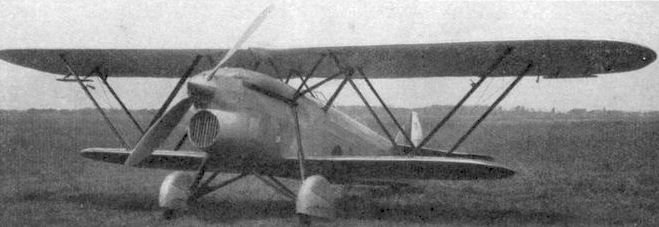
Designed by chief biplane fighter engineer Celestino Rosatelli, the Fiat CR.30 was developed in the early 1930s as a modernized successor to the aging CR.20. The aircraft's development was driven in part by pressure from Italo Balbo to upgrade Italy's fighter capabilities. Prototypes of the CR.30 first took to the air in March 1932, with some sources noting between three and four prototype airframes were constructed. The design was viewed as a clean break from previous Fiat biplanes, establishing the structural and aerodynamic foundation for the subsequent CR.32 and CR.42 fighters.
Power was provided by the Fiat A.30 RA, a liquid-cooled 12-cylinder V piston engine producing approximately 600 hp. This powerplant allowed the CR.30 to achieve a maximum speed of 218 mph (roughly 351 km/h) and a service ceiling of 27,845 feet. While early prototypes were equipped with two heavy 12.7 mm nose-mounted machine guns, production models were standardized with two 7.7 mm Breda-SAFAT guns, each supplied with 500 rounds of ammunition.
Production began in 1933, with the first aircraft delivered to the Regia Aeronautica in 1934. Total production numbers are debated, with estimates ranging from 124 to 176 aircraft, though it is generally accepted that slightly more than a hundred were built. While Fiat Aviazione handled the primary production in Turin, the company CANSA (Costruzioni Aeronautiche Novaresi S.A.) manufactured 20 CR.30B two-seat trainers to replace wartime losses.
In military service, the CR.30 was primarily operated by the Regia Aeronautica, most notably by the 2° Stormo (2nd Wing) in Libya from 1935 until the type's retirement from front-line service in 1938. Beyond Italy, Hungary was the primary foreign operator. Other export customers included Paraguay, which ordered two aircraft in 1937 for training, and Venezuela, which received one aircraft in 1938. A specialized seaplane variant, the CR.30 Idro, was developed as a twin-float fighter; two prototypes were converted, capable of carrying up to 24 kg of anti-personnel bombs.
Despite its role as a transitional aircraft, the CR.30's legacy is significant as the direct precursor to the CR.32, which would later see extensive action in the Spanish Civil War. No surviving CR.30 airframes are documented in current records.