
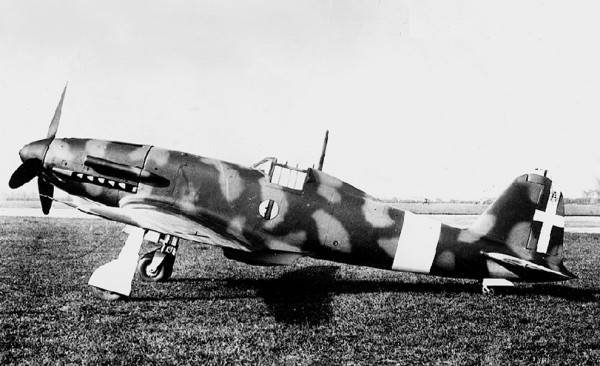
The Fiat G.55 Centauro was a single-seat, single-engine fighter designed by engineer Giuseppe Gabrielli, whose surname provided the "G" in the aircraft's designation. Developed as part of the Italian "Serie 5" fighters—which also included the Macchi C.205 and Reggiane Re.2005—the G.55 was intended to modernize Italy's aerial defense. The prototype, designated MM.491, first took flight on 30 April 1942 at Caselle airfield in Turin, with Valentino Cus serving as the test pilot.
Designed and manufactured by Fiat's aviation division in Turin, the G.55 was powered by the Fiat RA-1050 RC.58 "Tifone." This 12-cylinder, liquid-cooled, inverted-V piston engine was produced under license from the German Daimler-Benz DB 605 and delivered approximately 1,475 CV of power. The aircraft utilized a three-bladed, variable-pitch metal propeller manufactured by Piaggio. Technically, the Centauro was noted for its stability and structural strength, achieving a service ceiling of approximately 12,500 meters and a maximum speed of roughly 620 km/h at an altitude of 7,400 meters.
Production of the wartime G.55 ran from 1942 to 1945. While exact production totals are debated, estimates suggest between 270 and 300 airframes were built, including prototypes and various series. The Regia Aeronautica received 13 preseries aircraft before the armistice of 8 September 1943, after which the Aeronautica Nazionale Repubblicana (A.N.R.) became the primary operator, receiving approximately 90 aircraft. One of the first operational A.N.R. units was the Squadriglia Autonoma "Montefusco," formed in November 1943 under Captain Giovanni Bonet.
In combat, the G.55 served as a high-altitude interceptor defending industrial centers in northern Italy against Allied bomber formations. Its armament typically consisted of one 20 mm MG 151 cannon firing through the propeller hub and four 12.7 mm Breda-Safat machine guns, though Serie I variants often featured a heavier load of three 20 mm cannons. Despite its technical excellence—which led German evaluators to rank it among the best Axis fighters—its impact was limited by Italy's industrial constraints and the timing of its introduction. Today, very few original examples survive, though wreckage recovered near Turin serves as a testament to its late-war service.