
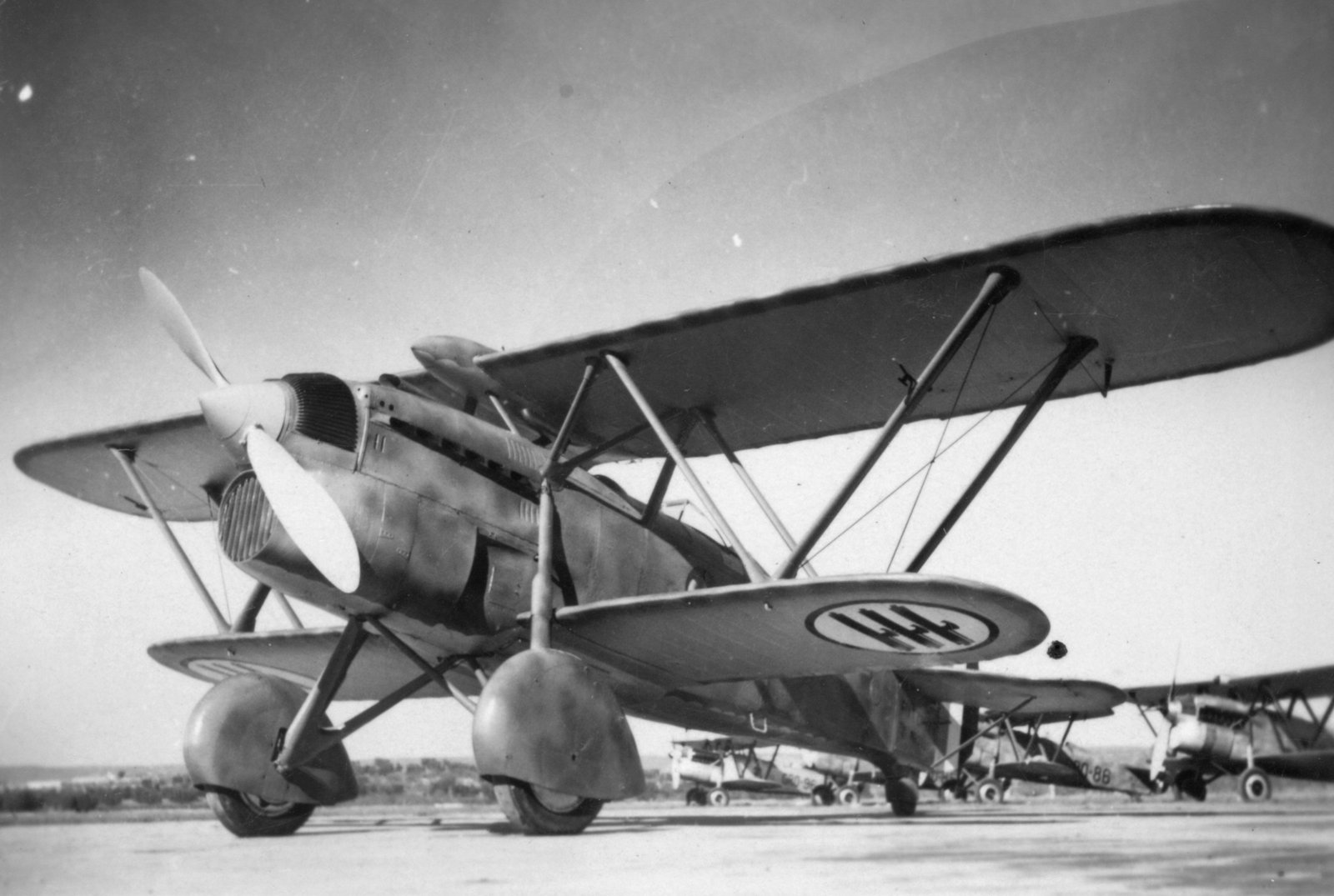
Designed by aeronautical engineer Celestino Rosatelli—whose initials provided the "CR" designation—the Fiat CR.32 was a single-seat biplane fighter developed in the early 1930s. The prototype first flew in April 1933, and the aircraft entered Italian service in 1934. Its design focused on agility and ruggedness, utilizing a light-alloy structure with fabric covering and a fixed, spatted undercarriage that allowed the aircraft to operate from rough airfields, making it ideal for colonial and expeditionary missions.
Production began in Italy between 1933 and 1934 and continued through the late 1930s. While production totals vary, records indicate at least 1,150 to 1,200 airframes were built in Italy, with an official total often cited as 1,178. Additionally, approximately 100 aircraft were license-built in Spain as the Hispano HA-132-L "Chirri" between 1939 and 1942. The aircraft was powered by the Fiat A.30 R.A., a liquid-cooled, 12-cylinder V-type piston engine producing approximately 600 hp (447 kW).
Technically, the CR.32 was characterized by its compact airframe and high maneuverability. Early versions were armed with two 7.7 mm Breda-SAFAT machine guns, while later variants (bis, ter, and quater) were up-gunned to 12.7 mm Breda-SAFATs and could carry light bombs for fighter-bomber roles. Typical performance figures included a maximum speed of roughly 360 km/h, a range of 780 km, and a service ceiling of 8,800 m.
In military service, the CR.32 was a cornerstone of the Regia Aeronautica, representing two-thirds of Italy's fighter strength by May 1939. It saw extensive combat in the Spanish Civil War, where it helped Nationalist forces achieve air superiority over Soviet-supplied Polikarpov fighters. Other operators included Nationalist China, Hungary, Austria, Venezuela, and Paraguay. During the Second World War, it served in North Africa, East Africa, Albania, and the Mediterranean. In Spain, the license-built Chirri variants remained in service as aerobatic trainers until 1953.
Today, the CR.32's legacy survives through a few static museum pieces. At least four aircraft are documented: two original Italian-built examples and two Spanish-built HA-132-L variants, with the latter preserved at the Museo del Aire in Cuatro Vientos, Madrid. There are no known airworthy examples remaining.