
Design and Development
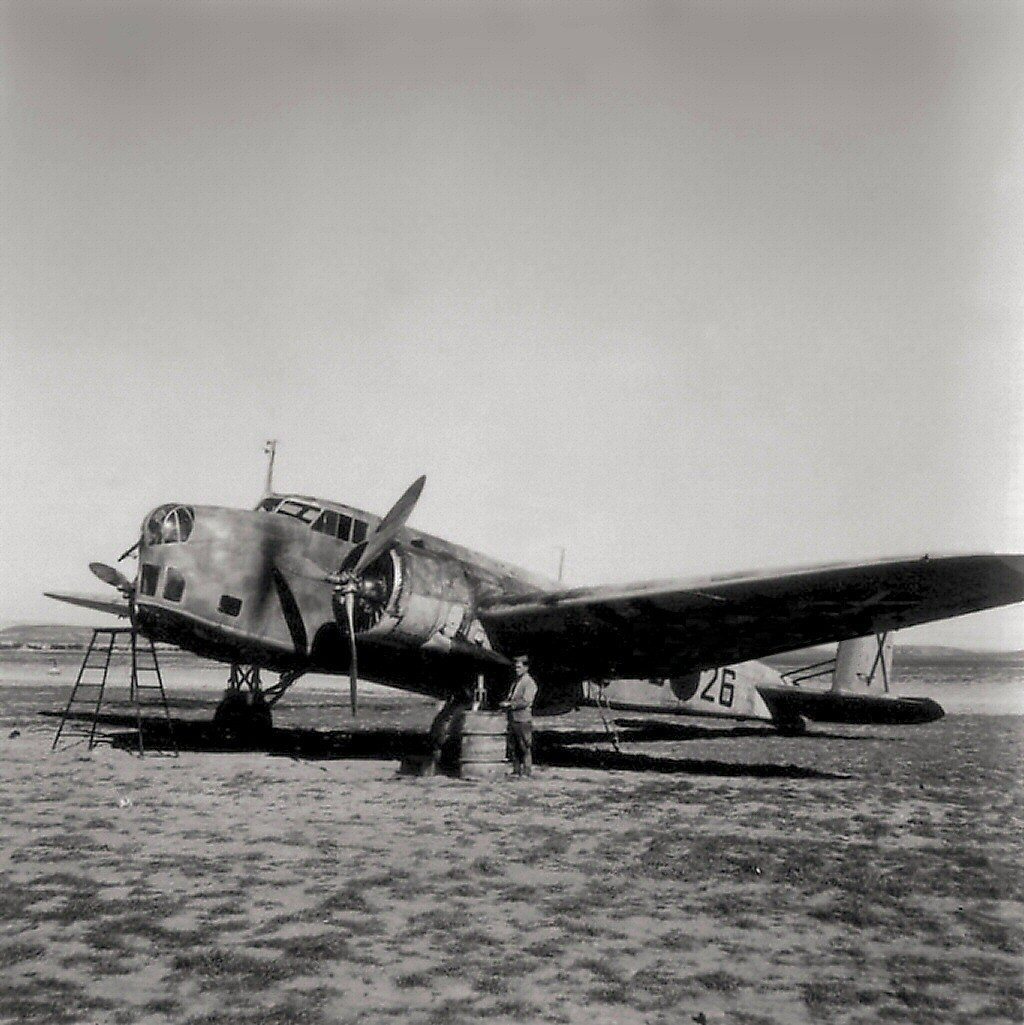
The Fiat BR.20, known as the "Cicogna" (Stork), was designed by Celestino Rosatelli, the chief designer at Fiat Aviazione who also developed the CR-series fighters. The aircraft was a departure from previous Italian bomber designs, being the nation's first all-metal, low-wing, twin-engine monoplane produced in quantity. It featured a clean aerodynamic profile, enclosed crew positions, and retractable landing gear. Notably, the BR.20 moved away from external bomb racks in favor of an internal bomb bay capable of carrying up to 1,600 kg of ordnance.
The prototype, designated MM.274, made its maiden flight on February 10, 1936, piloted by Enrico Rolandi. By September 1936, the aircraft had entered operational service with the 13° Stormo Bombardamento Terrestre. Initial design requirements specified a range of at least 1,000 km with a 1,200 kg bomb load, and speeds of 330 km/h at 4,500 m and 385 km/h at 5,000 m.
Production and Manufacturer
Production took place at Fiat's aircraft works in Turin, Italy. The production span ran from approximately 1936 to 1942. According to archival records, 233 original BR.20s and 279 improved BR.20M variants were built, totaling at least 512 aircraft, with a small number of additional BR.20Bis and experimental versions produced. The aircraft was powered by two Fiat A.80 RC.41 18-cylinder, air-cooled radial piston engines, each producing roughly 1,030 hp and driving Hamilton Standard variable-pitch propellers.
Military Service
The BR.20 saw extensive combat across three continents. During the Spanish Civil War, the Aviazione Legionaria deployed 13 aircraft for high-altitude bombing and photo-reconnaissance, particularly during the 1938 Battle of the Ebro. Following the conflict, nine surviving aircraft were transferred to the Spanish Air Force. In Asia, the Imperial Japanese Army Air Service purchased 82 units, designating them the Army Type I Heavy Bomber. These were operated by the 12th and 98th Sentai for long-range strategic strikes in China from bases in Manchukuo.
During World War II, the BR.20M served in the Battle of Britain in October 1940, with the 13° and 43° Stormo deployed to Belgium as part of the Corpo Aereo Italiano. The type also operated in North Africa for maritime patrol and medium bombing, and on the Eastern Front from August 1942 to April 1943. By the September 1943 armistice, only 67 aircraft remained, used primarily for training and maritime patrol. The final BR.20 in Italian service was retired on June 7, 1946.
Legacy
While the BR.20 was state-of-the-art upon its introduction, it was quickly surpassed by newer Allied and German designs. No complete airframes are known to survive today, leaving the aircraft as a subject of archival research. The manufacturer's aero-engine lineage continues through Avio Aero, a GE Aerospace company based in Turin.