
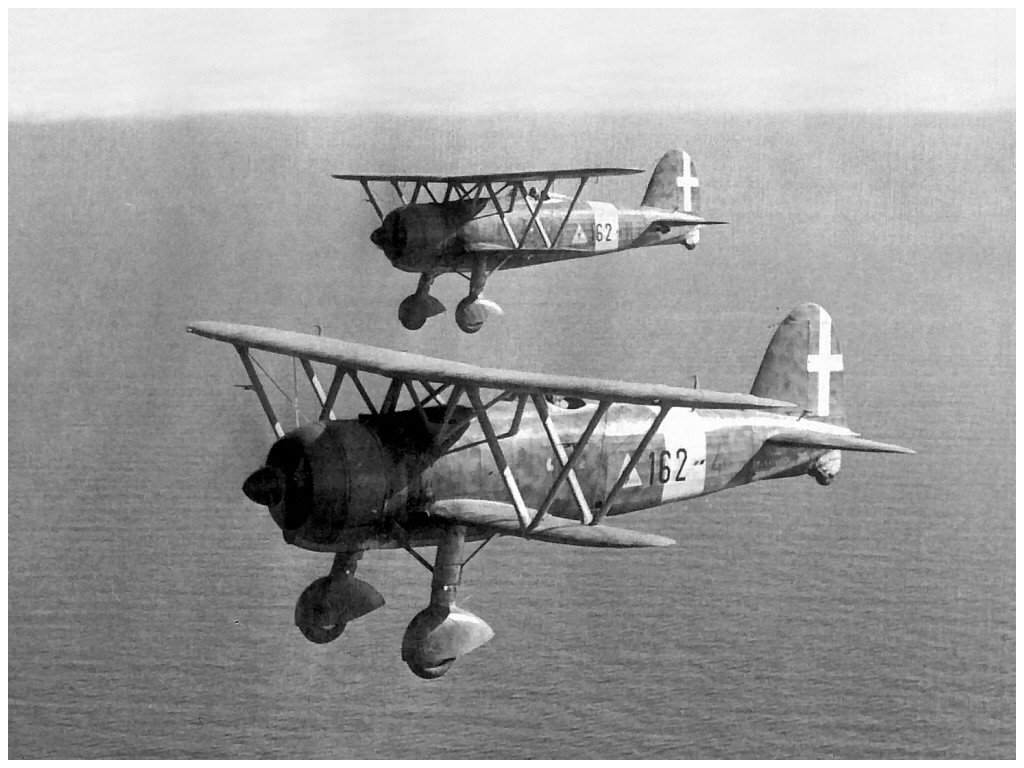
The Fiat CR.42 Falco was a single-seat sesquiplane fighter developed by Fiat Aviazione as an advanced derivative of the earlier CR.32. Designed under the leadership of Celestino Rosatelli, the aircraft represented the final evolution of Fiat's successful CR biplane series. The prototype first flew on May 23, 1938, and the type was officially adopted by the Regia Aeronautica in May 1939. Construction featured a mixed approach, utilizing a welded steel-tube fuselage with metal skinning forward and fabric covering aft, while the wings were composed of steel and duralumin with fabric skins.
Production took place at Fiat's aviation facilities in the Turin area from 1939 until the collapse of Fascist Italy in 1943. Total production is estimated between 1,800 and 1,819 aircraft, making it the most numerous Italian fighter of the war. The Falco was powered by a Fiat A.74 RC38 14-cylinder, air-cooled radial piston engine, which enabled a maximum altitude speed of approximately 441 km/h (274 mph). While considered obsolete by some before its debut, the CR.42 was praised as the best biplane in service in 1940 due to its exceptional agility at low to medium altitudes.
Combat operations began not with Italy, but with the Belgian Air Force, which operated 30 export models during the German invasion starting May 10, 1940. The Regia Aeronautica deployed the type during the Battle of France in the summer of 1940 and later as part of the Corpo Aereo Italiano (CAI) in Belgium during October and November 1940. Throughout World War II, the CR.42 served across the Mediterranean, North Africa, East Africa, and the Middle East, operating in regions ranging from Greece and Libya to Ethiopia and Iraq. Beyond Italy, the aircraft was operated by the Royal Hungarian Air Force, the Air Force of the Independent State of Croatia, Spain, and Sweden (where it was designated J 11).
As monoplanes like the Macchi C.202 and Fiat G.50 took over front-line duties by 1942, the CR.42 was adapted for specialized roles. The CR.42CN served as a night fighter, while the CR.42AS was utilized for close-support and ground-attack missions. Following the 1943 armistice, the Italian Co-Belligerent Air Force continued using the CR.42AS. Additionally, the Luftwaffe employed captured units for anti-partisan missions and night harassment raids. Today, only four airframes are known to survive, including a captured example (BT474) at the Royal Air Force Museum and a reconstructed aircraft at the Museo Storico dell’Aeronautica Militare.