
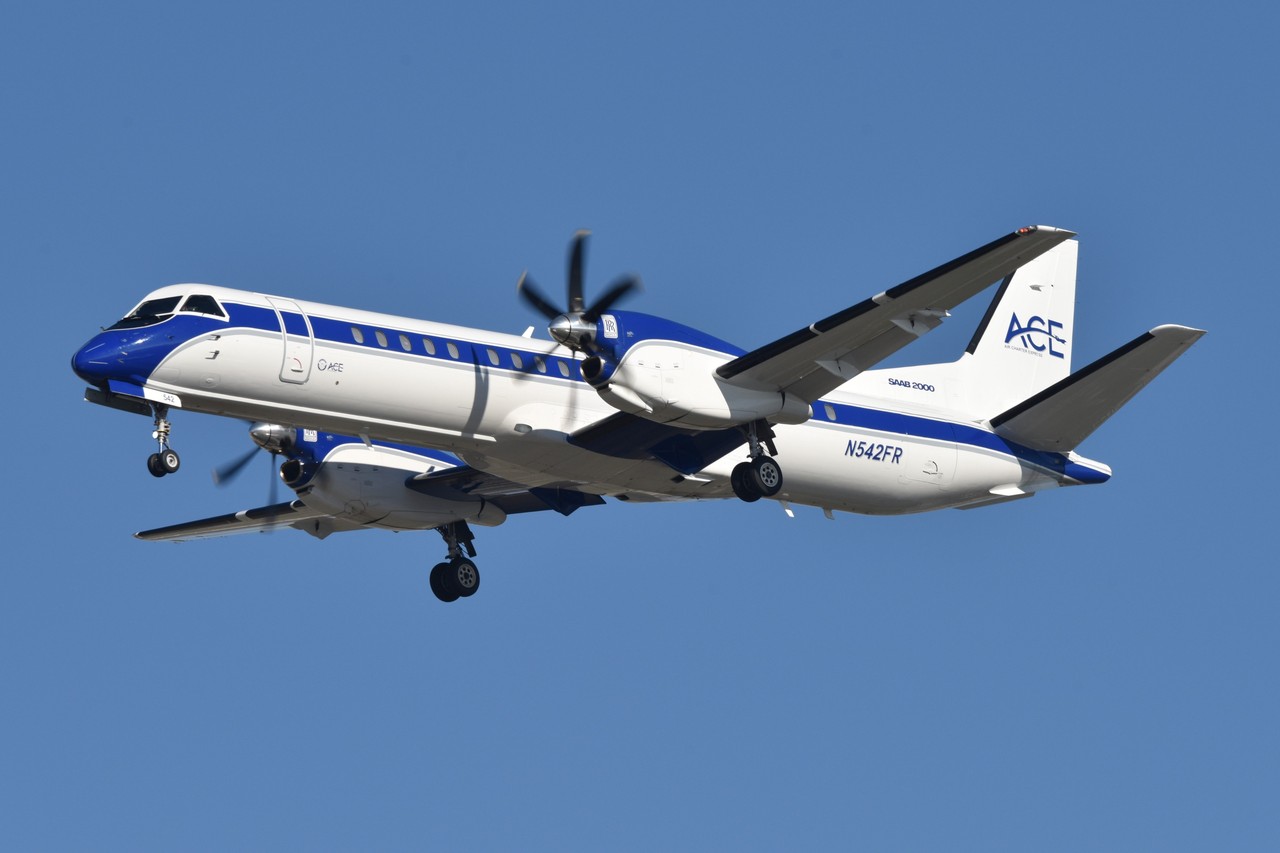
Service History
The SAAB 2000 entered scheduled airline service in September 1994 with Swiss carrier Crossair, which became the type's largest operator and ultimately received the final delivery on April 29, 1999. Despite achieving its design goals of jet-like performance with turboprop economics, the aircraft faced a rapidly changing market where regional airlines increasingly preferred pure jets like the Bombardier CRJ and Embraer ERJ 145 family for their superior passenger appeal and route flexibility.
With only 63 aircraft produced over seven years, the SAAB 2000 found diverse operators including Air Marshall Islands, which served remote Pacific routes between 1995 and 1998, and Air Vanuatu, which leased aircraft for Fiji-Vanuatu services until March 1999. The type also attracted corporate users, with General Motors purchasing several aircraft as executive shuttles, while NASCAR teams discovered second-hand SAAB 2000s offered an economical alternative to chartered jets for transporting racing crews.
The Manufacturer
SAAB's commercial aviation journey began in the early 1970s when the Swedish company, famous for military jets and automobiles, partnered with American manufacturer Fairchild to develop the Saab-Fairchild 340. After Fairchild exited aviation in 1985 following production of 40 aircraft, SAAB continued alone and achieved considerable success with the 340, ultimately building over 400 examples. This success prompted the company to launch the SAAB 2000 project in May 1989 with firm orders for 46 aircraft and options for 147 more.
The SAAB 2000 was manufactured at the company's Linköping factory in southern Sweden, with major subcontractors including Spain's CASA for wings, Northern Ireland's Short Brothers for the rear fuselage, and Finland's Valmet for tail surfaces. This international collaboration reflected SAAB's strategy of leveraging European aerospace expertise while maintaining final assembly in Sweden.
Engine & Technical Innovation
The SAAB 2000 pioneered the civil use of Allison AE-2100A turboprops, powerful engines originally developed for the V-22 Osprey military tiltrotor. Each engine produced 4,125 shaft horsepower, driving six-bladed Dowty propellers that enabled the aircraft to cruise at 370 knots – speeds approaching those of contemporary regional jets. The engines were mounted further from the fuselage than on the smaller SAAB 340, reducing cabin noise transmission.
Most innovative was the aircraft's active noise control system, featuring 72 strategically placed microphones and 36 speakers that generated anti-phase sound waves to cancel engine noise. This technology, advanced for the early 1990s, significantly improved passenger comfort compared to conventional turboprops. The cockpit featured Rockwell Collins Pro Line 4 avionics operated by a two-pilot crew.
Performance & Pilot Perspective
The SAAB 2000 delivered impressive performance statistics that validated its design philosophy. With a service ceiling of 31,000 feet and initial climb rate exceeding 2,300 feet per minute, it could operate above weather and traffic congestion like jet aircraft while consuming significantly less fuel. The aircraft's maximum takeoff weight of 21,320 kilograms supported ranges up to 1,549 nautical miles with full passenger loads.
Pilots praised the aircraft's jet-like handling characteristics and powerful engines, which provided excellent single-engine performance and short-field capabilities with takeoff distances of just 1,500 meters. The high cruise speeds meant block times competitive with regional jets on routes under 500 nautical miles, while the 1×2 cabin seating with 32-inch pitch offered passenger comfort superior to many competitors.
Production & Legacy
Production ceased in 1999 after just 63 aircraft due to market preference for regional jets, despite the SAAB 2000's superior fuel efficiency and operating economics. The timing proved unfortunate, as the aircraft entered service just as the regional airline industry was transitioning toward jet equipment that passengers and airlines perceived as more modern and prestigious.
Today, the SAAB 2000 enjoys a second life in specialized roles. As of October 2024, 31 aircraft remain in service with various operators including cargo airlines that appreciate the type's large cabin volume and payload capacity. The first freighter conversion, designated SAAB 2000(F), completed test flights in March 2023, demonstrating the design's adaptability. Several aircraft continue flying with European operators like NyxAir and Frost Air, while others serve corporate and government roles.
The SAAB 2000's legacy lies in its technological innovations, particularly the active noise control system that influenced future turboprop designs, and its demonstration that turboprops could match jet performance while maintaining superior fuel efficiency – a lesson increasingly relevant in today's environmentally conscious aviation industry.