
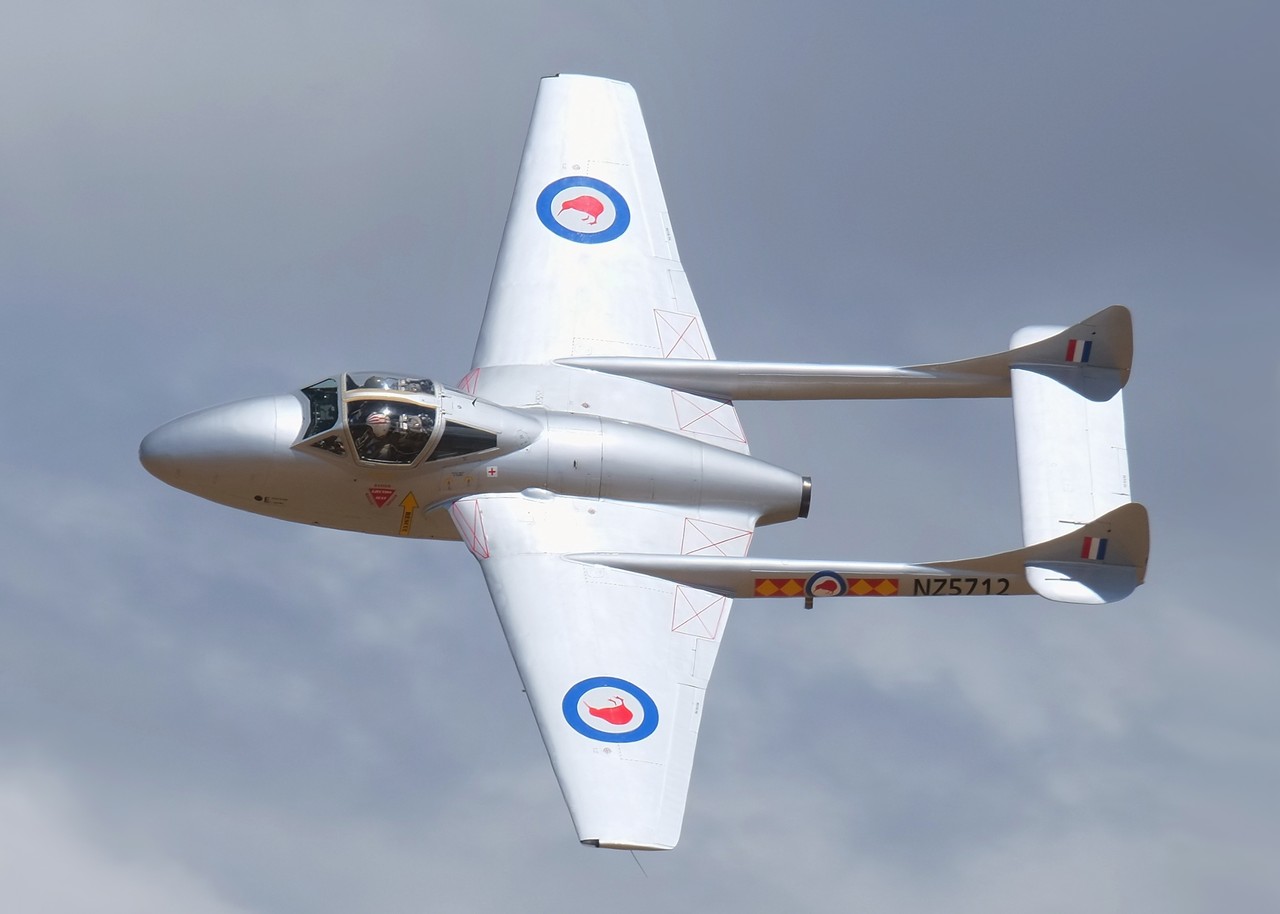
Revolutionary Design and Development
The Vampire emerged from a 1942 Ministry of Aircraft Production requirement for a new jet fighter, originally designated under Specification E.6/41. Development began in May 1942 at de Havilland's Hatfield facility, where engineers created an innovative twin-boom configuration that maximized the effectiveness of the compact Goblin turbojet engine. The prototype, initially codenamed "Spider Crab," exploited de Havilland's expertise in molded plywood construction developed for the famous Mosquito bomber.
Geoffrey de Havilland Jr., son of the company founder and chief test pilot, conducted the maiden flight from Hatfield Aerodrome. The aircraft demonstrated exceptional performance, easily exceeding 500 miles per hour and proving the viability of the twin-boom layout. Production authorization came on May 13, 1944, for an initial 120 aircraft, quickly expanded to 300 as the design's potential became clear.
Production Excellence
Production began with the Vampire Mk I in April 1945, manufactured primarily by English Electric Aircraft at Preston, Lancashire, rather than de Havilland's own facilities. This arrangement allowed de Havilland to focus on design development while English Electric handled mass production. Nearly 3,300 Vampires were ultimately manufactured, with approximately 825 built under license in Australia, Canada, France, Italy, and Switzerland.
Fairey Aviation at Manchester Airport produced the trainer variants, with deliveries beginning in January 1952. The Commonwealth Aircraft Corporation in Australia built 80 fighters and fighter-bombers between 1949 and 1953, while France produced 250 Mistral variants powered by French Hispano-Suiza engines. This international production network made the Vampire one of the most widely manufactured early jet fighters.
Military Service and Combat Operations
The Vampire entered RAF service in June 1946 as Britain's second operational jet fighter, following the Gloster Meteor. More than 15 countries operated the type, making it a cornerstone of early jet fighter development worldwide. The Royal Canadian Air Force received its first Vampires in 1948, marking Canada's entry into the jet age, while the Royal Australian Air Force and Navy operated trainer variants from 1952.
Combat operations proved the Vampire's effectiveness in various conflicts. British forces employed the type during the Suez Crisis and Malayan Emergency, while other operators used Vampires in the Rhodesian Bush War. The aircraft's rugged construction and reliable Goblin engine made it particularly suitable for operations in challenging environments, contributing to its widespread adoption.
Technical Innovation and Variants
The Vampire introduced several advanced features to fighter aviation, including cockpit pressurization and tricycle landing gear, technologies that many pilots experienced for the first time. The distinctive twin-boom configuration housed the jet exhaust safely away from the pilot while providing excellent structural efficiency. The cockpit and nose section used molded birch and balsa plywood, demonstrating how traditional materials could be adapted for jet-age requirements.
Major production variants included the Mk I fighter with 244 aircraft built, the F.3 with 202 examples, and the highly successful FB Mk 5 fighter-bomber that arrived in 1949 with clipped wings and underwing hardpoints for rockets and bombs. The T.11 trainer variant exceeded 600 examples, while specialized versions like the DH.113 radar-equipped night fighter explored advanced operational concepts.
The De Havilland Legacy
The de Havilland Aircraft Company, founded by Sir Geoffrey de Havilland, established itself as one of Britain's premier aircraft manufacturers through innovations like the Vampire. The company's expertise in wooden construction, gained through the Mosquito program, proved surprisingly relevant to early jet aircraft design. De Havilland continued Vampire development with derivatives including the DH.115 trainer and DH.112 Venom fighter.
The company eventually became part of the Hawker Siddeley Group before being acquired by BAE Systems, which continues operations today. This evolution reflects the consolidation of Britain's aviation industry, with de Havilland's innovative spirit living on in modern aerospace development.
Historic Achievements and Lasting Impact
In 1948, a Vampire F.3 became the first jet fighter to cross the Atlantic Ocean, completing the journey in stages and demonstrating the type's reliability and range capabilities. This achievement, along with the aircraft's introduction of jet flight to numerous air forces, established the Vampire as a pivotal aircraft in aviation history.
The type's operational longevity proved remarkable, with Swiss Air Force Vampires not retiring until the late 1980s, more than four decades after the prototype's first flight. Today, preserved examples reside in museums worldwide, including the Canadian Museum of Science and Technology, RAF Museum, and South Australian Aviation Museum, testament to the Vampire's enduring significance in aviation development.