
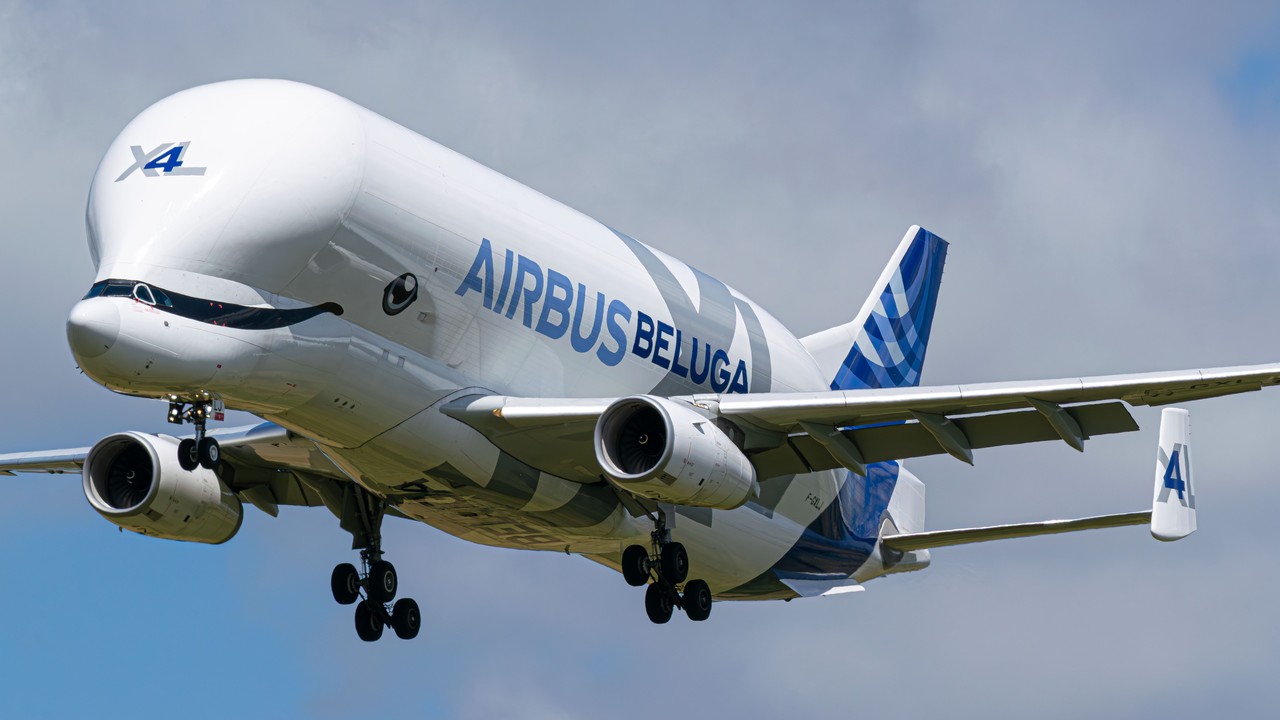
Revolutionary Cargo Operations
The Beluga XL fundamentally transformed how Airbus manufactures its commercial aircraft fleet. By 2020, all six aircraft had assumed responsibility for transporting oversized components between production sites across Europe, replacing the smaller A300-600ST Beluga fleet that had served since the 1990s. The aircraft routinely carries A350 wings from Broughton, Wales to Toulouse assembly lines, A380 fuselage sections from Hamburg, Germany, and other components that would be impossible to transport by conventional means. This internal logistics capability enabled Airbus to ramp up production of widebody aircraft without relying on external cargo carriers or complex ground transportation.
Design Innovation and Engineering
Airbus engineers faced the challenge of creating an aircraft 7 meters longer and 1 meter wider than the original Beluga while maintaining operational efficiency. The design team built upon the proven A330-200 Freighter platform, retaining the wing structure, landing gear, and flight deck while completely reimagining the upper fuselage. The resulting aircraft features a distinctive whale-like appearance with a horseshoe-shaped cargo hold measuring 12 meters wide at the nose section.
The engineering solution required lowering the cockpit position relative to the cargo deck and creating a massive hinged nose door that swings upward for loading. This configuration allows ground crews to load components up to 9 meters wide and 8 meters long into the forward cargo bay. The cargo volume exceeds that of military giants like the C-5 Galaxy and Antonov An-124, though it falls short of the massive An-225.
Manufacturing Excellence
Production began in earnest following the program launch in November 2014, with metal cutting commencing in December 2015. Airbus coordinated a complex supply chain, with rear fuselage panels manufactured by Aernnova in Berantevilla, Spain, nose sections built by Stelia Aerospace in Meaulte, France, and upper front fuselage components produced at Stelia's Rochefort facility. Final assembly occurred at the Toulouse facility, where skilled technicians integrated these specialized components with standard A330 lower fuselage sections.
The first aircraft, registration F-GXLG with manufacturer serial number 1824, rolled out on January 4, 2018, marking a significant milestone in the one billion dollar program. Each subsequent aircraft followed at carefully planned intervals, with the final delivery completed in 2024. The six aircraft bear registrations F-GXLG through F-GXLN, maintaining Airbus's systematic approach to fleet management.
Rolls-Royce Powerplant Performance
Two Rolls-Royce Trent 700 turbofan engines provide the substantial thrust required to lift the aircraft's maximum payload of 51 tons. These proven powerplants, which entered commercial service in 1994 on standard A330 aircraft, deliver approximately 72 kilonewtons of thrust each. The engine selection proved ideal for the Beluga XL's mission profile, providing reliable performance for short to medium-range flights between European production facilities while maintaining fuel efficiency during frequent cargo cycles.
The Trent 700's high-bypass design offers excellent reliability for the demanding schedule required by Airbus production timelines. With over 1,800 Trent 700 family engines produced by the 2020s, spare parts availability and maintenance expertise remain readily accessible across the Airbus route network.
Operational Capabilities
The Beluga XL cruises at Mach 0.80 with a service ceiling of 12,500 meters, matching standard A330 performance parameters despite its unconventional configuration. The aircraft typically operates on routes between 1,000 and 4,000 kilometers, perfectly suited for intra-European flights connecting Airbus facilities in France, Germany, Spain, and the United Kingdom. Flight crews consist of two pilots plus specialized loadmasters who oversee the complex cargo handling procedures.
Certification required an extensive test program totaling more than 700 flight hours across 200+ flights using the first aircraft. The European Union Aviation Safety Agency granted type certification on November 13, 2019, following comprehensive evaluation of the aircraft's unique design characteristics and operational procedures.
Current Fleet Status and Legacy
All six Beluga XL aircraft remain in active service as of 2024, operating under Airbus Transport International. The fleet successfully phased out the original Beluga aircraft by 2021, demonstrating the newer aircraft's superior efficiency and capacity. Recent flight tracking data from June 2024 confirms continued operations, with aircraft regularly spotted at major European airports supporting ongoing A350 and A380 production programs.
The Beluga XL's cultural impact extends beyond its utilitarian mission, earning recognition as the "flying whale" that captures public imagination at air shows and through social media coverage. Airbus celebrated the broader Beluga program's 30-year anniversary in 2024, highlighting how these specialized aircraft enabled the company's evolution from a European consortium to a global aerospace leader. No examples have yet entered museum collections, as the entire fleet remains essential to Airbus manufacturing operations.