
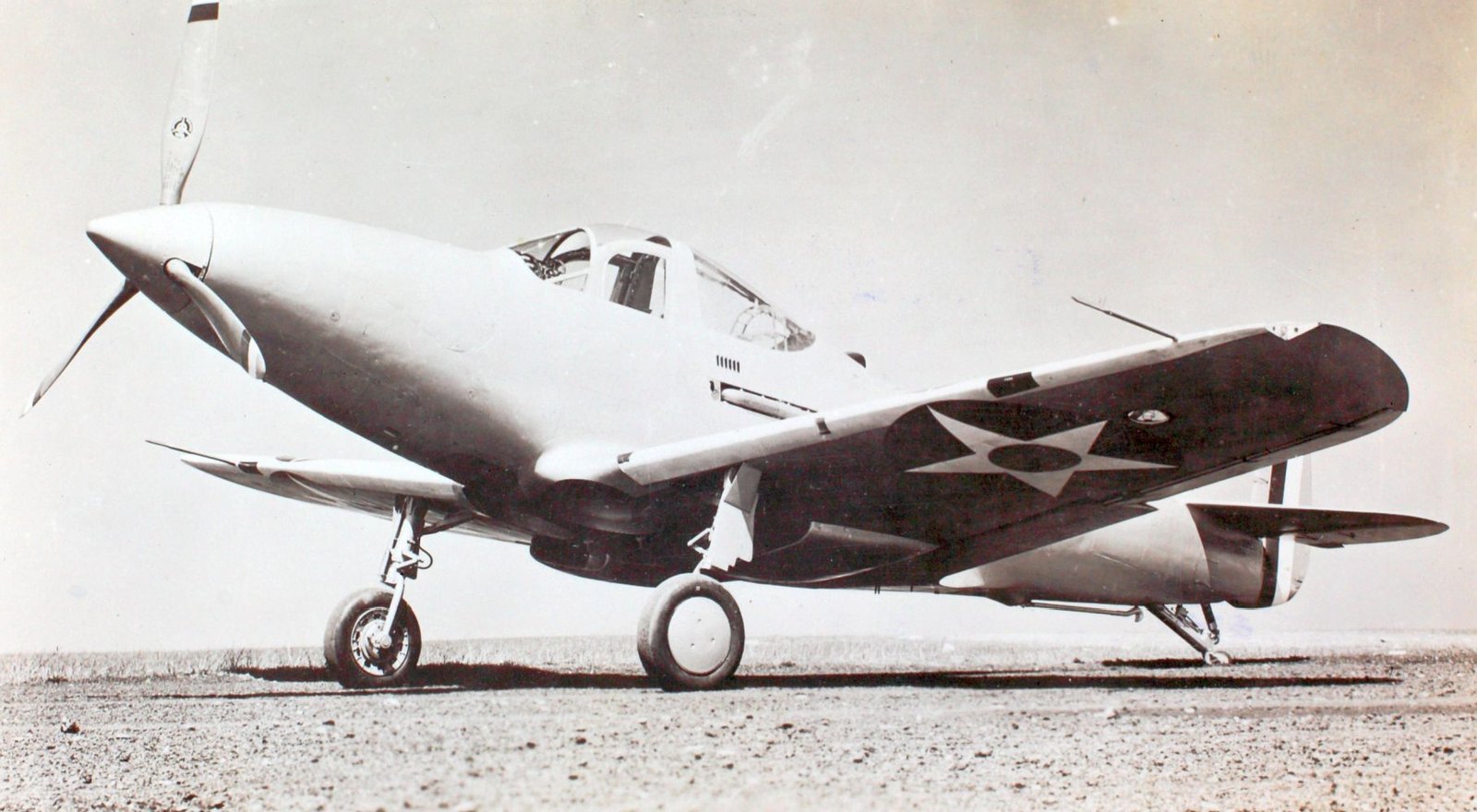
The Bell XFL-1 Airabonita was a one-off experimental fighter developed by the Bell Aircraft Corporation of Buffalo, New York, for the United States Navy. The program originated from a January 1938 Navy specification seeking a light carrier-based fighter to replace obsolete biplanes. On April 11, 1938, Bell submitted a proposal alongside Brewster, Curtiss, Grumman, and Vought-Sikorsky. Bell was awarded a prototype contract on November 8, 1938, leading to the construction of a single aircraft.
Designed as a navalized derivative of the XP-39/P-39 Airacobra, the XFL-1 utilized an unconventional mid-fuselage engine layout, with the powerplant situated behind the pilot and driving the propeller via a long shaft. To adapt the land-based design for carrier operations, Bell replaced the Airacobra's tricycle landing gear with a retractable tailwheel undercarriage. Additionally, the coolant radiators were moved to external fairings under the wings. The aircraft was powered by a single liquid-cooled V-12 Allison XV-1710-6 engine, produced by the Allison Division of General Motors, which delivered 1,150 horsepower. Notably, this engine lacked the turbo-supercharger found in early XP-39s, which limited its high-altitude performance.
The XFL-1 first flew on May 13, 1940. Its armament was concentrated in the nose, featuring provision for either a 37 mm Oldsmobile T9 cannon or a 0.50 in Browning M2 machine gun firing through the propeller hub, supported by two 0.30 in nose machine guns. Technical specifications recorded a maximum speed of 336 mph at 11,000 feet, a service ceiling of 30,900 feet, and a maximum range of 1,072 miles.
Official Navy flight evaluations began in July 1940. Despite its innovative design, the XFL-1 was never certified for carrier operations due to persistent issues with its main landing gear. After further modifications and a return to NAS Anacostia on February 27, 1941, the Navy concluded the aircraft failed to meet performance requirements. Consequently, no production order was placed, and the Navy instead selected the Vought XF4U-1 Corsair. In February 1942, the sole prototype was transferred to the Aircraft Armament Unit at NAS Patuxent River for testing before being grounded and eventually destroyed. No examples of the XFL-1 survive today.