
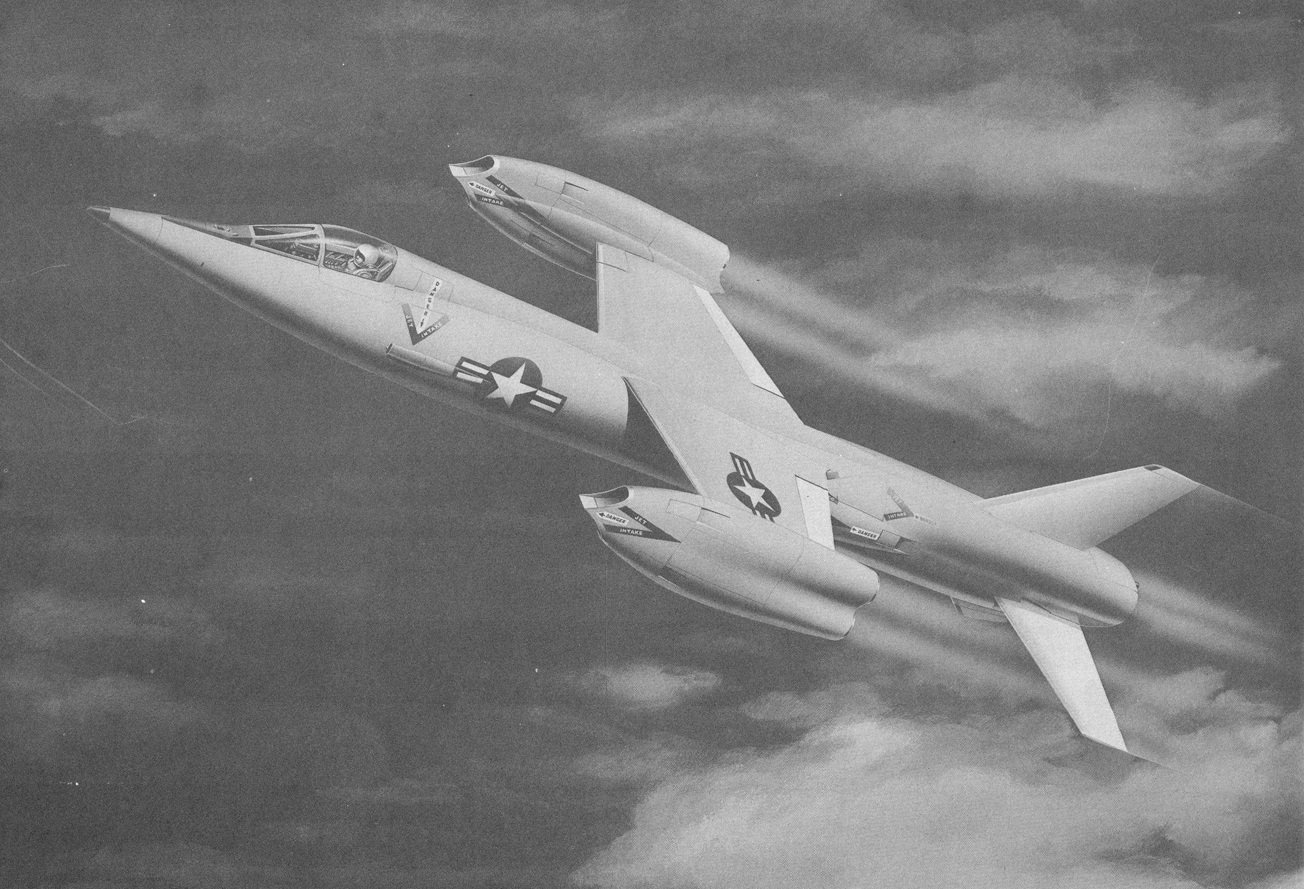
The Bell D-188A was a conceptual supersonic VTOL fighter-interceptor developed by the Bell Aircraft Corporation. Designed during the Cold War, the project sought to address the strategic need for dispersing airpower to reduce runway vulnerability by combining vertical takeoff and landing (VTOL) capabilities with high-speed interceptor performance. The aircraft was intended to serve as an all-weather interceptor, fighter-bomber, or air-defense aircraft for both the U.S. Air Force and the U.S. Navy. While the project was internally known as Model 2000, it was also associated with the unofficial military designations XF-109 and XF3L.
Technically, the D-188A was one of the most radical VTOL proposals of its era. The design called for a single-seat cockpit and a sharply pointed nose, with an armament suite consisting of two or four 20 mm cannons, an internal weapons bay, and eight wing hardpoints. To achieve its performance goals, Bell planned for the aircraft to reach speeds exceeding Mach 2. The propulsion system was particularly complex, utilizing eight General Electric J85-GE-5 turbojets arranged in a specific configuration: four engines were housed in rotating wingtip pods, two were located in the rear fuselage, and two were positioned behind the cockpit to provide the necessary vertical lift.
Despite the ambition of the design, the D-188A never progressed to a flying prototype. Bell collaborated with Convair on a joint weapon system management team for the Air Force version of the project, but the aircraft only reached the full-scale mock-up stage. The program was officially canceled in 1961. Because no flyable aircraft were ever produced, there is no record of a first flight or operational service history. The legacy of the D-188A remains as a testament to the extreme engineering explorations of the period, serving as a precursor to more practical VTOL developments like the Harrier. The original manufacturer, Bell Aircraft Corporation, which was founded in 1935, continues to operate today as Bell Textron, Inc.