
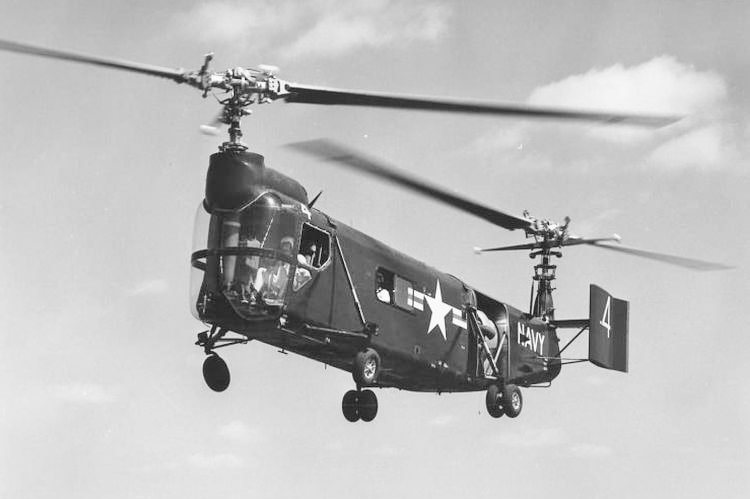
The Bell HSL, designated as the Model 61 by the manufacturer and HSL-1 by the United States Navy, was a specialized anti-submarine warfare (ASW) helicopter developed during the early Cold War. Designed to counter the expansion of the Soviet submarine fleet, the HSL-1 was the first helicopter specifically engineered for the ASW role for the U.S. Navy. The project began in June 1950 after Bell won a Navy competition, and the prototype, designated the XHSL-1, completed its first flight on 3 March 1953.
Technically, the HSL-1 was a departure from Bell's typical design philosophy, serving as the company's only tandem-rotor helicopter. It featured a rectangular-section fuselage and a specialized four-leg, six-wheel landing gear system designed to handle heavy loads and provide stability during shipboard operations. The aircraft was powered by a single Pratt & Whitney R-2800-50 air-cooled, 18-cylinder radial piston engine mounted in the aft fuselage, which produced 2,400 shaft horsepower to drive the two rotors via a transmission system.
Designed for a crew of four—consisting of a pilot, copilot, and two sonar operators—the HSL-1 was equipped with dipping sonar for submarine detection. For attack missions, the crew was reduced to three, and the aircraft could be armed with missiles or two Mark 43 torpedoes. Performance figures varied by mission profile; it reached a maximum speed of 124 mph and a cruising speed between 96 and 98 mph. Its range was cited at 350 miles, while its combat range was approximately 120 nautical miles, with a loiter time of 3 hours and 30 minutes during search operations.
Despite initial contracts for at least 160 aircraft—including 18 intended for the British Royal Navy—technical issues and development delays severely hampered the program. Only 50 aircraft were completed and delivered before the U.S. Navy officially terminated production in July 1955. The HSL-1 never entered full operational service; instead, a small group of approximately seven aircraft were utilized by the U.S. Naval Air Mine Defense Unit in Panama City, Florida, for airborne mine sweeping development starting in September 1956. The final aircraft were struck from records by early 1960. No examples of the HSL-1 are known to have survived to the present day.