
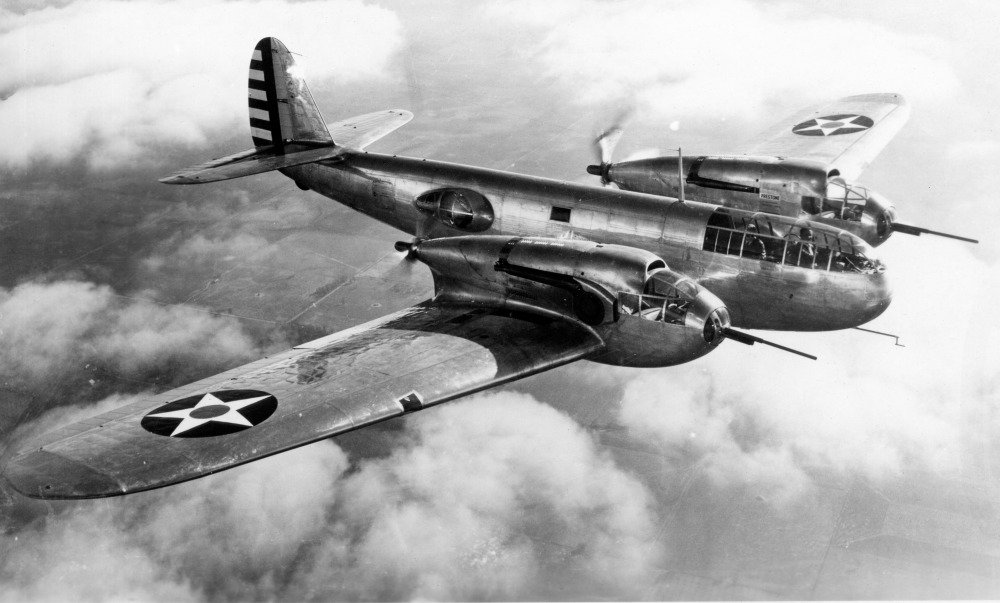
The Bell YFM-1 Airacuda (Bell Model 1) was a pioneering but ultimately unsuccessful heavy fighter developed in the late 1930s. Conceived as a "bomber destroyer," the aircraft was intended to engage enemy bomber formations from a distance, reflecting a pre-war aviation trend toward long-range, heavily armed interceptors similar to the German Bf 110 and French Potez 630. The prototype, designated XFM-1, made its first flight on September 1, 1937. A total of 13 aircraft—consisting of one prototype and 12 production units—were manufactured between 1937 and 1939 at the Bell Aircraft Corporation plant in Buffalo, New York.
The Airacuda's design was highly unconventional. It utilized twin pusher-propeller engine nacelles mounted on the wing leading edges. Each nacelle featured a manned compartment at the front, where a gunner operated a 37 mm M4 cannon. While innovative, this arrangement created significant safety and egress concerns. To support its advanced electrical systems and gyro-stabilized fire-control for the cannons, the aircraft was equipped with a 13.5 hp, 2-cylinder, four-cycle piston auxiliary power unit (APU) located in the forward fuselage belly to drive a generator.
Power was provided by Allison V-1710 series liquid-cooled, supercharged V-12 piston engines. The standard YFM-1 configuration used V-1710-9 engines producing 1,090 hp each, while two airframes were converted to YFM-1B specifications using V-1710-41 engines without turbo-superchargers. The aircraft's crew of five included a pilot, co-pilot/navigator, radio operator/gunner, and two cannon gunners.
Operated exclusively by the United States Army Air Corps (USAAC), the Airacuda never saw combat. A single squadron was equipped with the type between 1938 and 1940, with the aircraft officially introduced into limited service on February 23, 1940. However, technical problems and obsolescence led to its early withdrawal. Several aircraft were lost in accidents, with only one fatality recorded. By January 1942, the remaining nine airworthy aircraft were dispersed to training schools for instructional use. All surviving examples were scrapped by 1942, and no aircraft survive today.