
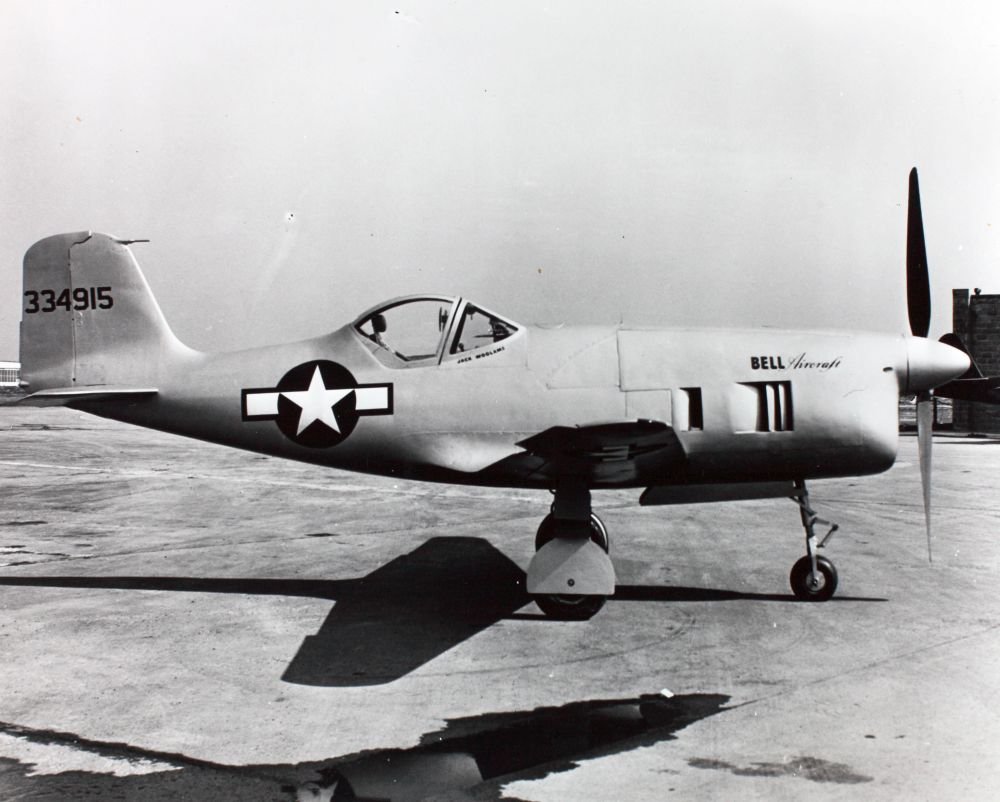
The Bell XP-77 was an experimental project conceived by the Bell Aircraft Corporation to provide the United States Army Air Forces (USAAF) with a small, simple, and lightweight interceptor. The aircraft was specifically designed for point-defense roles, intended to intercept bombers attacking critical installations such as command centers or airbases. To reduce the consumption of critical war materials like aluminum, the XP-77 was constructed using non-strategic materials, most notably wood, making it the only wooden fighter ever built for the USAAF.
Originally authorized on May 16, 1942, under the Tri-4 concept, the program initially called for 25 aircraft. However, due to the unavailability of the intended supercharged engine, the order was reduced to six prototypes and two static test airframes. The aircraft featured a distinctive configuration, combining a very small airframe with tricycle landing gear and a rear-mounted cockpit. The design was executed by a Bell design team during the company's wartime fighter development efforts.
Power was provided by a Ranger V-770-7 (or XV-770-7) inverted V-12 piston engine, which produced 520 hp. Because the planned supercharger was delayed, the prototypes utilized a normally aspirated version of the engine, which significantly hindered the aircraft's performance. The first prototype took its maiden flight on April 1, 1944, at Wright Field, with Jack Woolams serving as the test pilot.
Performance specifications for the XP-77 included a maximum speed of 330 mph at 4,000 feet under war emergency conditions and a cruising speed of 274 mph. It had a service ceiling of 30,100 feet and a rate of climb between 3,600 and 3,630 feet per minute. The aircraft measured 22 feet 10 inches in length with a wingspan of 27 feet 6 inches and a height of 8 feet 2 inches. Its empty weight was 2,855 lb, with a maximum takeoff weight of 4,028 lb and a range varying between 305 and 550 miles.
Only two flying prototypes were completed at Bell's production facilities in Wheatfield, New York. The program never reached operational status or saw combat use. On October 22, 1944, the second prototype crashed at Eglin Field, Florida, after entering an inverted spin; the pilot survived by bailing out. Due to disappointing performance and a shift in wartime material availability, the USAAF canceled the contract on December 2, 1944. One surviving XP-77 is currently held at the National Museum of the U.S. Air Force in Dayton, Ohio.