
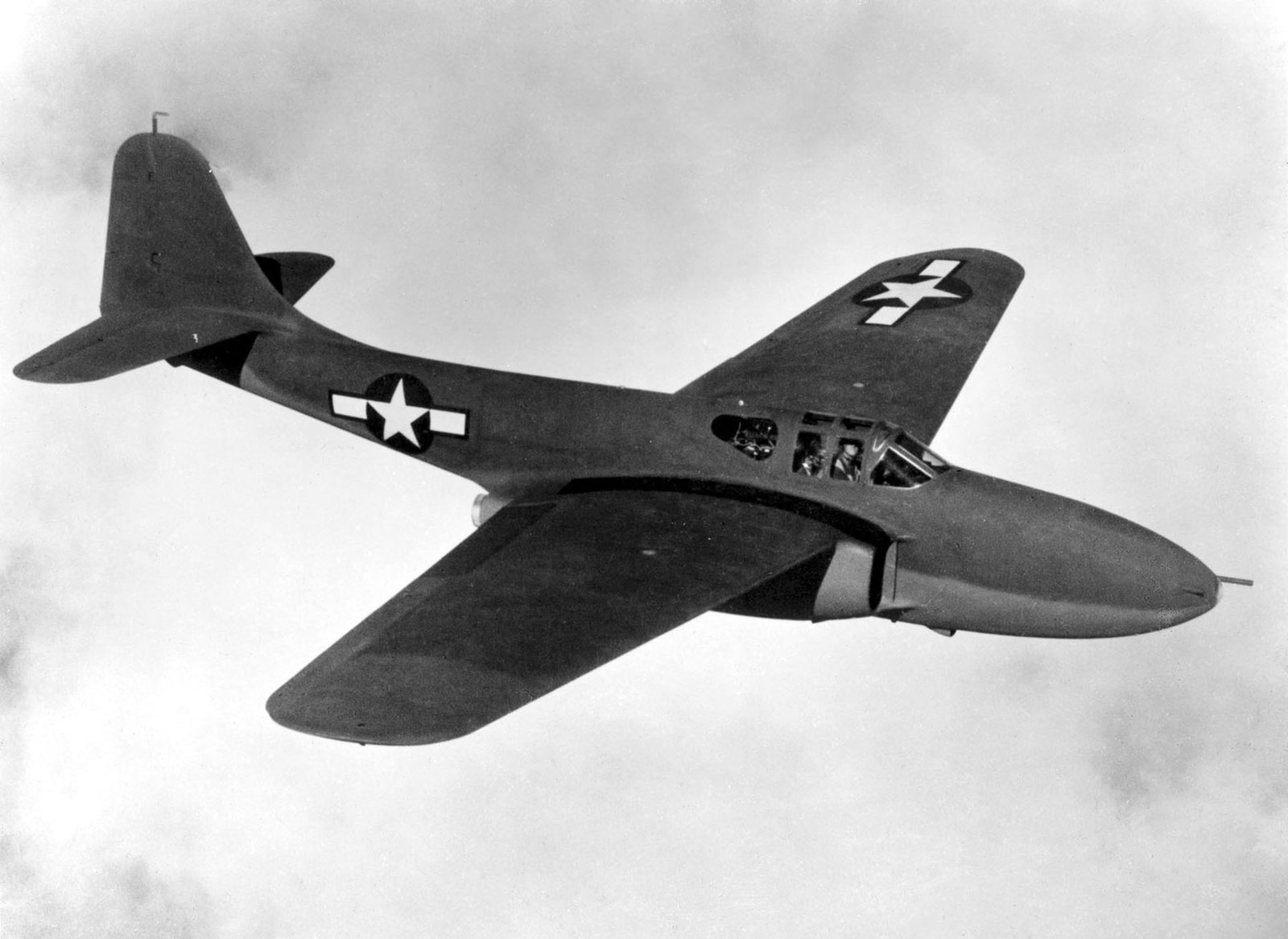
The Bell P-59 Airacomet was the first jet aircraft produced in the United States, emerging from a highly secret "black" program designated MX-397. Assigned by General H. H. “Hap” Arnold to the Bell Aircraft Corporation, the project was initially known only to a small inner circle, including company president Lawrence “Larry” Bell. The aircraft's development was centered at Bell's Wheatfield, New York plant, a major production facility near Niagara Falls.
The P-59's maiden flight occurred on October 1, 1942, at Muroc Dry Lake, California, piloted by Robert Morris Stanley. The following day, Colonel Laurence C. Craigie conducted the official first flight, reaching an altitude of 10,000 feet. The design utilized turbojet propulsion based on the British Whittle W.1 design. Early XP-59A prototypes were powered by two General Electric Type I-A centrifugal-flow turbojets, each producing 1,250 lbf of thrust. Production models (P-59A and P-59B) utilized the General Electric J31 (Army designation I-16), the first U.S.-produced turbojet to enter service, providing approximately 1,600 to 2,000 lbf of thrust per engine.
Production spanned from 1943 to 1945, with a total of 66 aircraft built: three XP-59A prototypes, 13 YP-59A service-test aircraft, 20 P-59A production fighters, and 30 P-59B production fighters. The aircraft featured a tricycle retractable landing gear, a length of 11.6 meters, and a wingspan of 13.4 meters. While designed as a fighter with a planned armament of one 37 mm cannon and three 0.50-cal machine guns, it was outperformed in mock combat by contemporary piston fighters such as the P-38, P-47, and the Mitsubishi A6M Zero. Consequently, the USAAF determined the P-59 offered no appreciable advantage over piston aircraft, leading to a reduction in the original order.
Though it never saw combat during World War II, the P-59 was invaluable for training and testing. The 412th Fighter Group at Muroc Army Air Field, including the 29th, 31st, and 445th Fighter Squadrons, used the aircraft to introduce pilots to jet handling. The U.S. Navy also operated a small number of P-59s, providing early jet experience to future admirals such as Frederick Trapnell and Paul Ramsey. Additionally, the Royal Air Force received one P-59 (RJ362/G) in exchange for a Gloster Meteor I (EE210/G) for evaluation purposes.
The legacy of the Airacomet lies in its role as a technology demonstrator. The knowledge gained regarding high-speed aerodynamics and jet systems directly informed the development of the Lockheed P-80 Shooting Star. Today, only about six P-59 series aircraft survive as static museum exhibits, including the first XP-59A at the Smithsonian National Air and Space Museum and a P-59A at the March Field Air Museum.