
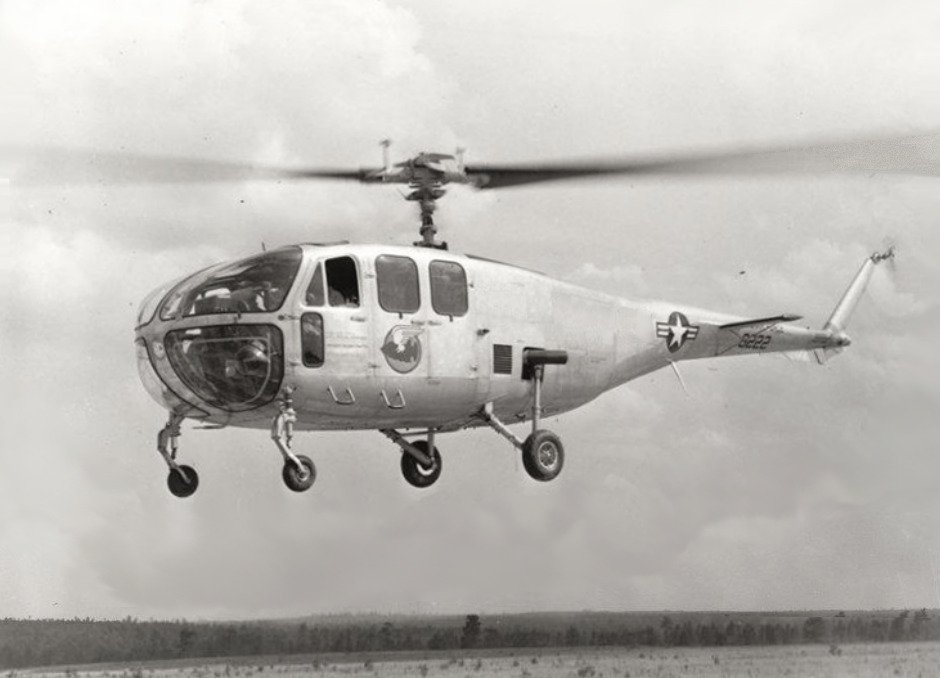
The Bell H-12, originally designated as the R-12 and known internally as company Model 48, was an American military utility helicopter developed by Bell Aircraft Corporation in the mid-1940s. Evolving from the civilian Model 42 concept, which was itself a scaled-up version of the successful Model 47, the H-12 was designed to provide significantly greater lift and passenger capacity than contemporary rotorcraft. The aircraft featured a single main rotor with a tail rotor and a large, fully enclosed cabin with a glazed nose, capable of transporting between five and ten occupants depending on the variant.
Production was centered at Bell's helicopter operations in the Buffalo, Gardenville, and Niagara Falls region of New York. The program began with two XR-12 prototypes, followed by an enlarged XR-12B (Model 48A) and a pre-production batch of ten YR-12B aircraft, each costing approximately US$175,000. While the U.S. Army had initially ordered 34 production R-12A helicopters, this order was cancelled in 1947. Consequently, approximately 13 aircraft were completed in total, none of which entered full series production.
Technical development focused on increasing power and load capacity. The initial XR-12 utilized a Pratt & Whitney R-1340 air-cooled radial piston engine producing between 540 and 550 horsepower. To improve performance for the XR-12B and YR-12B, Bell installed a more powerful 600 hp engine. Despite these upgrades, the program was plagued by rotor blade reliability issues and performance shortfalls when loaded to capacity. These technical hurdles led the U.S. military to abandon the type in the early 1950s in favor of other designs, such as the Sikorsky S-51.
Although the H-12 never saw operational combat or civil service, it left a lasting legacy. It served as a vital testbed for rotor-system research and influenced international aviation; a surviving YH-12B provided the design inspiration for the Italian Agusta AB-102. One YH-12B, nicknamed "Fat Boy," is currently preserved and undergoing restoration at the Lawrence D. Bell Aircraft Museum in Indiana. The H-12 is regarded as a transitional design that helped Bell evolve from small early machines toward the eventual development of the UH-1 Huey.