
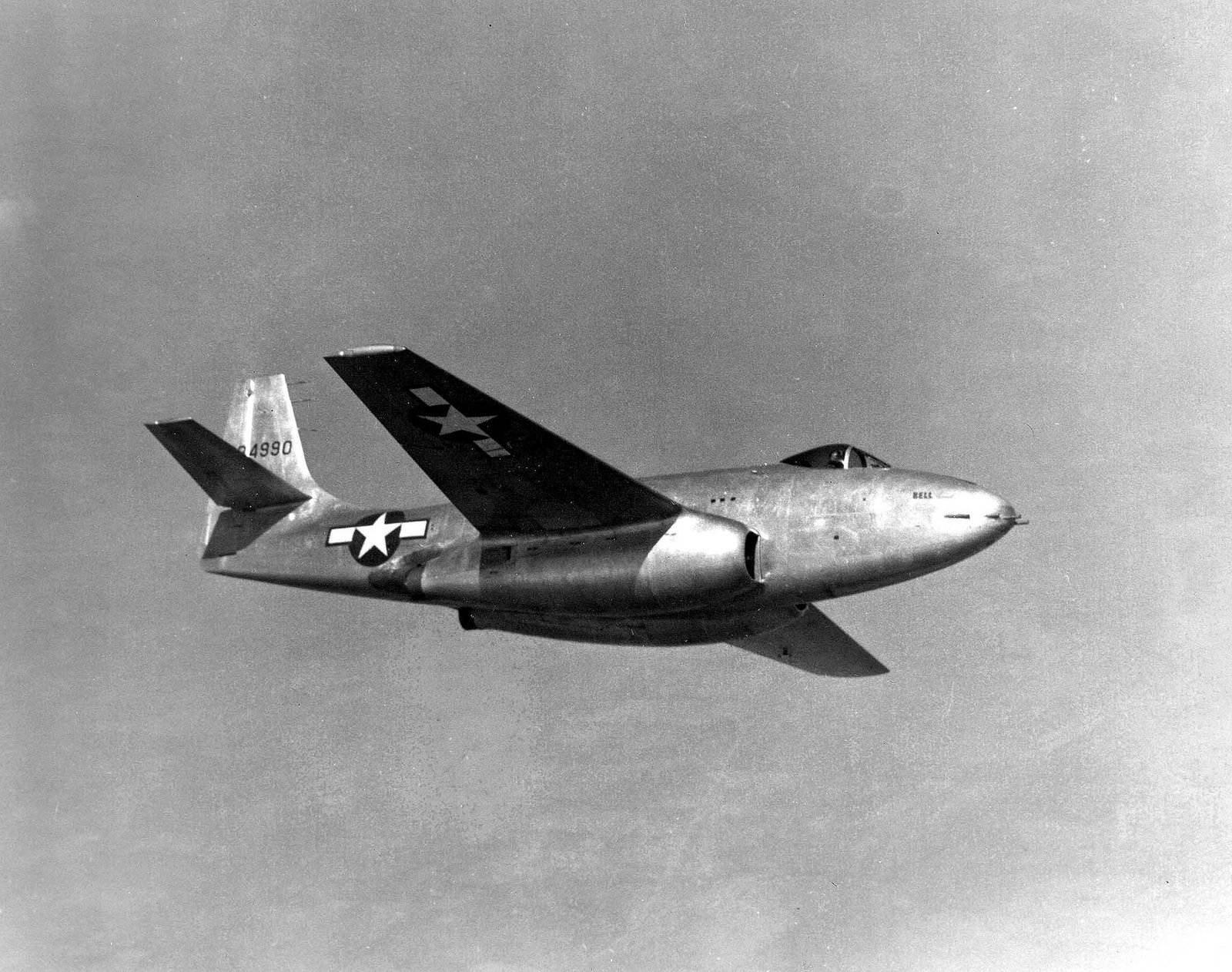
The Bell XP-83 was developed by the Bell Aircraft Corporation as a specialized long-range jet escort fighter for the United States Army Air Forces (USAAF) during World War II. The project originated from Bell's 'Model 40' interceptor, which had been under development in 1943. To meet specific USAAF requirements for extended operational range, the Model 40 was redeveloped into the XP-83. The aircraft's design was heavily influenced by the earlier P-59 Airacomet, incorporating a pressurized cockpit and a fuel capacity optimized for endurance over raw speed, representing an early engineering effort to solve the insufficient combat radius common to first-generation jet fighters.
Technical specifications for the XP-83 included a length of 44.10 feet, a wingspan of 53 feet, and a height of 15.3 feet, with a total wing area of 431 square feet. The prototype was powered by two General Electric XJ33-GE-5 centrifugal-flow compressor turbojets, each capable of producing 4,000 lbf of thrust. These engines enabled a projected maximum speed of 522 mph at an altitude of 15,600 feet and a service ceiling of 45,000 feet. The aircraft's range was a primary focus, offering 1,730 miles using internal fuel, which could be extended to a ferry range of 2,050 miles when equipped with two 300-gallon drop tanks. Other performance metrics included an empty weight of 14,105 lb, a maximum takeoff weight of 27,500 lb, and a rate of climb of 5,650 ft/min.
Only two prototypes were completed. The first XP-83 took its maiden flight on February 25, 1945, piloted by Jack Woolams, Bell's chief test pilot. Despite its range advantages, the aircraft's overall performance was found to be inferior to the Lockheed P-80 Shooting Star. Consequently, the USAAF canceled the program following the flight testing phase, and the XP-83 never entered production or saw operational combat service. Both prototypes were eventually scrapped, with one documented as destroyed in 1947. While short-lived, the XP-83 served as a critical transitional design that provided Bell Aircraft with essential experience in high-speed aerodynamics and advanced jet engineering. Bell Aircraft, founded in the 1930s, was later acquired by Textron in 1960 and continues to operate today as Bell Textron.