
Service History
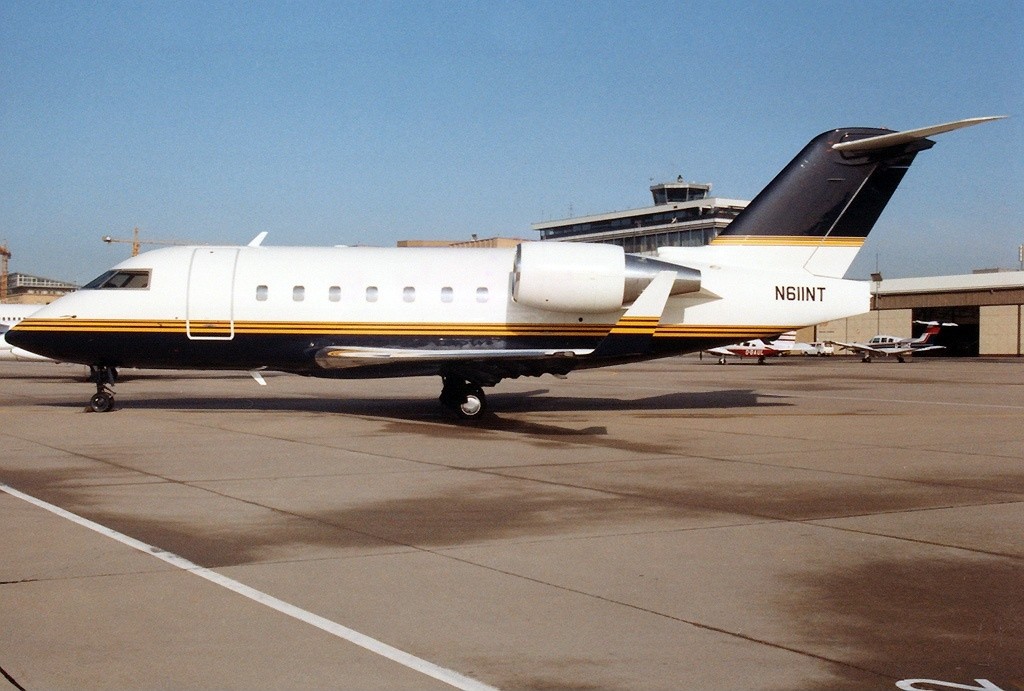
The Challenger 601-3A transformed the business aviation market by solving the critical shortcomings of its predecessor, the Challenger 600. Between 1987 and 1993, Bombardier delivered between 122 and 134 aircraft to charter companies, corporations, and private owners worldwide. The aircraft's 3,290 nautical mile range enabled non-stop transcontinental flights across North America, revolutionizing executive travel by eliminating fuel stops that had plagued earlier business jets.
Unlike scheduled airline aircraft, the 601-3A operated exclusively in the charter and corporate market, configured with luxurious cabins measuring 8.2 feet wide and 6.1 feet tall. The aircraft typically seated 9 passengers in a standard configuration, though operators could accommodate up to 12 passengers by utilizing lavatory seating arrangements.
The Manufacturer
The aircraft's development story begins with Canadair, founded in 1944 when the Canadian government nationalized aircraft manufacturing facilities. Canadair launched the original Challenger program on October 29, 1976, based on American inventor Bill Lear's 1974 LearStar 600 concept. Lear had partnered with the Canadian company because he lacked the production capacity to build his revolutionary business jet design.
In 1986, Bombardier Inc. acquired Canadair, transforming the Montreal-based manufacturer into Bombardier Aerospace. Founded in 1942 as a snowmobile manufacturer, Bombardier's acquisition of Canadair marked its dramatic entry into aviation. The CL-601-3A became the first Challenger variant marketed under the Bombardier name, establishing the company's reputation in business aviation that continues today with the Challenger and Global series.
Engine & Technical Innovation
The 601-3A's success stemmed from its adoption of two General Electric CF34-3A high-bypass turbofan engines, each producing 8,650 pounds of thrust with flat rating to ISA+21°C conditions. These engines replaced the problematic Lycoming ALF 502 powerplants that had plagued earlier Challenger variants with reliability issues and limited performance.
General Electric derived the CF34 series from the proven CFM56 core, creating an exceptionally reliable powerplant that enabled 6,000-hour inspection intervals. This reliability advantage, combined with the engines' fuel efficiency, allowed the 601-3A to cruise at Mach 0.85 to its maximum ceiling of 41,000 feet.
The aircraft featured a two-pilot crew operating the industry's first glass cockpit system available on a Bombardier aircraft. This advanced avionics package reduced pilot workload and improved situational awareness, contributing to the variant's commercial success.
Design Excellence
Measuring 68.3 feet in length with a 64.5-foot wingspan enhanced by distinctive winglets, the 601-3A incorporated several design improvements over the original Challenger 600. Engineers relocated fuel storage from the fuselage to the wings, improving weight distribution and center of gravity characteristics. The adoption of a T-tail configuration and supercritical wing design further enhanced aerodynamic efficiency.
The aircraft's cabin, stretching 28.3 feet in length, provided baggage space for 12 full-size suitcases while maintaining the comfortable passenger environment that became a Challenger trademark. These dimensions created an interior volume that competed directly with much larger aircraft while maintaining the operating economics of a super-midsize business jet.
Performance Characteristics
Pilots praised the 601-3A for its transcontinental capability and improved handling characteristics compared to earlier Challenger variants. The aircraft's 3,290 nautical mile range enabled flights from New York to Los Angeles or London to Moscow without refueling stops, a significant advantage for business travelers.
Operating at a maximum cruise speed of Mach 0.85, the 601-3A matched the performance of contemporary airliners while providing the scheduling flexibility and privacy that corporate operators demanded. The aircraft's ability to access shorter runways than larger business jets expanded destination options for operators.
Production Legacy
Certified in April 1987 after first flight in September 1986, the 601-3A represented a turning point for Bombardier's aviation ambitions. The variant's commercial success, with production continuing through 1993, validated the company's investment in the Challenger program and provided the foundation for subsequent business jet development.
The 601-3A's engineering solutions influenced Bombardier's later regional jet programs, including the successful CRJ series that dominated regional airline markets. Today, dozens of 601-3A aircraft remain operational worldwide, valued by operators for their fuel efficiency, reliability, and versatility in charter and corporate roles.
The aircraft's significance extends beyond its commercial success to represent Bombardier's transformation from a recreational vehicle manufacturer into a major aerospace company. The 601-3A proved that Canadian aerospace engineering could compete globally, establishing Bombardier's reputation that continues with modern Global and Challenger variants serving the worldwide business aviation market.