
Service History
The DHC-8-100 carved out a significant niche in regional aviation markets worldwide, with operators praising its ability to serve airports that larger jets could not access economically. Airlines found the aircraft particularly valuable for connecting smaller communities to major hubs, with its 37-39 seat capacity proving optimal for thin routes that required frequency over size. The type's short takeoff and landing capabilities, requiring runways as short as 3,500 feet, opened previously inaccessible markets to scheduled airline service.
By the late 1980s, the Dash 8-100 had established itself as the backbone of numerous regional carriers across North America and internationally. Its operational economics proved superior to competing aircraft in its class, with direct operating costs approximately 20 percent lower than comparable turboprops of the era.
The Manufacturer
De Havilland Canada originally developed the DHC-8 series as a government-owned Crown Corporation, building on decades of experience in STOL (Short Takeoff and Landing) aircraft design. The company had previously achieved success with aircraft like the DHC-6 Twin Otter and DHC-7 Dash 7, establishing expertise in turboprop technology and short-field performance.
In 1986, Boeing acquired De Havilland Canada for $155 million Canadian, continuing development and production of the Dash 8 series. Boeing later sold the operation to Bombardier Aerospace in 1992, where the program expanded significantly with stretched variants including the DHC-8-200, -300, and eventually the highly successful Q400 series.
The program came full circle in 2019 when Longview Aviation Capital acquired the entire Dash 8 program from Bombardier for approximately $300 million US, reviving the De Havilland Canada name. This acquisition included manufacturing rights to all variants and transferred approximately 1,200 professionals to the reconstituted company, making it North America's largest commercial turboprop manufacturer.
Engine & Technical Details
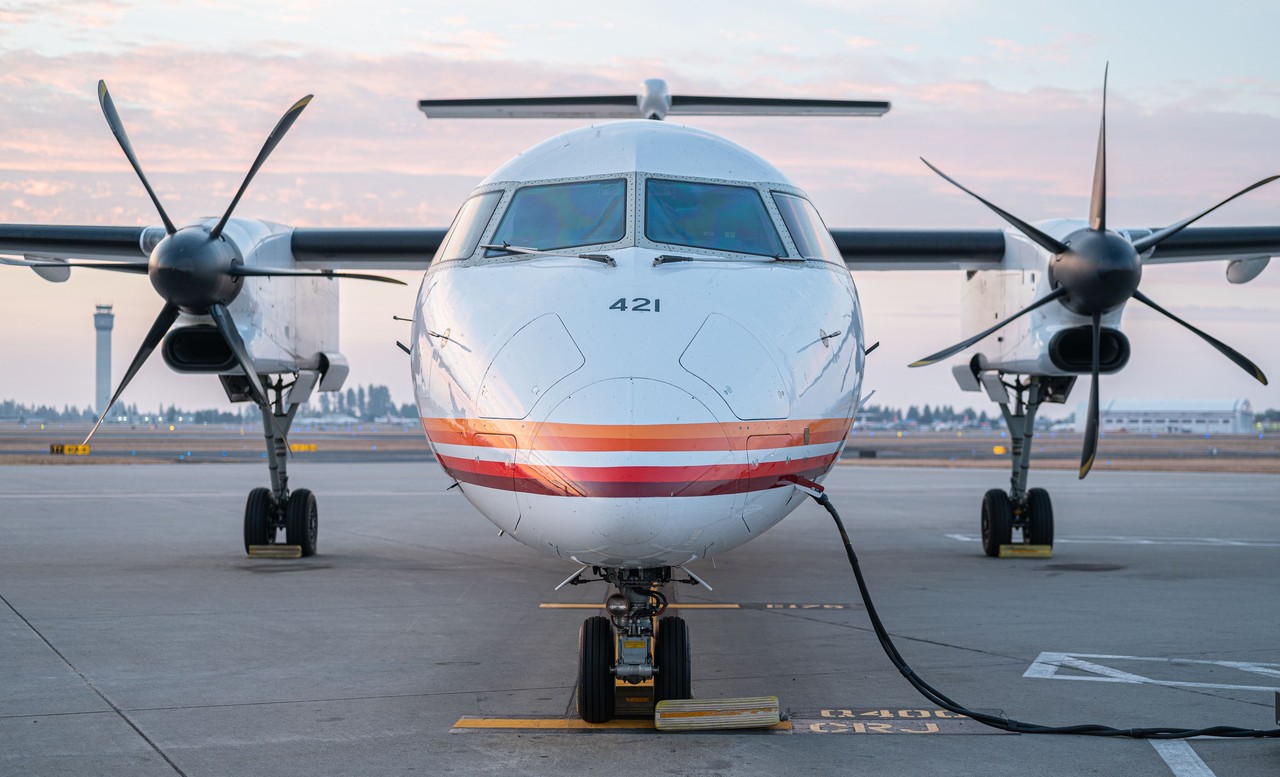
The DHC-8-100 utilized twin Pratt & Whitney Canada PW120A turboprop engines, each producing 2,000 shaft horsepower and driving four-blade Dowty Rotol propellers. This powerplant combination provided exceptional fuel efficiency while maintaining the reliability record essential for regional airline operations. The engines featured FADEC (Full Authority Digital Engine Control) systems, advanced for their era and reducing pilot workload significantly.
The aircraft's high-wing configuration contributed to its outstanding short-field performance while providing natural ground clearance for the large-diameter propellers. The wing incorporated full-span flaps and ailerons, enhancing low-speed handling characteristics crucial for operations at smaller airports. Landing gear design emphasized ruggedness for frequent cycles typical of regional airline service.
With a maximum takeoff weight of 36,300 pounds, the DHC-8-100 could carry a full passenger load over ranges up to 1,200 nautical miles, making it ideal for regional route networks. The pressurized cabin maintained comfortable conditions at cruising altitudes up to 25,000 feet.
Pilot Perspective
Pilots consistently praised the DHC-8-100 for its predictable handling characteristics and forgiving flight envelope. The aircraft's natural stability and excellent control response made it particularly suitable for training pilots transitioning from smaller aircraft to airline operations. Flight crews appreciated the spacious cockpit layout and comprehensive avionics suite, which included weather radar and navigation systems comparable to those found on larger aircraft.
The type's short-field capabilities allowed experienced crews to access airports that challenged other aircraft in its class. Approach speeds as low as 105 knots, combined with effective thrust reversers, enabled operations from runways as short as 2,800 feet under optimal conditions. This performance envelope made the aircraft invaluable for serving remote communities and challenging airports throughout its operational career.
Production & Legacy
De Havilland Canada produced approximately 299 DHC-8-100 aircraft between 1984 and 1995, establishing the foundation for the entire Dash 8 family. The variant's success led directly to the development of stretched versions, ultimately resulting in over 1,200 total Dash 8 aircraft delivered across all variants by 2019.
The DHC-8-100's design philosophy of combining turboprop efficiency with jet-like performance and reliability influenced regional aircraft development for decades. Its success demonstrated the viability of the 30-40 seat market segment and encouraged other manufacturers to develop competing designs.
Today, many DHC-8-100 aircraft remain in active service worldwide, testament to their robust construction and enduring utility. The type continues serving routes in North America, Europe, and developing markets where its combination of economy and short-field performance remains unmatched. Several examples are preserved in aviation museums, including the Canadian Aviation and Space Museum in Ottawa, recognizing the aircraft's significance in Canadian aerospace achievement.