
Military Dominance and Vietnam Service
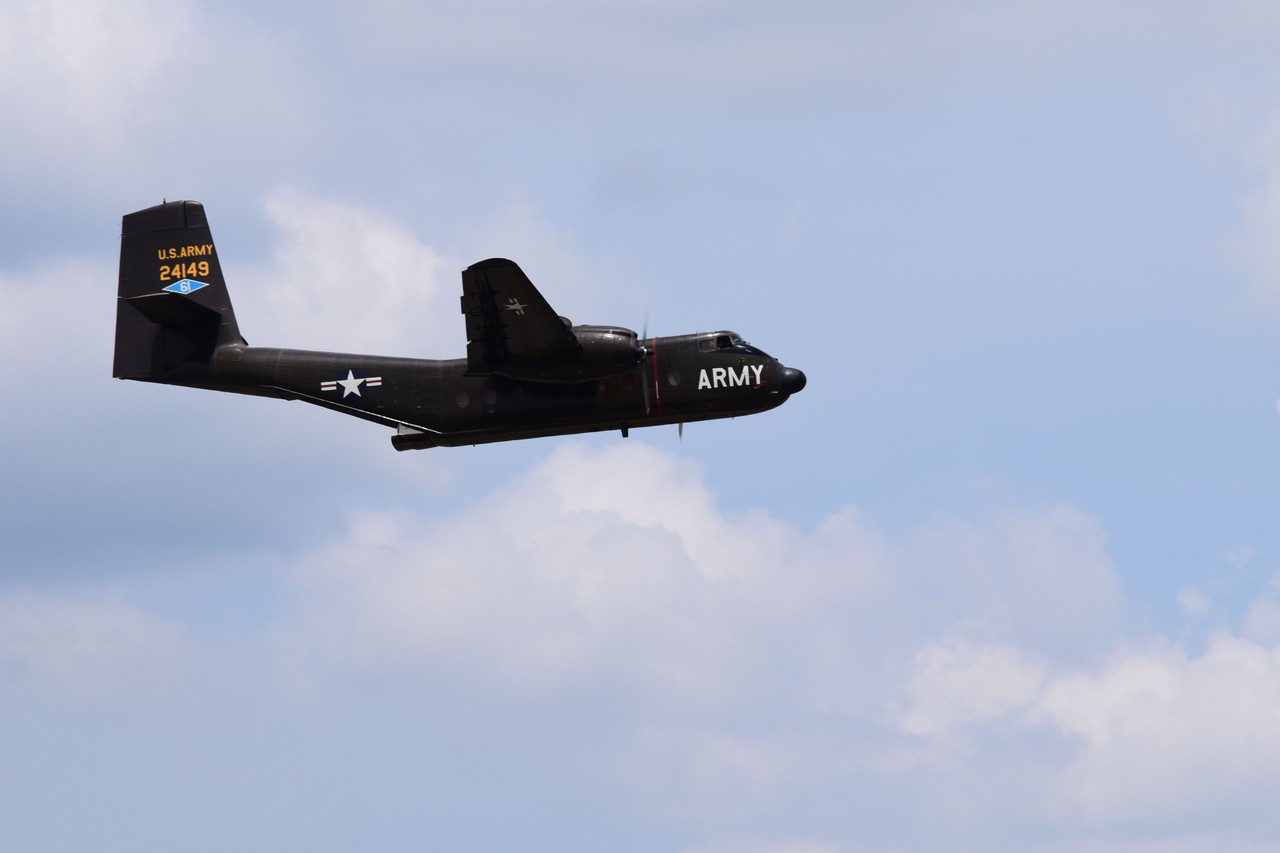
The Caribou quickly established itself as the backbone of tactical airlift operations during the Vietnam War, where it earned legendary status among military aviators. The United States Air Force acquired 173 aircraft designated C-7A, while the Army operated them as CV-2A variants before transferring them to Air Force control in 1967. During the conflict's peak years from 1961 to 1975, Caribou aircraft flew countless missions into the Central Highlands, delivering troops and supplies to remote fire bases accessible only by helicopter or STOL aircraft.
The aircraft's exceptional short-field performance allowed operations from strips that would challenge even modern turboprop transports. Combat losses were significant but acceptable given the challenging operational environment, with approximately 50 C-7As lost to enemy action and accidents throughout the Vietnam conflict. Beyond American service, the Royal Australian Air Force operated DHC-4s extensively in Southeast Asia, while South Vietnamese forces used them for both transport and medical evacuation missions.
International Military Adoption
Military operators worldwide recognized the Caribou's unique capabilities, leading to widespread international adoption. The Royal Canadian Air Force designated their aircraft CC-108, using them for northern operations and NATO commitments. India acquired Caribous for operations along its mountainous borders, while Malaysia employed them during the Malayan Emergency for counterinsurgency operations in jungle terrain where conventional transports could not operate.
Military variants included specialized configurations with optional armament packages featuring side-firing machine guns, rocket pods, or light bombs for armed reconnaissance missions. The aircraft's high-mounted wing and tricycle landing gear provided excellent ground clearance and stability during loading operations, while the rear cargo door enabled rapid deployment of paratroopers or cargo drops.
De Havilland Canada's Engineering Achievement
De Havilland Canada, established in March 1928 as a subsidiary of the British de Havilland Aircraft Company, created the Caribou under chief engineer Phil Garratt's leadership. The design team focused on maximizing STOL performance through innovative aerodynamic solutions, including high-lift wings with full-span slotted flaps that provided exceptional low-speed handling characteristics. The high-mounted tailplane cleared the cargo door area while maintaining elevator authority during steep approaches.
The company's ownership changed hands multiple times throughout its history. The Canadian government purchased it from Hawker Siddeley Aviation in 1974, then sold it to Boeing in 1986 for CAD $155 million. After Boeing accumulated $636 million in losses over five years, Bombardier Aerospace acquired the company in 1992. Most recently, Longview Aviation Capital Corporation purchased remaining programs in 2019, continuing operations today as De Havilland Aircraft of Canada Limited.
Powerplant and Performance
Two Pratt & Whitney Canada R-2000 radial engines, each producing 1,450 shaft horsepower, powered the Caribou. These 14-cylinder, air-cooled powerplants represented Canadian modifications of the proven R-1830 Wasp design, enhanced for reliable operation in extreme cold climates. The engines featured geared superchargers for improved high-altitude performance, crucial for operations in mountainous terrain.
The R-2000's robust construction and simplified maintenance requirements made it ideal for bush operations and forward military bases with limited support facilities. Maximum speed reached 201 miles per hour, while the practical range extended to 758 miles with full payload. Service ceiling of 23,000 feet and a climb rate of 1,000 feet per minute provided adequate performance for most tactical scenarios.
Pilot Experience and Handling
Pilots praised the Caribou's predictable handling characteristics and exceptional short-field performance. The aircraft required a crew of three, including two pilots and a loadmaster for cargo operations. Approach speeds as low as 70 miles per hour enabled landings on strips that would challenge much smaller aircraft, while the rugged landing gear absorbed the punishment of repeated operations from unpaved surfaces.
Control response remained positive throughout the flight envelope, with the high-wing configuration providing inherent stability and excellent visibility for the flight crew. The spacious cockpit accommodated the extensive instrumentation required for all-weather operations, while the reliable radial engines provided redundancy crucial for single-strip operations in hostile territory.
Production Legacy and Current Status
Production concluded in 1965 after 307 aircraft rolled off the assembly line at De Havilland Canada's Downsview, Ontario facility. The relatively short production run reflected the aircraft's specialized nature and the emergence of turboprop competitors like the company's own Twin Otter, which offered similar STOL performance with more modern powerplants.
Civil Operations and Museum Preservation
Civilian operators including Transair of Canada, Air New Zealand, and various cargo companies adapted surplus military Caribous for bush flying and remote cargo operations. The aircraft's ability to carry substantial loads into primitive airstrips made it valuable for mining, logging, and exploration companies operating in remote regions of Canada, Alaska, and Australia.
Today, dozens of DHC-4 Caribous remain airworthy worldwide, primarily serving civilian cargo and specialized transport roles. The U.S. Army Aviation Museum at Fort Rucker, Alabama displays a preserved C-7A, while the Canadian Warplane Heritage Museum at Mount Hope, Ontario maintains Canadian examples. The Caribou's cultural significance extends beyond aviation museums, having appeared in Hollywood films including The Green Berets (1968), cementing its place in popular culture as the quintessential military transport of the Vietnam era.