
Service History
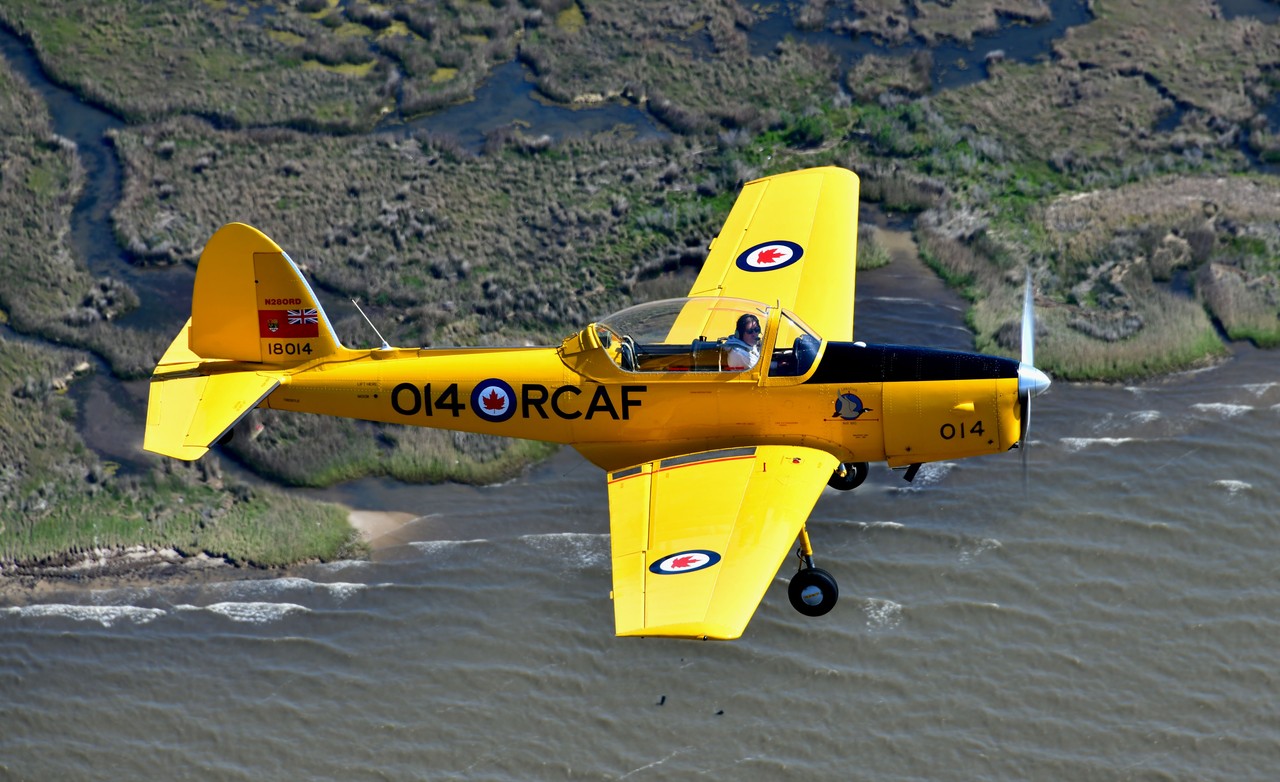
The Chipmunk dominated military flight training from the late 1940s through the 1990s, serving with more than 12 air forces worldwide. The Royal Canadian Air Force received its first batch in 1948, while the Royal Air Force operated the type until 1996 when it was replaced by the Scottish Aviation Bulldog. The British Army Air Corps continued flying Chipmunks until March 27, 1997, marking nearly five decades of continuous military service. Over 1,000 aircraft served with British forces alone, making it one of the most numerous trainers in Commonwealth service.
The Designer and Development
Wsiewolod Jakimiuk designed the Chipmunk in 1946 as a modern replacement for the aging Tiger Moth biplane. His design incorporated advanced features for the era, including an enclosed cockpit with a rear-sliding canopy, wing strakes to prevent inadvertent spins, and stall breaker strips on the inboard wing leading edges. The prototype CF-DIO-X made its maiden flight on May 22, 1946, at Downsview, Toronto, with Pat Fillingham at the controls. This marked de Havilland Canada's first indigenous all-metal monoplane design, representing a significant departure from the fabric-covered biplanes that dominated training fleets.
The Manufacturer
De Havilland Canada developed the Chipmunk as the company's first postwar indigenous design, operating as a subsidiary of the British de Havilland Aircraft Company since the 1920s. The company leveraged Canada's expanded wartime aviation manufacturing capacity to establish itself in the postwar market. Through a series of corporate acquisitions, de Havilland Canada was absorbed into Hawker Siddeley in the 1960s, then became part of British Aerospace in 1977, followed by Boeing in the 1990s. The de Havilland Canada name was revived in 2019 when a new company acquired the type certificates, though the original manufacturer had long since ceased independent operations.
Production and Variants
Total production reached 1,283 aircraft across three manufacturing locations between 1946 and 1958. De Havilland Canada built 217 aircraft at its Downsview facility near Toronto, completing the last Canadian-built example in 1956. Under license, de Havilland's British factories at Hatfield Aerodrome and later Hawarden Aerodrome near Chester produced 1,000 aircraft. OGMA in Portugal manufactured an additional 66 examples specifically for the Portuguese Air Force. Military variants included the T.10 designation for RAF and Army Air Corps aircraft, and the T.22 variant, while civil modifications produced the Supermunk glider tug with a 180-horsepower Lycoming O-360 engine.
Engine and Performance
The Chipmunk was powered by a single de Havilland Gipsy Major engine, with most production aircraft receiving the Gipsy Major 8 variant producing 143 to 145 horsepower. This four-cylinder air-cooled inverted inline engine, manufactured by the British de Havilland Aircraft Company, drove a two-bladed fixed-pitch propeller. The powerplant enabled a cruise speed of 90 knots and a maximum speed of 173 knots (200 miles per hour), with an endurance of up to three hours. The engine's reputation for reliability made it an ideal choice for training operations, building on decades of successful service in the Tiger Moth.
Training Excellence
Pilots praised the Chipmunk for its forgiving handling characteristics and modern training features that surpassed those of its biplane predecessor. The enclosed cockpit provided protection from the elements while maintaining excellent visibility, and the spin-resistant design reduced training accidents. The tandem seating arrangement allowed instructors to closely monitor student progress while maintaining full control authority. These characteristics made the Chipmunk particularly effective for ab initio pilot training, where students progressed from no flying experience to solo flight.
Legacy and Preservation
Hundreds of Chipmunks remain airworthy today, continuing to serve in civilian flying schools and private ownership for training and aerobatic flying. Notable museum examples include a DHC-1A Pennzoil Special modified by aerobatic pilot Art Scholl in 1968, displayed at the Smithsonian National Air and Space Museum. The Shuttleworth Collection in England maintains a flying T.22 variant, while the Canadian Aviation and Space Museum commemorates the type's first flight. The Delaware Aviation Museum houses a DHC-1 as part of its postwar aviation exhibit, recognizing the aircraft's significance as a bridge between wartime training methods and modern flight instruction.