
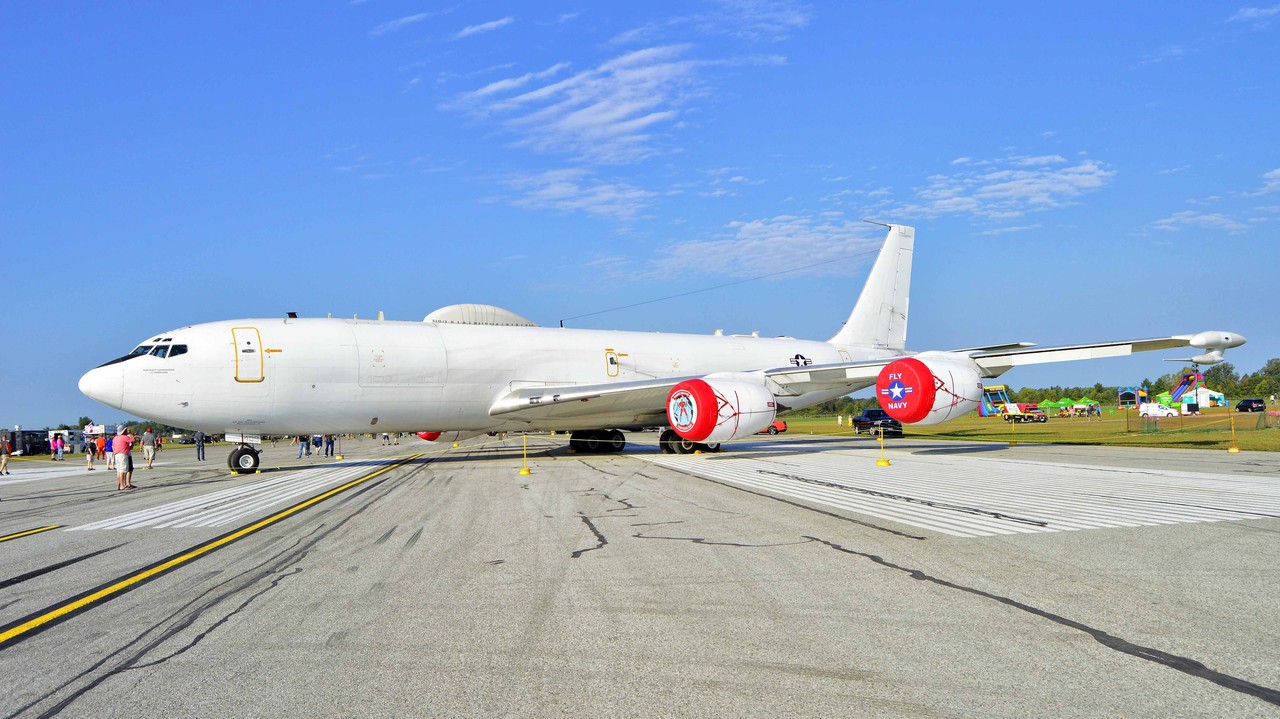
Strategic Communications Dominance
Since entering service in 1989, all 16 E-6 Mercury aircraft have maintained an unbroken chain of strategic communications for the United States nuclear triad. Operating in continuous rotations, these aircraft provide the only guaranteed method for the National Command Authority to communicate with submerged ballistic missile submarines through Very Low Frequency radio transmissions. The fleet handles 100 percent of America's airborne nuclear command and control missions, making it one of the military's most critical "no-fail" platforms.
Boeing's Final 707 Derivative
The Boeing Company, founded by William Boeing in 1916, selected its proven 707-320B commercial airliner as the foundation for the E-6 program in the mid-1980s. Boeing engineers at the Seattle facility modified 16 existing 707 airframes with electromagnetic hardening, dual trailing wire antennas up to 26,000 feet long, and specialized battle staff compartments. The first aircraft rolled out in December 1986, with initial deliveries to Fleet Logistics Squadron VQ-3 beginning in August 1989. Boeing completed all E-6A to E-6B upgrades by 2003, adding Airborne Launch Control System capabilities for land-based intercontinental ballistic missiles.
Advanced Powerplant Technology
Four CFM56-2A-2 high-bypass turbofan engines power each E-6, manufactured by CFM International, the joint venture between General Electric and Safran Aircraft Engines. These engines, producing approximately 24,000 pounds of thrust each, enable the aircraft to maintain station for up to 16 hours during critical missions. The CFM56 series, which entered production in 1974, proved ideal for the Mercury's demanding endurance requirements, providing the reliability necessary for continuous nuclear deterrent operations.
Dual-Role Strategic Platform
The E-6B configuration, operational since October 1998, serves two distinct strategic roles. As a TACAMO (Take Charge And Move Out) platform, it maintains communications with the submarine fleet through its distinctive trailing wire antennas that extend far below the aircraft during flight. In its Looking Glass role, inherited from the Air Force's retired EC-135C fleet, the E-6B functions as an airborne command post capable of launching Minuteman III intercontinental ballistic missiles if ground-based command centers become inoperable.
Operational Excellence
Navy squadrons VQ-3 "Ironmen" and VQ-4 "Shadows" operate the entire E-6B fleet from Tinker Air Force Base in Oklahoma. Each aircraft carries a crew of 22, including four flight crew members, five mission specialists, and additional battle staff personnel. With a maximum takeoff weight of 342,000 pounds and a range exceeding 6,600 nautical miles, the E-6B can reach any global location and maintain communications coverage for extended periods. The aircraft routinely operates above 40,000 feet with a maximum speed of 522 knots.
Continuous Modernization
Despite being based on 1960s airliner technology, the E-6B remains thoroughly modern through ongoing upgrade programs. The Orbit Improvement Program has extended the fleet's operational life well into the 21st century, with all 16 aircraft remaining in active service as of 2024. At a unit cost of $141.7 million per E-6B, the program represents one of the most cost-effective strategic systems in the American military inventory.
Enduring Nuclear Deterrent Role
The E-6 Mercury stands as the final military derivative of Boeing's legendary 707 airliner, bridging the gap between commercial aviation and modern strategic command systems. Unlike its airliner predecessors that revolutionized commercial travel, the Mercury operates in complete secrecy, its missions classified and its crews among the most highly trained in naval aviation. As long as America maintains a nuclear deterrent, the distinctive white and gray E-6B aircraft will continue their silent vigil, ensuring that command authority over the nation's ultimate weapons remains unbroken regardless of global circumstances.