
Market Dominance and Service History
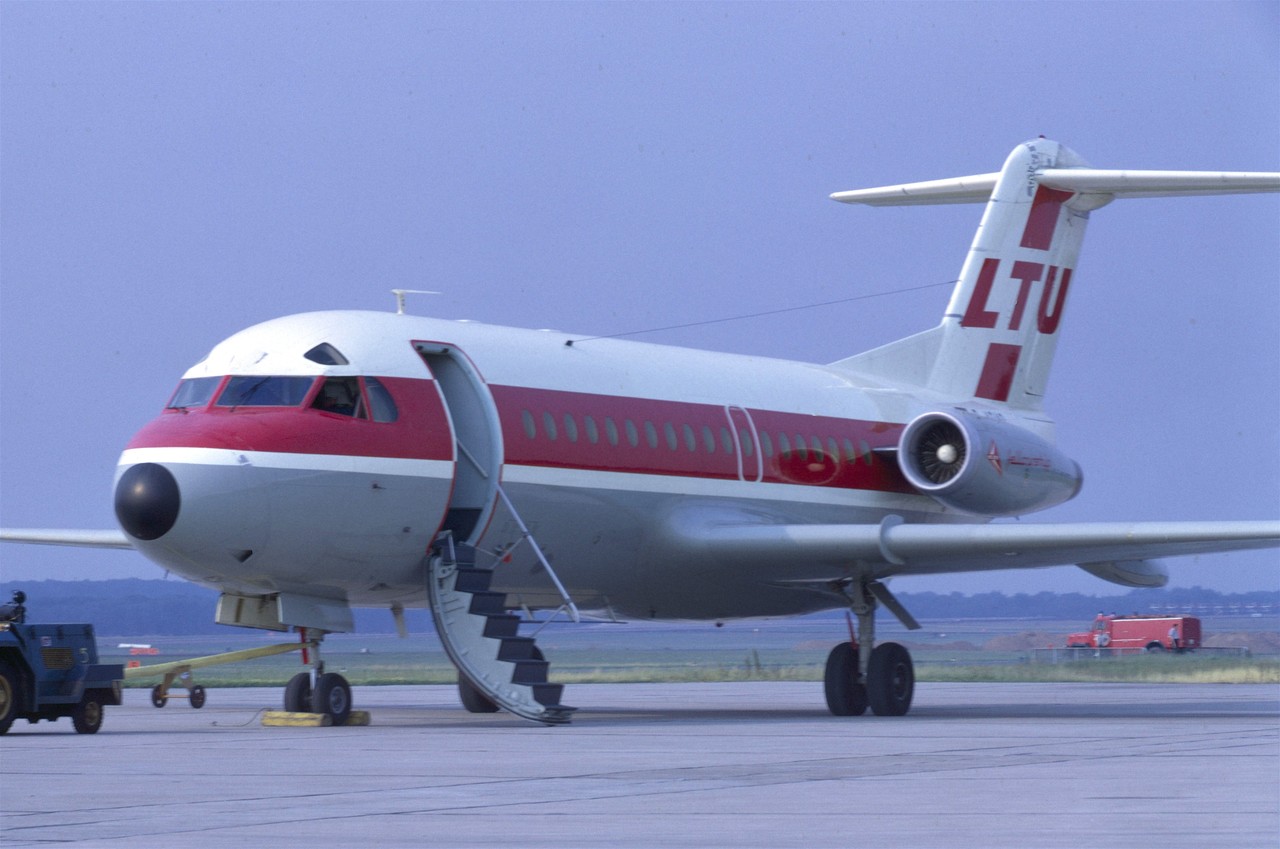
The F28 Fellowship carved out a unique niche in regional aviation by operating from airports that were previously accessible only to turboprops. During its 20-year production run, airlines across Europe, Africa, and Asia adopted the type for thin routes connecting smaller cities. Braathens SAFE inaugurated passenger service on March 28, 1969, operating short sectors throughout Norway's challenging terrain. By the mid-1970s, operators like LTU were using the type for Mediterranean charter flights, while Nigeria Airways deployed F28-2000s from October 1971 for domestic routes across West Africa.
Swedish carrier Linjeflyg introduced the stretched F28-4000 variant in late 1976, maximizing passenger capacity on domestic routes between Stockholm and regional centers. The aircraft's ability to operate from 85 percent of airports served by the venerable DC-3 made it invaluable for airlines seeking to upgrade from turboprop service without abandoning smaller destinations.
International Manufacturing Partnership
Fokker orchestrated an unprecedented European manufacturing collaboration for the F28 program. The Dutch parent company retained responsibility for the nose section, center fuselage, and inner wing components at their Schiphol Airport facility. German partner MBB (later Fokker-VFW following the 1969 merger) manufactured the forward fuselage, rear fuselage sections, and complete tail assembly. Shorts of Belfast, Northern Ireland, contributed the outer wing panels, creating a truly multinational production line.
This distributed manufacturing approach allowed Fokker to share development costs while leveraging each partner's specialized expertise. The arrangement proved successful enough that all 241 aircraft were completed through this collaborative system between 1967 and 1987.
The Fokker Legacy
Founded in 1912 by Anthony Fokker, the Dutch manufacturer had established its reputation with the highly successful F27 Friendship turboprop before venturing into jet propulsion. Market research conducted in the early 1960s identified demand for a jet-powered successor that could serve the same airports as the F27 while offering passengers the comfort and prestige of turbofan power.
The company's philosophy prioritized operational flexibility over raw performance, accepting lower cruise speeds in exchange for superior short-field capabilities. This approach proved prescient, as the F28 could access airports that faster competitors like the Sud Caravelle could not reach. Fokker continued aircraft manufacturing until declaring bankruptcy in 1996, with assets subsequently acquired by various firms. Today, Fokker Technologies maintains the company name while providing maintenance and component services rather than manufacturing complete aircraft.
Engineering Innovation
Chief Test Pilot Jas Moll, Test Pilot Abe van der Schraaf, and Flight Engineer Cees Dik conducted the maiden flight of prototype PH-JHG on May 9, 1967. The aircraft's design team, working collectively across the partner companies, emphasized practical operational considerations over theoretical performance maximums.
The high-wing configuration enabled steep approach angles essential for short runway operations, while the overwing engine placement reduced foreign object damage risks common at smaller airports with less sophisticated ground maintenance. Twin Rolls-Royce Spey turbofans provided reliable power throughout the aircraft's service life, with later variants receiving the more powerful and quieter Spey 555-15H engines.
Operational Characteristics
Pilots appreciated the F28's straightforward handling characteristics and robust design philosophy. The aircraft's maintenance-friendly systems reduced operational costs for regional carriers operating with limited technical resources. While cruise speeds lagged behind pure-jet competitors, the F28's short-field performance opened route possibilities that faster aircraft simply could not serve.
The basic F28-1000 accommodated 65 passengers, while the stretched F28-2000 increased capacity to 79 through a 1.4-meter fuselage extension. The ultimate passenger variant, the F28-4000, combined the longer fuselage with extended wings to seat 85 passengers while maintaining short-field capabilities.
Production Evolution and Legacy
Fokker delivered 241 F28s across four main variants during the program's two-decade span. The F28-3000 cargo version served freight operators, while the basic passenger models dominated airline fleets. Production averaged approximately 12 aircraft annually, reflecting the specialized nature of the regional jet market during the 1970s and early 1980s.
Very few F28s remain in active service today, with most examples retired as newer regional jets offering improved fuel efficiency and passenger comfort entered the market. The aircraft's influence extended beyond its own production run, as lessons learned from the F28 program directly contributed to Fokker's subsequent 70 and 100 series aircraft before the company's final closure in 1996.
The F28 Fellowship established the template for European regional jet development, proving that smaller manufacturers could successfully compete in specialized market segments by prioritizing operational flexibility over raw performance statistics.