
Service History
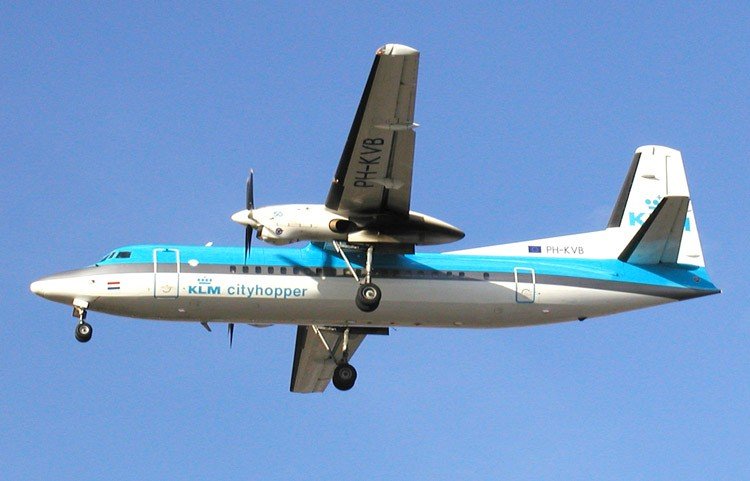
The Fokker 50 entered commercial service in 1987 with German carrier DLT Luftverkehrsgesellschaft as its launch customer, followed closely by Ansett Australia. Despite competing directly against the ATR 42 and Dash 8 in the regional aviation market, the aircraft struggled to achieve the commercial success of its predecessor, the F27 Friendship. The timing of its introduction coincided with intense competition in the regional turboprop sector, limiting its market penetration despite superior fuel efficiency and modern avionics.
Military Operations
While primarily designed for civilian service, the Fokker 50 found limited military applications through specialized variants. The Royal Netherlands Air Force operated the Fokker 60 variant, while other military operators included the Peruvian Naval Aviation and Republic of China Air Force, which acquired ex-RNLAF aircraft. The Republic of Singapore Air Force and Royal Brunei Air Force each operated two F27 Mark 0502 variants built in 1993, featuring reconfigured interiors and modified aft exits for transport missions.
The Manufacturer's Final Chapter
Fokker, founded in 1912 by Anthony Fokker, had established itself as a pioneering force in aviation through both world wars and the early commercial aviation era. The company had achieved considerable success with the F27 Friendship, producing over 500 units from 1958, and the F28 Fellowship, establishing its reputation in regional aviation. By the 1990s, ownership had transferred to Daimler-Benz Aerospace AG (DASA), which initiated the Fokker 50 program in November 1983 alongside the larger Fokker 100 project. However, mounting financial pressures led DASA to seek a Dutch government bailout in 1995, which ultimately failed. Fokker declared bankruptcy and entered liquidation in 1996-1997, with final aircraft deliveries completed in 1997. The company's assets were partially acquired by DASA, later integrated into EADS and subsequently Airbus, while other components became part of GKN Aerospace Fokker Services.
Engineering Innovation
The Fokker 50's design team achieved their objective of creating a modern successor to the F27 while maintaining structural commonality. The aircraft incorporated significant technological advances, including the powerful Pratt & Whitney Canada PW125B or PW127B turboprops producing 2,500 horsepower each, paired with six-bladed Dowty Rotol composite propellers measuring 12 feet in diameter. Electronic engine and propeller controls replaced mechanical systems, while the cockpit featured modern EFIS displays and integrated warning systems.
The manufacturing process demonstrated international collaboration typical of modern aircraft production. While final assembly occurred at Fokker's Netherlands facilities, major components were sourced globally: SABCA in Belgium manufactured the wings, Dassault in France produced fuselage sections, Messerschmitt-Bölkow-Blohm in Germany supplied the flaps, and Fuji Heavy Industries in Japan contributed the vertical and horizontal stabilizers.
Performance Characteristics
Pilots appreciated the Fokker 50's enhanced performance envelope compared to the F27. The aircraft achieved a maximum speed of 351 miles per hour and cruised at 310 miles per hour, with a service ceiling of 25,000 feet and operational range of 1,000 miles. Empty weight reached 29,542 pounds, while maximum takeoff weight peaked at 45,900 pounds, with fuel capacity of 9,090 pounds. The two-person crew configuration reduced operational costs compared to earlier three-crew requirements on similar aircraft.
The redesigned wing incorporated increased composite materials, contributing to the aircraft's improved fuel efficiency. Hydraulic systems replaced pneumatic alternatives from the F27, enhancing reliability and reducing maintenance requirements. The fuselage featured doubled window arrangements, improving passenger comfort on short-haul regional routes.
Production Legacy
The Fokker 50's production history reflects both technical achievement and commercial disappointment. Following successful certification by the Dutch RLD authority in 1987, the aircraft remained in production for exactly one decade, concluding with Fokker's bankruptcy. The total production of 213 aircraft represented a modest success compared to contemporary competitors but fell short of the F27's impressive production numbers.
Several restart proposals emerged following Fokker's collapse, including a May 1996 initiative involving Hindustan Aeronautics Limited for assembly operations in India, but none materialized. The aircraft's legacy remains tied to its role as an efficient bridge between the F27 era and modern regional aviation, though it was ultimately overshadowed by more successful competitors and its manufacturer's financial collapse. Today, many examples remain in storage, while others continue serving regional routes worldwide, representing the final chapter of Dutch commercial aircraft manufacturing excellence.