
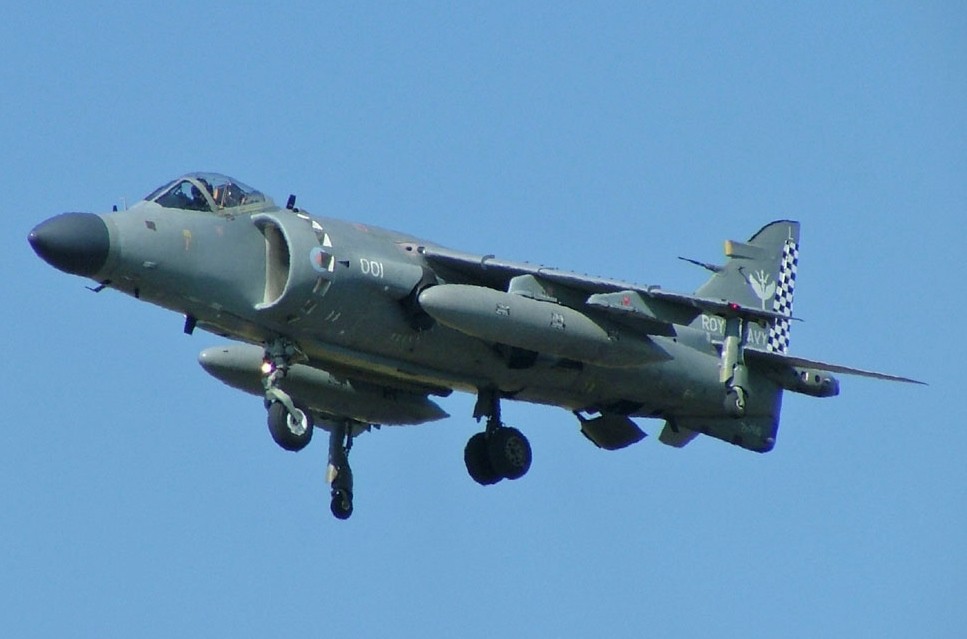
Revolutionary Combat Capability
The Sea Harrier FA2 emerged from hard-learned lessons of the 1982 Falklands War, where its predecessor, the FRS1, proved both invaluable and limited in air-to-air combat. The FA2 transformation focused exclusively on beyond-visual-range interception capabilities, making it the Royal Navy's most sophisticated carrier-based fighter. When deliveries began on April 2, 1993, the FA2 provided British naval aviation with a quantum leap in defensive capability that would serve until March 2006.
Fleet Air Arm squadrons operated the FA2 from HMS Invincible, HMS Illustrious, and HMS Ark Royal, providing critical air defense for carrier battle groups. The aircraft excelled in operations over the Adriatic Sea during Balkan conflicts and Persian Gulf patrols, where its unique V/STOL capabilities allowed operations from shorter carrier decks that conventional fighters could not use.
The Manufacturer's Evolution
British Aerospace inherited the Harrier lineage from Hawker Siddeley, which had pioneered V/STOL technology in the 1960s. Formed in 1977 through the merger of British Aircraft Corporation, Hawker Siddeley Aviation, Scottish Aviation, and Bristol Aircraft, British Aerospace represented Britain's attempt to consolidate its aviation industry. The company operated until 1999, when it merged with Marconi Electronic Systems to create BAE Systems, which continues today as one of the world's largest defense contractors.
The FA2 program showcased British Aerospace's engineering capabilities during a critical period when the company was transitioning from government ownership to privatization. Manufacturing took place at British Aerospace facilities across the United Kingdom, with final assembly incorporating cutting-edge avionics and weapons systems that positioned Britain at the forefront of naval aviation technology.
Pegasus Power and Technical Innovation
The heart of the FA2's revolutionary capability lay in its Rolls-Royce Pegasus Mk 106 turbofan engine, an evolution of the powerplant that first enabled practical V/STOL flight. Four cascade-type vectoring nozzles could rotate through 98.5 degrees, directing thrust downward for vertical takeoffs and landings or rearward for conventional flight. This system allowed the FA2 to operate from carriers barely 600 feet long, compared to the 1,000-foot minimum required by conventional naval fighters.
The Blue Vixen radar system represented another technological breakthrough, providing the FA2 with look-down/shoot-down capability against low-flying threats. This pulse-Doppler system could track multiple targets simultaneously while guiding AIM-120 AMRAAM missiles to beyond-visual-range intercepts. The radar's integration with advanced head-up and head-down displays gave FA2 pilots unprecedented situational awareness in the cramped confines of a single-seat cockpit.
Pilots praised the FA2's unique combat technique called VIFFing (vectoring in forward flight), where thrust vectoring during air combat maneuvering could rapidly decelerate the aircraft, forcing pursuing enemies to overshoot. However, the Pegasus engine's sensitivity to high ambient temperatures limited the FA2's vertical recovery payload in hot climates, requiring rolling takeoffs in demanding conditions.
Production Achievement and Variants
British Aerospace delivered exactly 56 FA2 aircraft through an efficient production program that combined new construction with upgrades. The program included 18 new-build aircraft at £12 million each, ordered in 1990, plus 33 conversions from existing Sea Harrier FRS1 airframes. An additional contract in 1994 added four more upgrades, completing the Royal Navy's requirements.
The Indian Navy operated a related variant based on upgraded FRS.51 aircraft, which received Israeli Elta EL/M-2032 radar systems and Rafael Derby missiles in 2009 modifications. These Indian Sea Harriers served until their retirement on March 6, 2016, marking the end of the type's frontline service worldwide.
Testing Innovation and Final Service
During its service life, the FA2 platform tested revolutionary technologies that pointed toward future naval aviation concepts. In 1998, trials with Exint special forces insertion pods demonstrated the aircraft's potential for covert operations. More significantly, 2005 Autoland system tests achieved fully automated vertical landings on pitching aircraft carrier decks, technology that would later influence modern unmanned aerial vehicle development.
Legacy and Preservation
The Sea Harrier FA2's retirement in March 2006 ended Britain's fixed-wing carrier aviation capability until the recent introduction of F-35B Lightning II aircraft. Today, only one FA2 remains airworthy: N94422 (formerly Royal Navy XZ439), owned by Nalls Aviation in St. Mary's County, Maryland. This aircraft was restored between 2006 and 2007 but suffered damage in a hard landing at NAS Patuxent River in December 2007.
Museum preservation ensures the FA2's technical achievements remain visible to future generations. The Pima Air & Space Museum in Arizona displays ZH810, painted in 899 Naval Air Squadron markings from its final Royal Navy service at RNAS Yeovilton in 2005. These surviving examples represent the culmination of British V/STOL technology and the Royal Navy's last generation of conventional aircraft carrier operations.