
Service History
The Jetstream 31 carved out a significant niche in the regional airline market during the 1980s and early 1990s, serving operators across North America, Europe, and Australia. Northwest Airlink became a prominent operator through subsidiaries like GQ Grand Airways, which operated three Jetstream 32 variants from 1988 to 1989 on routes connecting Memphis, Minneapolis, and Billings hubs. The aircraft's 18-passenger capacity made it ideal for thin regional routes where larger aircraft proved uneconomical, while its superior speed and comfort advantages over piston-engine competitors like the Beechcraft King Air attracted quality-conscious carriers.
Military Service
Though primarily designed for civilian operations, the Jetstream 31 saw limited military adoption. The Royal Navy ordered four aircraft in 1985, designated Jetstream T.3, initially intended as radar observer trainers. These military variants were later repurposed for VIP transport duties, demonstrating the aircraft's versatility beyond its commercial passenger role. The type saw no combat operations, as production commenced in 1982 well after major military conflicts.
The Manufacturer
The Jetstream's complex manufacturing heritage began with Handley Page, the British company famous for the Victor nuclear bomber, which launched the original Jetstream program in 1965. Following Handley Page's bankruptcy in 1970, Scottish Aviation resurrected the design in the mid-1970s, producing additional Jetstream 1 and 2 variants before nationalization led to integration into British Aerospace in 1978. BAe transformed the struggling design into the commercially successful Jetstream 31, with manufacturing distributed across multiple facilities: final assembly at the former Handley Page facility at Radlett aerodrome north of London, wing construction by Scottish Aviation at Prestwick, Scotland, and tail sections produced by Northwest Industries in Edmonton, Alberta, Canada.
Engine & Technical Innovations
The Jetstream 31's success stemmed largely from its re-engineering with Honeywell TPE331-12UAR turboprops, each flat-rated at 1,020 shaft horsepower with thermodynamic limits reaching 1,100 shaft horsepower. These engines, driving Dowty 106-inch four-bladed reversible metal propellers, offered dramatic improvements over the underpowered Turboméca Astazou engines that plagued earlier Jetstream variants. The TPE331 series provided 6,000-hour overhaul intervals and modular construction that significantly reduced maintenance costs, addressing one of the primary concerns of regional operators.
The aircraft featured a streamlined design philosophy emphasizing performance over the typical boxy regional aircraft configuration. Its distinctive long nose profile and low-wing, high-tail arrangement provided aerodynamic advantages that translated into superior cruise performance and fuel efficiency. The modular construction approach extended beyond the engines to the airframe itself, enabling easier maintenance access and reduced downtime for operators.
Pilot Perspective
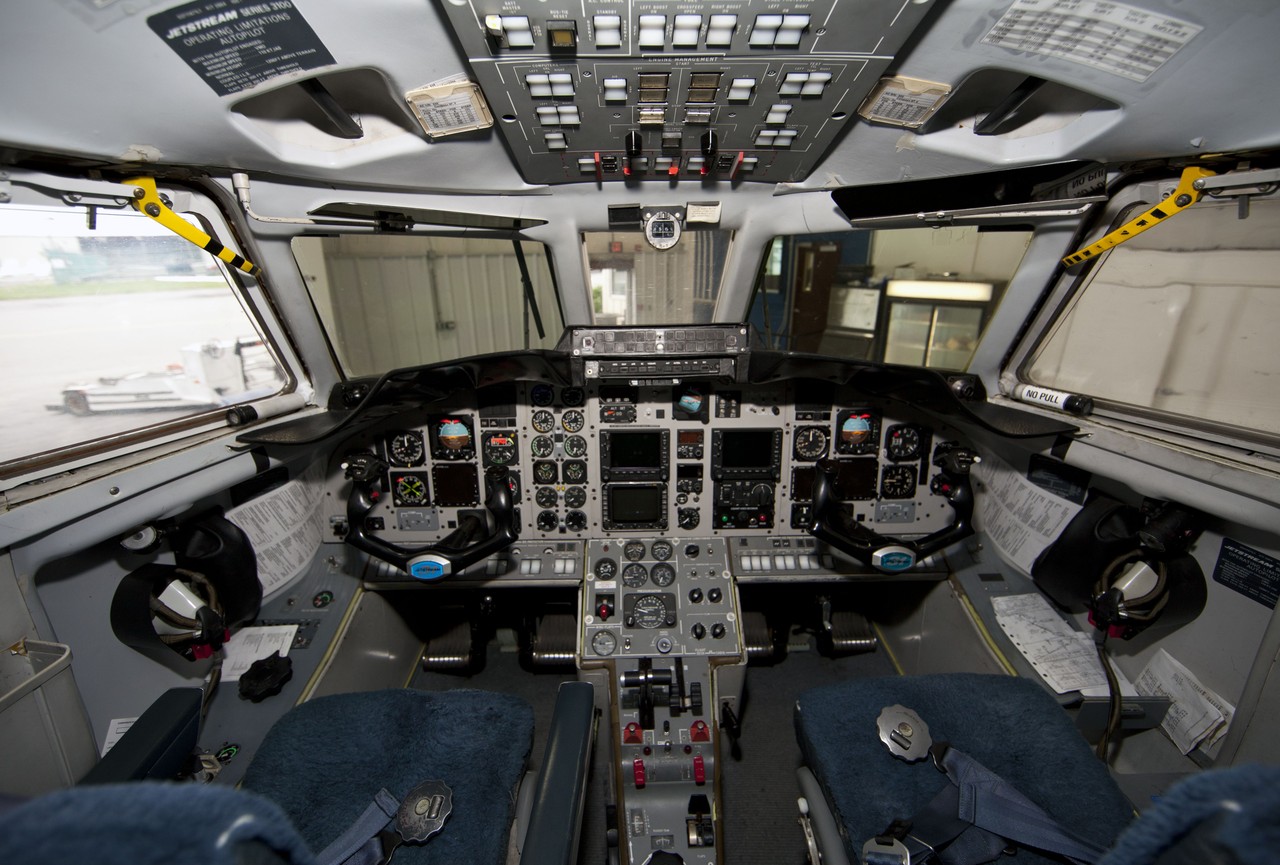
The Jetstream 31 earned praise from flight crews for its enhanced short-field and hot-high performance capabilities, making it suitable for challenging airport environments that limited other regional aircraft. The aircraft's tricycle landing gear configuration and improved power-to-weight ratio compared to earlier Jetstream variants provided confident handling characteristics during critical phases of flight. Pilots appreciated the reliability of the Honeywell powerplants, which offered predictable performance and reduced in-flight engine failures compared to the troublesome earlier engines.
Production & Legacy
British Aerospace manufactured 386 Jetstream 31 and 32 aircraft between 1982 and 1993, representing a commercial triumph that validated the company's investment in revitalizing the Jetstream line. The type's success led to further development, including the Jetstream 32EP variant certificated in 1997 with enhanced performance capabilities. Combined with the larger Jetstream 41, total Jetstream family deliveries exceeded 400 aircraft, establishing BAe as a significant player in the regional aircraft market.
Today, preservation efforts maintain the type's historical significance, with a complete Jetstream 31 displayed at Bournemouth Aviation Museum in the United Kingdom. While many examples transitioned out of regular passenger service by the early 2000s, the aircraft demonstrated how effective re-engineering could transform a troubled design into a reliable regional transport, influencing subsequent regional aircraft development programs throughout the industry.