
Service History
The BAe 146-100 entered commercial service in December 1983 when Brazilian carrier TABA received the first delivery, aircraft PP-LEP. Dan-Air had launched the program with an initial 70-seat order, followed by operators including Royal West Airlines (N802RW delivered June 18, 1986), Air Nova, Air UK, and Jersey European Airways. The aircraft's unique four-engine configuration and exceptional quietness opened markets at noise-restricted airports in city centers, where competing twin-engine jets faced operational limitations.
Despite being the shortest variant in the BAe 146 family, the -100 demonstrated remarkable versatility through passenger, freight (QT variant with rear cargo door for TNT), and Quick Change (QC) configurations. Airlines valued its ability to operate from short runways without requiring reverse thrust, instead utilizing large flaps, full-span spoilers, and an innovative petal airbrake for steep approaches.
The Manufacturer
British Aerospace originated the BAe 146-100 following a complex corporate evolution. The program began under Hawker Siddeley Aviation as a private venture but ceased in October 1974 due to inflation pressures. Trade union lobbying and government intervention preserved limited research until British Aerospace, formed through March 1977 nationalization merging British Aircraft Corporation, Hawker Siddeley Aviation, and Scottish Aviation, relaunched development in July 1978.
Manufacturing occurred at Hatfield for design, nose construction, and final assembly, with a second production line established at the Avro factory in Woodford beginning deliveries in 1988. British Aerospace later evolved into BAE Systems, which continued BAe 146 family production until 2002, though the -100 variant concluded earlier in 1992.
Engine & Technical Innovation
Chief designer Bob Grigg prioritized operational simplicity and cost control, selecting four Textron Lycoming ALF 502R-3 turbofans (6,700 pounds thrust each) or ALF 502R-5 variants (6,970 pounds thrust). The American-built engines contributed to international content requirements while providing redundancy that enhanced safety over challenging terrain and remote airfields.
The high-mounted wing and T-tail configuration enabled exceptional short-field performance, while the four-engine layout provided unprecedented quietness for regional operations. The aircraft featured innovative systems including full-span spoilers deployed upon landing and a unique petal airbrake usable during flight for steep descent profiles required at challenging airports.
Performance & Pilot Perspective
The BAe 146-100 achieved a cruise speed of 477 mph at altitude with a maximum range of 1,864 miles, powered by its quartet of turbofans. Maximum takeoff weight reached 84,000 pounds, supporting operations from runways as short as those typically reserved for turboprops. The cabin measured 15.42 meters in length, 3.42 meters wide, and 2.03 meters high, providing comfortable passenger accommodation despite the compact fuselage.
Pilots appreciated the aircraft's forgiving handling characteristics and exceptional redundancy provided by four-engine configuration. The absence of reverse thrust was compensated by aerodynamic braking systems that proved highly effective, though some pilots initially required training adaptation from conventional twin-engine operations.
Production & Legacy
Production of the BAe 146-100 totaled exactly 35 aircraft between 1983 and 1992, representing the smallest production run within the successful BAe 146 family. Economic recession forced British Aerospace to announce production cessation on February 12, 1992, with Hatfield manufacturing ending in 1993. Despite limited numbers, the -100 proved the viability of the four-engine regional concept that spawned larger variants.
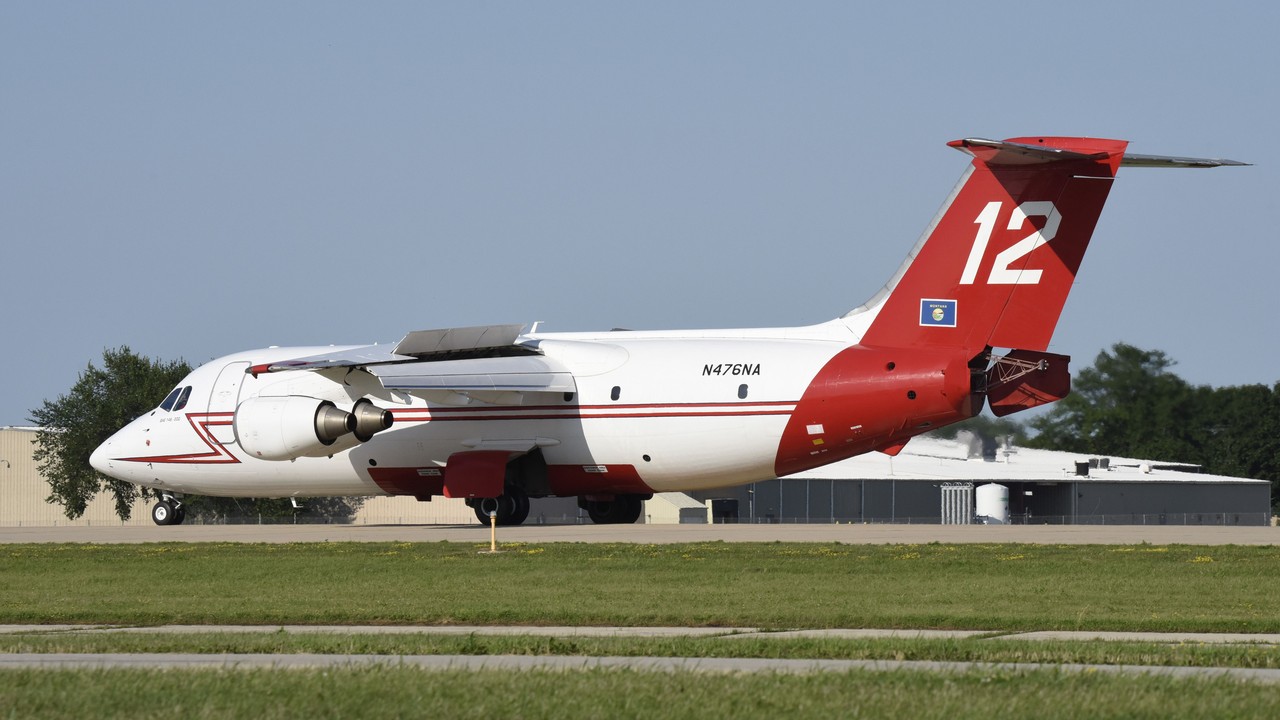
The type's legacy extends beyond commercial aviation, as the BAe 146 family totaled 387 aircraft, making it Britain's most successful civil jet program. Several examples found second careers in freight operations and specialized firefighting roles, demonstrating the robust design philosophy Bob Grigg implemented.
At least one BAe 146-100 survives in preservation: aircraft c/n 1010 (ex-G-JEAO) underwent restoration after arrival at the de Havilland Aircraft Museum on July 27, 2009. This former Jersey European Airways aircraft, later operated in British Airways colors, represents the innovative spirit of British regional aviation during the 1980s expansion era.
The "Jumbolino" nickname reflected public affection for the compact four-engine design, while its "Whisperjet" marketing emphasized the revolutionary quietness that opened new route possibilities. Though production numbers remained modest, the BAe 146-100 established technical foundations that influenced regional aviation development and demonstrated Britain's capability to compete in specialized commercial aircraft markets.