
Service History
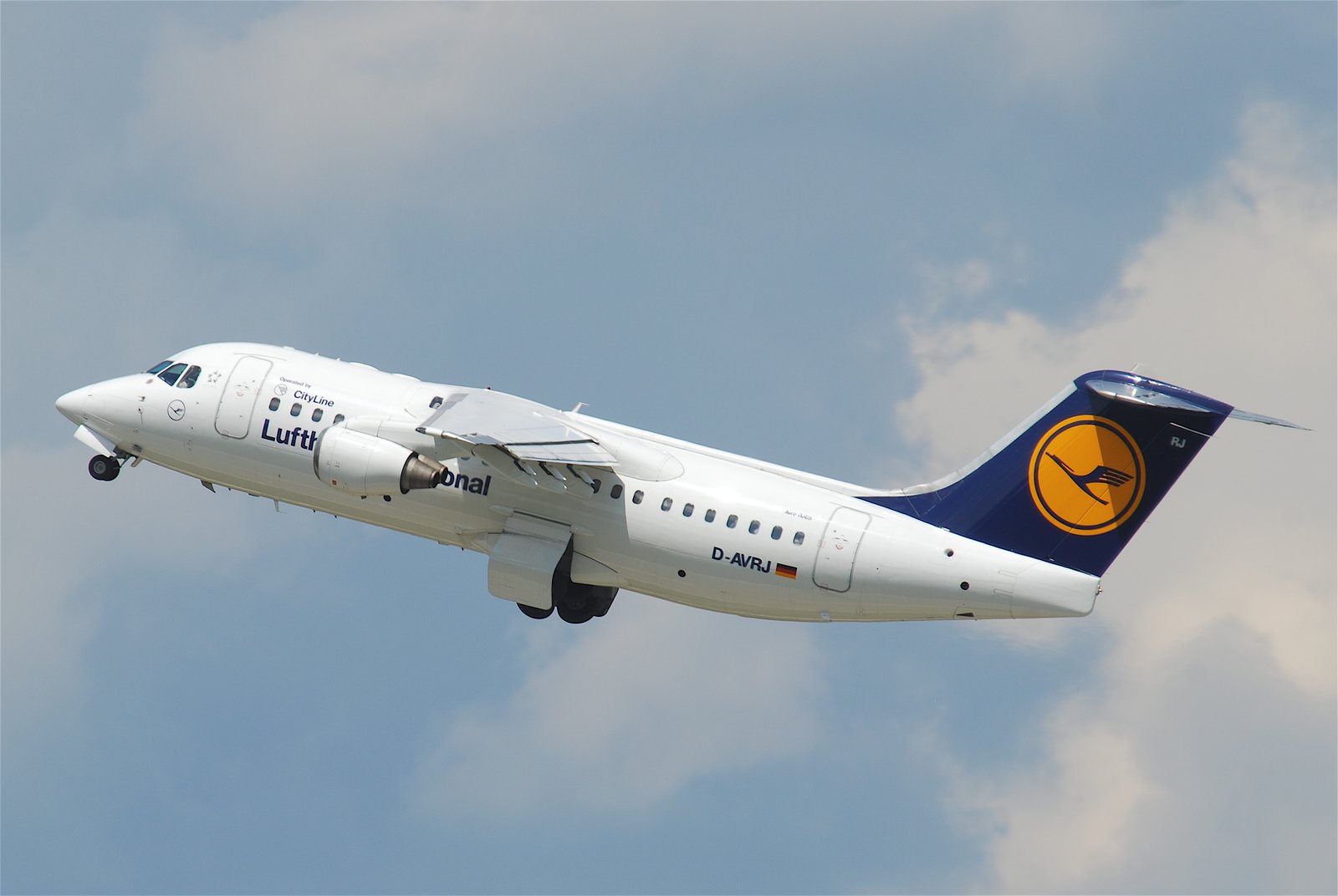
The RJ-70 carved out a specialized niche serving regional routes requiring exceptional short-field performance and low noise operation. Launch operators included airBaltic, which acquired three aircraft between 1996-1997 (registrations YL-BAN, YL-BAL, and YL-BAK), operating them on short-haul European routes from Riga until 2006-2007. Other notable operators included Business Express as part of the Delta Connection network, Air One in Italy, Transwede Airways, and Malmö Aviation in Scandinavia. The aircraft proved particularly valuable at challenging airports like London City Airport, where its steep approach capability and quiet "Whisperjet" operation made it ideal for urban environments with strict noise restrictions.
Despite its technical capabilities, the RJ-70's commercial impact remained limited due to its brief production run of just 12 aircraft. The type typically operated five-abreast seating for 70 passengers in standard configuration, though high-density arrangements could accommodate up to 94 passengers. Its specialized design made it particularly suited for mountainous terrain and hot-and-high airfields where conventional twin-engine aircraft faced performance limitations.
The Manufacturer
British Aerospace launched the RJ series in 1993 as an upgraded variant of its BAe 146 regional airliner, with development handled by subsidiary Avro International Aerospace. The company had emerged in 1977 from the consolidation of Britain's aircraft industry and operated until 1999, when it merged with Marconi Electronic Systems to form BAE Systems. The regional aircraft division became BAE Systems Regional Aircraft following the November 1999 merger.
The original BAe 146 program had faced significant challenges, including a halt in 1974 due to the oil crisis before resuming in 1981. By that time, program costs had reached £350 million with unit costs of £11 million for the 146-200 variant. Manufacturing occurred across multiple British sites, with final assembly at Woodford Aerodrome in Greater Manchester, rear fuselage sections from Chadderton, center fuselage from Filton, vertical stabilizers from Brough, and engine pylons from Prestwick. International suppliers included Textron for wings and Saab-Scania for tailplane and control surfaces.
Engine & Technical Innovation
The RJ-70's most distinctive feature was its four Textron Lycoming LF507 turbofan engines, each producing 31.15 kN of thrust. This powerplant upgrade from the earlier BAe 146's ALF502 engines incorporated Full Authority Digital Engine Control (FADEC) for improved reliability and efficiency. The engines were housed in redesigned nacelles and mounted on underwing pylons, providing the aircraft with exceptional three-engine performance capabilities for enhanced safety during single-engine failures.
The flight deck featured advanced digital Electronic Flight Instrument Systems (EFIS) replacing the analog instruments of earlier BAe 146 variants. The aircraft typically operated with a crew of two to three, depending on configuration and route requirements. The high-wing, T-tail configuration provided excellent short-field performance and allowed for steeper approach angles than conventional designs.
Design Philosophy
British Aerospace teams developed the RJ-70 specifically for short-haul regional operations from constrained airports. The design prioritized quiet operation, earning the marketing nickname "Whisperjet," along with exceptional short and steep runway capability. The four-engine configuration, while unconventional for regional aircraft, provided redundancy and performance advantages at challenging airfields.
The aircraft incorporated a retractable tricycle landing gear system and full airbrake capability for operations at airports with limited runway length. This design philosophy made it particularly valuable for city center airports and mountainous regions where conventional twin-engine regional jets faced operational limitations.
Production & Legacy
Production of the RJ-70 ran from 1993 to 2003 as part of the broader Avro RJ family, which totaled 387-394 aircraft across all variants. The RJ-70 represented the shortest fuselage version, with only 12 examples manufactured before BAE Systems discontinued regional aircraft production. Notable surviving airframes included G-BZFA (construction number E1223) and G-CDOE (E1224), both registered to BAE Systems Asset Management as of February 2010.
The limited production numbers reflected the specialized nature of the aircraft and changing market conditions in the regional aviation sector. Several aircraft have been scrapped, including YL-BAL, which was dismantled at Bacau, Romania on July 15, 2012. The RJ series marked the end of Britain's involvement in commercial airliner production, with the follow-on RJX program canceled in 2001 after only three aircraft were built.
The RJ-70's legacy lies in its demonstration of specialized aircraft design for niche markets, though the small production run highlighted the challenges facing European regional aircraft manufacturers in an increasingly competitive global market. The type's quiet operation and short-field capabilities influenced subsequent regional aircraft development, particularly for urban airport operations.