
Service History
The BAe 146-200 entered commercial service on May 27, 1983, with Dan-Air operating the inaugural flight from London Gatwick to Bern, Switzerland. Air Wisconsin had placed the first order for the -200 variant in May 1981, recognizing its potential for American regional routes. The aircraft quickly gained acceptance among carriers seeking to access noise-restricted airports, with TABA of Brazil receiving the first delivery on December 8, 1983.
The -200's revolutionary quiet operation earned it recognition as the quietest jetliner at its 1983 introduction, enabling airlines to serve airports with strict noise limitations that had been off-limits to other jets. Operators including Air Botswana, Star Peru, and TNT utilized both passenger and freight variants, with the -200QC combi version offering day passenger service and night freight operations. The aircraft's 85-passenger capacity in typical five-abreast seating made it ideal for thin regional routes.
Military Service
While primarily a civilian aircraft, the BAe 146-200 served the Royal Air Force in the VIP transport role. Three aircraft were designated BAe 146 CC.2 and operated as "Statesman" aircraft for the Queen's Flight, providing executive transport for senior government officials and the Royal Family. In 2012, the RAF acquired two refurbished -200QC aircraft designated CC.3 for transport and aeromedical missions, equipped with defensive aids systems.
The RAF's BAe 146 fleet concluded operations in 2022 when the last CC.3 aircraft were retired. Two examples were preserved for static display while two others returned to commercial service, marking the end of military BAe 146 operations after nearly four decades.
The Manufacturer
British Aerospace emerged from the March 1977 government nationalization that merged British Aircraft Corporation, Hawker Siddeley Aviation, and Scottish Aviation. The BAe 146 project originated as the HS.146 under Hawker Siddeley, which began formal development on August 29, 1973, before halting work in October 1974 due to inflation pressures. BAe relaunched the program in July 1978, leading to the prototype's first flight on September 3, 1981.
Production utilized an international supply chain, with Shorts Brothers in Belfast manufacturing engine nacelles, Avco Aerostructures in the United States building wings, and SAAB in Sweden producing tailplanes. Final assembly initially took place at Hatfield before transferring to Woodford in 1992, with Hatfield ceasing BAe 146 production by the end of 1993. British Aerospace later merged with Marconi Electronic Systems in 1999 to form BAE Systems, which continues operations today.
Engine and Technical Innovation
The BAe 146-200's four Textron Lycoming ALF 502 high-bypass turbofan engines defined its operational characteristics. These engines, selected for the original HS.146 design in 1971, provided exceptional fuel efficiency and remarkably low noise levels for regional operations. The high-wing, T-tail configuration optimized short-field performance, allowing access to airports with limited runway lengths.
Design objectives focused on simplicity and reliability for 70-100 passenger regional routes. The aircraft featured a maximum payload capacity of 10,040 kilograms in cargo variants, while passenger versions typically accommodated 100 passengers in five-abreast seating with 31-inch pitch. Later developments included autoland capability and EFIS glass cockpit systems in the successor RJ series.
Production Legacy
British Aerospace produced 221 BAe 146 aircraft across all variants during the original production run from 1983 to 1993. The program exceeded its 250-unit break-even point when combined with the later RJ series, achieving total production of 387 aircraft including 166 RJ variants built from 1990 to 2002. This success validated the concept of quiet regional jets and influenced subsequent aircraft development.
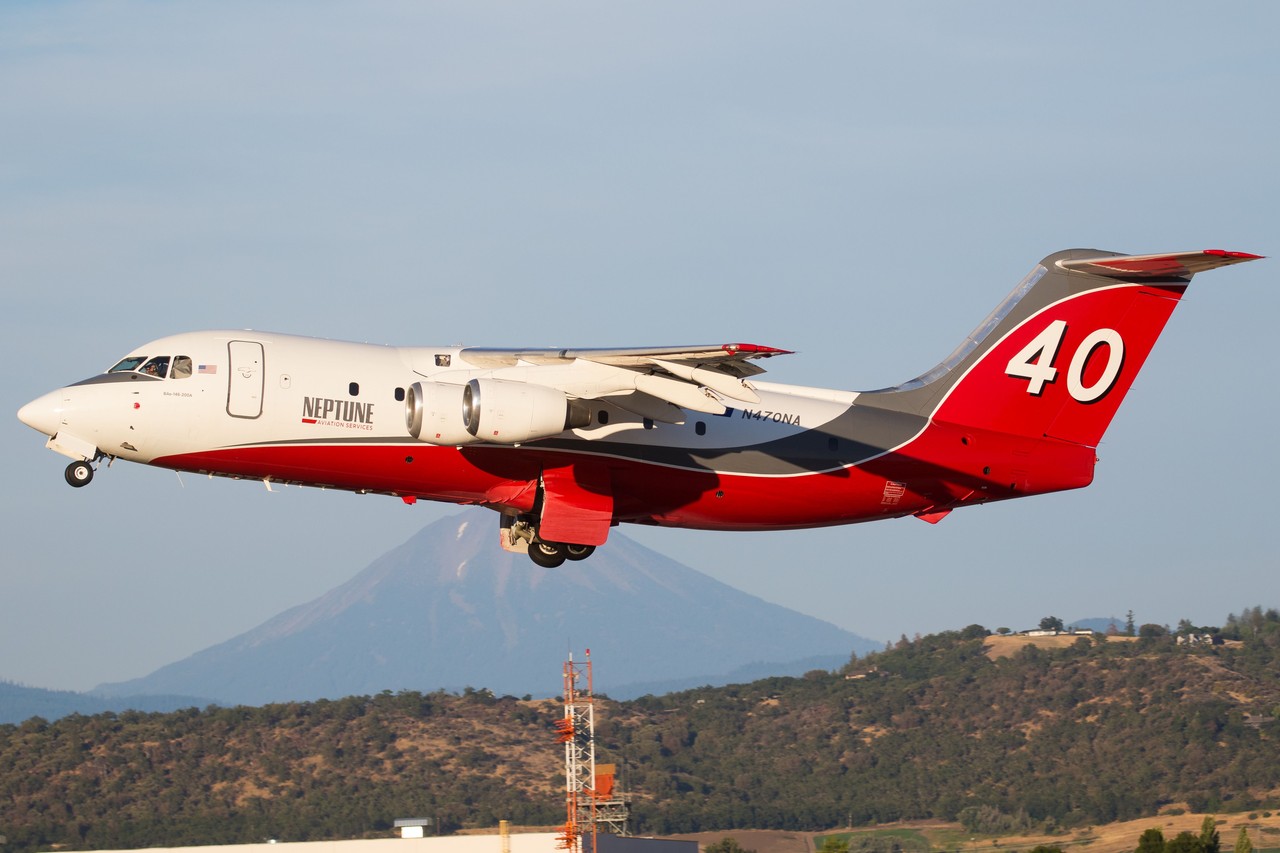
Today, numerous BAe 146 aircraft remain in service worldwide, though exact numbers continue to decline as the fleet ages. Some aircraft have found second careers as firefighting air tankers with operators like Neptune Aviation, while others serve specialized cargo and passenger charter roles. The de Havilland Aircraft Museum preserves BAe 146-100 construction number 1010, the former TABA aircraft PT-LEP that first flew on November 8, 1983.
The BAe 146's 40th anniversary in 2021 highlighted its lasting impact on regional aviation, having pioneered the quiet jet concept that enabled access to previously restricted airports and established the template for modern regional jet operations.