
Service History
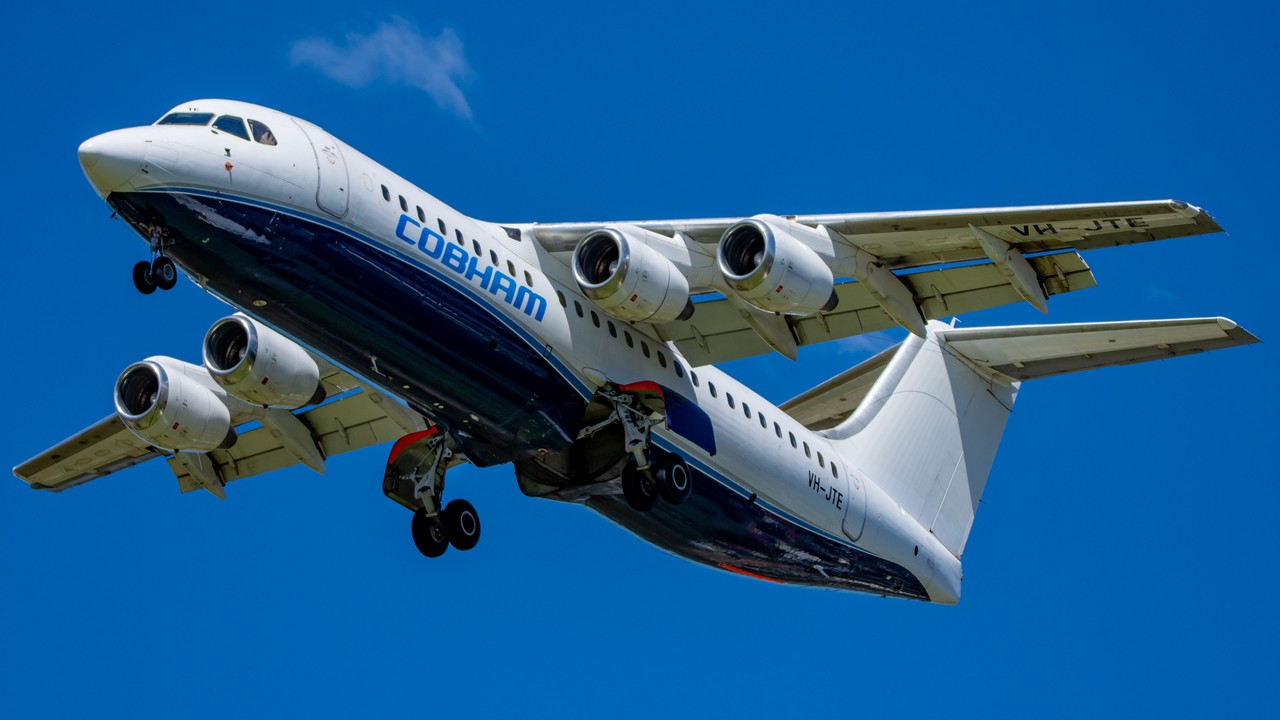
The RJ-100 entered commercial service in 1993 as part of the broader BAe 146/Avro RJ family that would become Britain's most commercially successful jet airliner program. Airlines including British European, Air UK, Jersey European, and Brazil's TABA operated the type on short-haul routes where its unique combination of four engines and quiet operation proved invaluable. The aircraft's exceptional noise characteristics made it particularly popular at airports with strict noise restrictions, including London City Airport where larger twin-engine jets could not operate during certain hours.
The RJ-100's four-engine configuration provided superior safety margins on short runways and challenging approaches, while its advanced avionics and glass cockpit systems reduced crew workload compared to earlier BAe 146 variants. TNT began operating freighter versions from 1988, establishing a successful cargo niche that continued throughout the aircraft's production life.
The Manufacturer
British Aerospace originated the BAe 146 program after acquiring it from Hawker Siddeley, which had initiated development as a private venture in April 1971 before suspending the project in October 1974 due to inflation concerns. British Aerospace, formed on April 29, 1977, through government nationalization merging British Aircraft Corporation, Hawker Siddeley Aviation, and Scottish Aviation, relaunched the program in July 1978.
In 1993, British Aerospace established Avro International Aerospace as a subsidiary to consolidate RJ production at Woodford Aerodrome near Manchester. This facility had opened a second production line in 1988 to supplement the original Hatfield assembly operations. British Aerospace evolved into BAE Systems following its merger with Marconi Electronic Systems on November 30, 1999, though the company closed its regional aircraft division in 2001 with the cancellation of the advanced RJX program.
Engine & Technical Innovation
The RJ-100 represented a significant technological advancement over the original BAe 146-300, powered by four Honeywell LF507 turbofan engines replacing the earlier Lycoming ALF 502 powerplants. These high-bypass turbofans, mounted in redesigned nacelles, provided increased thrust and improved fuel efficiency while maintaining the remarkably quiet operation that became the aircraft's signature characteristic.
The engines incorporated Full Authority Digital Engine Control (FADEC) systems that enhanced reliability and reduced pilot workload. This four-engine configuration, unusual for regional aircraft, provided exceptional safety margins during takeoff and climb performance, often exceeding manufacturer predictions. The aircraft achieved Stage 3 noise compliance, making it one of the quietest commercial aircraft of its generation.
Design Excellence
British Aerospace design teams at Hatfield developed the RJ-100's high-wing, T-tail configuration specifically for short-field performance and passenger comfort. The elevated wing design kept engines well clear of ground debris while providing excellent ground clearance, crucial for operations at smaller regional airports with limited ground support equipment.
The glass cockpit featured in RJ variants represented a significant advancement over the original BAe 146's analog instrumentation, reducing crew requirements to two pilots while improving situational awareness. The aircraft's maximum operating speed reached Mach 0.78, with a service ceiling exceeding 31,000 feet and range capabilities of approximately 1,800 nautical miles.
Production Achievement
Production of the entire BAe 146/RJ family spanned from 1983 to 2003, achieving a total of 387 aircraft across all variants. This comprised 221 original BAe 146 aircraft and 173 upgraded Avro RJ models, including the RJ-100. Dan-Air became the launch customer for the BAe 146-100 in March 1983, establishing the foundation for the program's commercial success.
The RJ-100 specifically entered production in 1992, with final deliveries occurring in late 2003. Despite achieving technical success and operator satisfaction, the program faced financial challenges, including a £1 billion write-off in 1992. The advanced RJX successor program, intended to feature new engines and systems, was cancelled on November 27, 2001, after only three aircraft were completed.
Continuing Legacy
Today, dozens of BAe 146 and RJ aircraft remain in active service worldwide, operating passenger services, cargo flights, and specialized missions including firefighting and VIP transport. The type's unique operational capabilities continue to make it valuable for airlines serving challenging airports and routes where larger aircraft cannot operate effectively.
Museum preservation efforts include BAe 146-100 G-JEAO at the de Havilland Aircraft Museum in Hatfield, representing the program's historical significance. The aircraft briefly returned to prominence as a testbed for Airbus's E-Fan X electric propulsion demonstrator program, though this project was abandoned in 2020. The RJ-100 stands as testament to British aerospace engineering capabilities and remains the most successful commercial jet aircraft program in United Kingdom aviation history.