
Service History
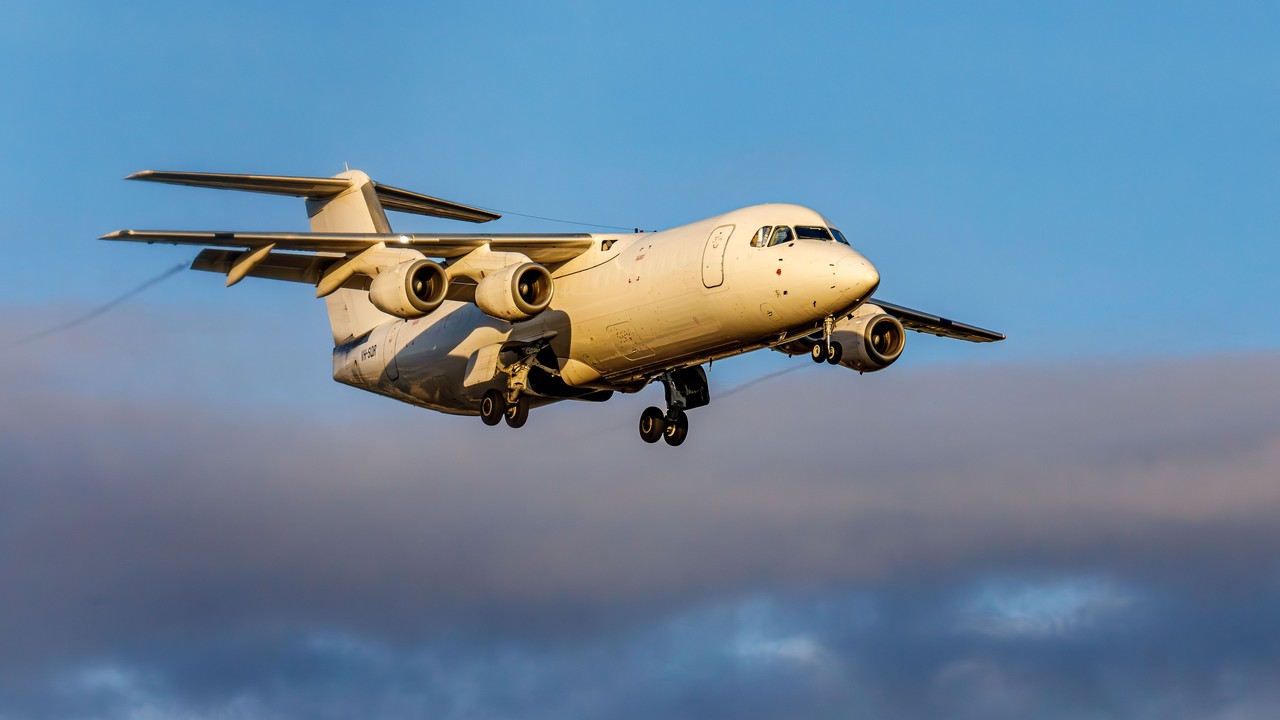
The BAe-146-300 entered service during the late 1980s as airlines sought aircraft capable of serving smaller airports with noise restrictions and short runways. Its exceptional quietness and short takeoff and landing capabilities made it ideal for city center airports, with the BAe-146 family becoming the first jet-powered aircraft to operate from London City Airport's challenging 1,508-meter runway in 1987. The aircraft found particular success with regional carriers and specialized operators who valued its ability to access airports that larger jets could not serve.
Aspen Airways demonstrated the aircraft's high-altitude capabilities by operating the first scheduled jet service into Colorado's Pitkin County Airport at 7,280 feet elevation. TNT recognized the type's freight potential, ordering pure cargo variants that featured large side-loading doors and prompted British Aerospace to establish a second assembly line at Woodford to meet demand.
The Manufacturer
British Aerospace inherited the BAe-146 program when the company formed in March 1977 through the nationalization of Britain's aerospace industry, combining British Aircraft Corporation, Hawker Siddeley Aviation, and Scottish Aviation. The project originated in August 1973 as Hawker Siddeley's HS 146, a 70-seat regional jet concept that was shelved during the 1974 economic crisis due to spiraling inflation.
British Aerospace revived the program in July 1978, recognizing the market potential for a quiet, fuel-efficient regional jet. The company established primary production at Hatfield, handling design, development, and final assembly, while opening a second line at the historic Avro factory in Woodford. British Aerospace ceased aircraft production at Hatfield by 1993, eventually evolving into BAE Systems, which continues as a major defense and aerospace contractor today.
Engine & Technical Innovation
The BAe-146-300's four Honeywell ALF 502R-5 turbofans, each producing 31 kN of thrust, represented an unconventional choice that defined the aircraft's character. Originally developed by Textron Lycoming, these engines contributed to the aircraft's reputation as the world's quietest jetliner when the family entered service in 1983. The four-engine configuration provided exceptional redundancy and allowed the aircraft to maintain performance at high-altitude airports where twin-engine aircraft struggled.
The aircraft featured a distinctive high-wing, T-tail design optimized for short-field performance and passenger comfort. Flight crew requirements included two pilots, with later variants incorporating advanced avionics including autoland capability and Electronic Flight Instrument System displays. The -300 variant stretched the fuselage to 30.99 meters, accommodating 100 passengers in five-abreast seating with 31-inch pitch.
Performance Characteristics
Pilots praised the BAe-146-300 for its forgiving handling characteristics and impressive short-field performance. The aircraft achieved a maximum cruise speed of 426 knots at its 31,000-foot service ceiling, while maintaining a range of 1,800 nautical miles. Its takeoff distance of 1,509 meters and landing distance of 1,228 meters enabled operations from airports inaccessible to conventional jets.
The aircraft's initial climb rate of 500 feet per minute and maximum takeoff weight of 44,225 kilograms provided adequate performance for regional operations. Pilots particularly appreciated the aircraft's stability and predictable flight characteristics, though some noted higher fuel consumption compared to twin-engine competitors due to the four-engine configuration.
Production & Legacy
British Aerospace manufactured exactly 71 BAe-146-300 aircraft as part of the broader 221-unit BAe-146 family produced between 1983 and 1992. The entire program, including later Avro RJ variants, ultimately delivered 394 aircraft, exceeding the company's break-even target of 250 units. Production concluded in 2001 with the final Avro RJX deliveries.
The BAe-146-300's legacy extends well beyond its commercial airline service. Many aircraft found second careers as firefighting platforms, where their short-field capabilities and four-engine reliability proved invaluable for aerial firefighting operations. The type's unique combination of quietness, short-field performance, and passenger comfort created a lasting niche in regional aviation that influenced subsequent aircraft designs.
Today, numerous BAe-146 variants remain in active service worldwide, testament to the soundness of British Aerospace's unconventional design approach. Museums including the de Havilland Aircraft Museum preserve examples of this distinctive aircraft family, ensuring future generations can appreciate this innovative chapter in British aerospace engineering.