
Strategic Foundation
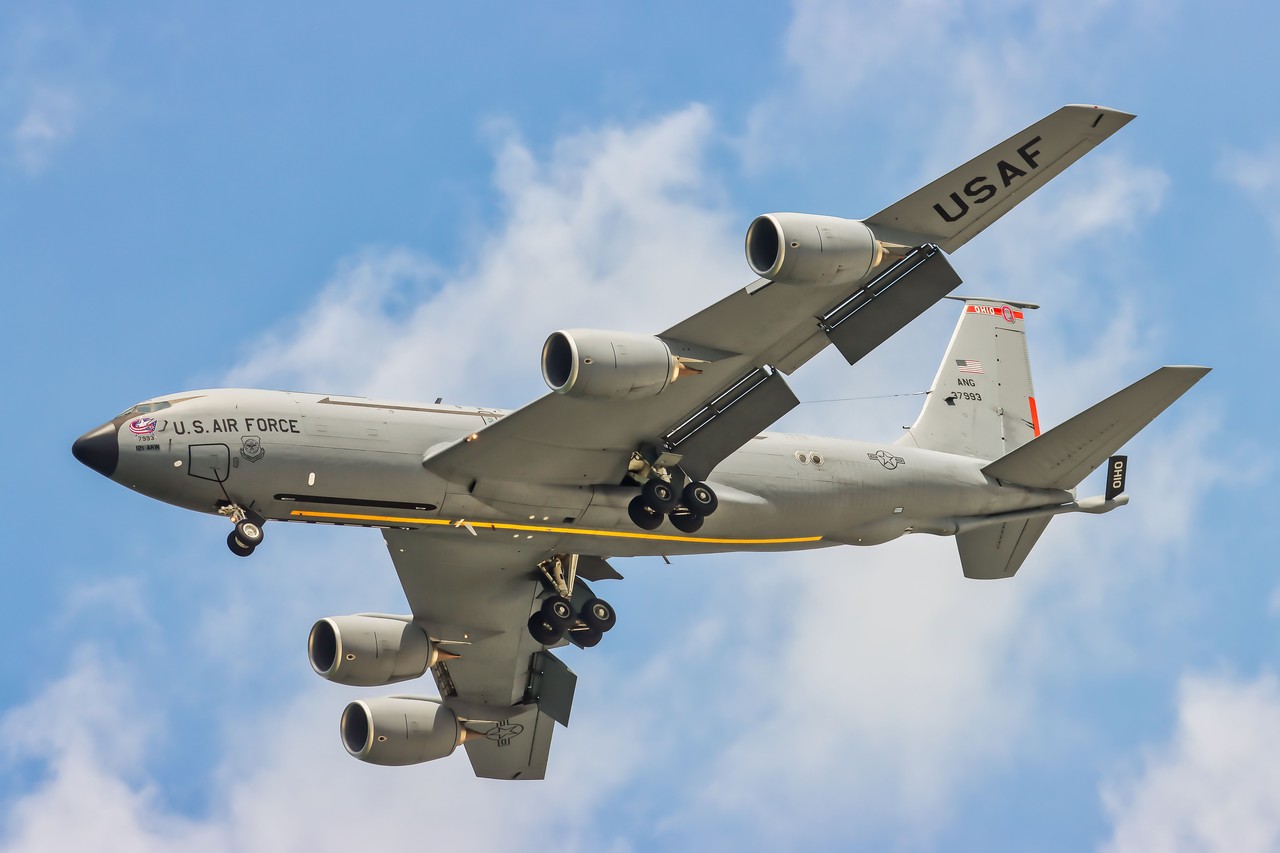
The KC-135 Stratotanker emerged from Boeing's bold 1952 investment in the Model 367-80 prototype, a company-funded project that risked significant resources without guaranteed military contracts. When the prototype rolled out on May 14, 1954, Boeing had created an aircraft that would reshape American strategic air power. The Air Force recognized its potential immediately, placing an initial order for 29 KC-135As in 1954 to extend the operational range of Strategic Air Command's B-52 bomber fleet.
Service Dominance
The KC-135 entered Air Force service in June 1957 at Castle Air Force Base, California, beginning an unprecedented era of aerial refueling capability. Strategic Air Command operated the aircraft continuously from 1957 through 1992, with the mission transferring to Air Mobility Command following SAC's inactivation. As of September 2024, the Air Force operates 376 KC-135s across active duty, Reserve, and National Guard units, making it the backbone of American aerial refueling operations.
The aircraft's longevity is remarkable even by military standards. KC-135 tail number 57-1419, built in 1957 and still serving with the 161st Air Refueling Wing in Arizona, holds the distinction of being the oldest active aircraft in the U.S. military. By 2013, this aircraft had accumulated 22,300 flight hours across 56 years of continuous service.
The Re-engining Revolution
The KC-135R variant emerged from a crucial 1980s modernization program that transformed the aircraft's capabilities. Originally powered by four Pratt & Whitney J57 turbojet engines, the KC-135A suffered from limited fuel efficiency and payload capacity. Boeing's re-engining program, conducted between July 1984 and June 2005, converted 420 KC-135As to KC-135R configuration using Pratt & Whitney TF33-PW-102 turbofan engines salvaged from retired Boeing 707 airliners.
This engine upgrade delivered dramatic improvements: the KC-135R could offload 50 percent more fuel than its predecessor while significantly reducing operational costs. The turbofan engines provided greater fuel efficiency and reduced noise, extending the aircraft's operational life and maintaining its relevance in modern air operations.
Boeing's Enduring Legacy
Boeing designed and manufactured all 803 C-135 variants at their Renton, Washington facility between 1955 and 1965. The program included 732 KC-135As plus additional specialized variants, representing one of Boeing's most successful military contracts. The company's investment in the initial prototype demonstrated the risk-taking that characterized American aerospace development during the Cold War era.
Today, Boeing continues supporting the KC-135 fleet while developing its successor, the KC-46 Pegasus. The first KC-46A was delivered to the Air Force on January 10, 2019, beginning a gradual transition that will see the KC-135 remain in service alongside its replacement for decades.
Technical Innovation
The KC-135's design incorporated advanced features for its era, including swept-back wings angled at 35 degrees, similar to Boeing's B-47 bomber. This configuration provided the high-altitude, high-speed performance necessary for strategic refueling missions. The aircraft's telescoping boom system, operated by a dedicated boom operator, could transfer thousands of gallons of fuel to receiver aircraft during flight.
Test pilots Alvin "Tex" Johnston and Richards "Dix" Loesch Jr. flew the first production aircraft, designated 55-3118 and named "City of Renton," on its maiden flight August 31, 1956. This aircraft now serves as a gate guardian at McConnell Air Force Base, Kansas, honoring the program's origins.
Operational Excellence
The KC-135's primary mission involves extending the range and endurance of combat aircraft through aerial refueling. Fighter aircraft, bombers, and transport planes all benefit from the Stratotanker's capability to deliver fuel at altitude. This force multiplication effect allows relatively short-range tactical aircraft to conduct long-range missions, fundamentally altering military planning and execution.
The aircraft's versatility extends beyond refueling. Various KC-135 variants have served as command posts, electronic warfare platforms, and special mission aircraft, demonstrating the basic airframe's adaptability to diverse military requirements.
Future Operations
Despite its age, the KC-135 fleet remains structurally sound. As of May 2018, 396 of the original 803 aircraft remained in service, with the fleet estimated at only 33 percent through its design lifetime limits. The Air Force plans to maintain KC-135 operations until at least 2050, though it intends to retire approximately 15 aircraft annually through the late 2030s while maintaining a minimum tanker force of 466 aircraft.
International operators have begun transitioning to newer platforms, with France and Singapore replacing their Stratotankers with Airbus A330 MRTTs. However, the U.S. Air Force's massive KC-135 fleet will continue serving as America's primary aerial refueling capability for decades to come, cementing its status as one of aviation's most enduring and successful military aircraft programs.